TMT Bar Weight Per Metre — All Diameters, D²/162 Formula Explained
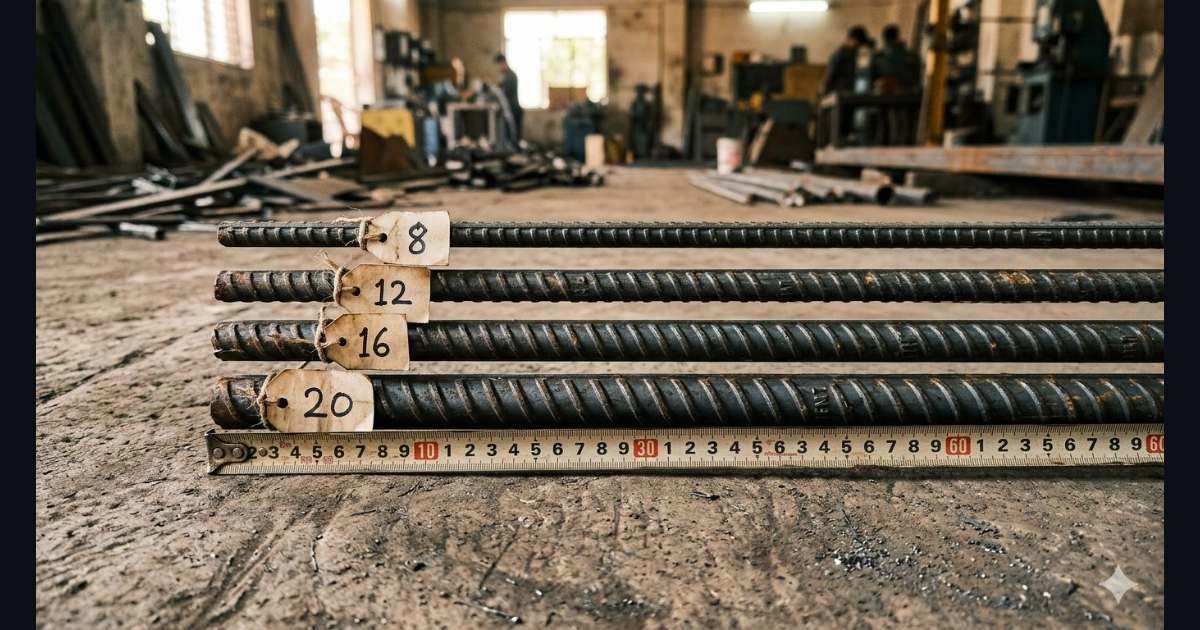
TMT bar weight per meter for every standard diameter — from 8mm to 40mm — is calculated using the formula W = D² ÷ 162, where D is the nominal diameter in millimetres and the result is in kilograms per metre. A 12mm TMT bar weighs 0.889 kg/m; a 16mm bar weighs 1.580 kg/m. These values apply to every grade under IS 1786:2008, from Fe 415 through Fe 600.
Key Facts
- Formula: W = D² ÷ 162 (kg/m, where D is in mm)
- Standard: IS 1786:2008 — High Strength Deformed Steel Bars and Wires for Concrete Reinforcement
- Grades covered: Fe 415, Fe 500, Fe 500D, Fe 550, Fe 550D, Fe 600
- Unit: kg per metre (kg/m)
- Density assumed: 7.85 g/cm³ for all steel grades
Where the D²/162 Formula Comes From
The constant 162 is not an arbitrary choice — it comes directly from the cross-sectional area of a circular bar combined with the density of steel. Here is the derivation step by step, so you can verify it independently or adapt it for other materials.
The cross-sectional area of a round bar of diameter D (in mm) is π/4 × D² mm². To find the volume per metre of length, we work in centimetres: area in cm² = (π/4 × D²) ÷ 100, and length = 100 cm. Volume per metre = (π/4 × D² ÷ 100) × 100 = π/4 × D² cm³.
Multiply by steel's density (7.85 g/cm³) and divide by 1,000 to convert grams to kilograms:
W = (π/4 × D² × 7.85) ÷ 1,000 = 0.006165 × D² kg/m
The inverse of 0.006165 is 162.2 — rounded to 162 for everyday use. The full precision version is sometimes written as D²/162.2, but 162 is standard practice in Indian fabrication and matches the values in IS 1786:2008 weight tables to within rounding. The formula is identical for MS round bars, stainless round bars, or any circular steel section — only the density changes when you switch material.
TMT Bar Weight Per Metre Chart — 8mm to 40mm
The table below gives nominal mass per metre for all standard diameters under IS 1786:2008. These are the same values used by Tata Tiscon, JSW Neosteel, Kamdhenu, and every other IS 1786-certified producer. Grade designation — Fe 500 versus Fe 550D — does not affect nominal mass. Only the mechanical properties (yield strength, elongation, UTS ratio) differ between grades.
| Dia. (mm) | D² (mm²) | kg/m | kg per 12m bar |
|---|---|---|---|
| 8 | 64 | 0.395 | 4.74 |
| 10 | 100 | 0.617 | 7.40 |
| 12 | 144 | 0.889 | 10.67 |
| 16 | 256 | 1.580 | 18.96 |
| 20 | 400 | 2.469 | 29.63 |
| 25 | 625 | 3.858 | 46.30 |
| 28 | 784 | 4.840 | 58.08 |
| 32 | 1024 | 6.321 | 75.85 |
| 36 | 1296 | 8.000 | 96.00 |
| 40 | 1600 | 9.877 | 118.52 |
Standard mill supply length is 12 metres for most diameters. The "kg per 12m bar" column saves you the multiplication step when cross-checking a delivery challan against your order quantity.
IS 1786 Tolerances — Why the Weight on Your Challan May Differ
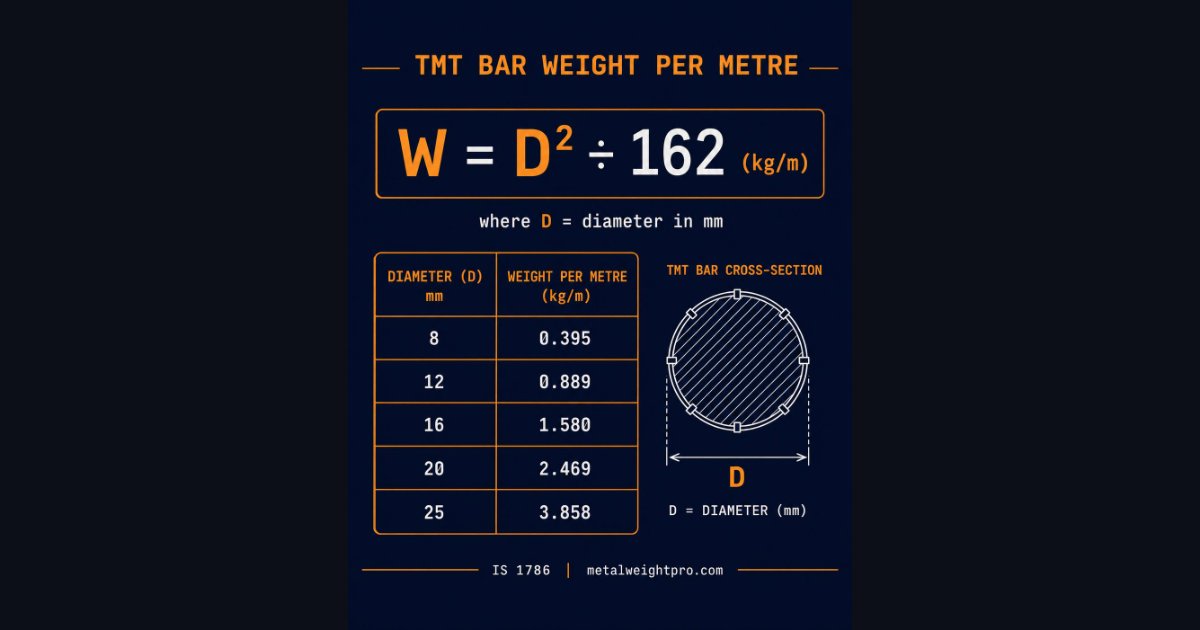
IS 1786:2008 permits a negative mass tolerance of −4.5% on individual bars. The average of any test sample from a consignment must not fall below −3% of the nominal mass. Both tolerances are important — one governs individual bar acceptance, the other governs the batch.
A concrete example: the 16mm bar has a nominal mass of 1.580 kg/m. At the maximum permitted under-mass of −4.5%, a single bar could legally weigh as little as 1.509 kg/m — a shortfall of 71 grams per metre. On a 1,000-metre order (roughly 84 bars at 12m each), that is 71 kg of steel you are paying for but not physically receiving, while remaining fully within IS 1786 compliance.
This matters at scale. Premium producers — including Tata Tiscon SD (Super Ductile) in the Fe 500D grade — target near-nominal mass as a documented quality differentiator and supply mill test reports (MTRs) showing actual mass per metre. JSW Neosteel 550D similarly includes actual mass data in its certified MTRs. When placing structural orders above 10 tonnes, request the MTR and verify the recorded mass per metre. If the batch average sits below 97% of nominal, you have grounds to raise a quality dispute with the supplier.
One point that causes frequent confusion on site: the 'D' suffix in grades like Fe 500D and Fe 550D denotes enhanced ductility — a higher minimum elongation at fracture and a tighter ratio of ultimate tensile strength to yield strength, both specified in IS 1786. It has no effect on bar mass. The D²/162 formula and all values in the chart above apply identically to Fe 500 and Fe 500D bars of the same diameter.
Worked Example: 50 Pieces of 16mm Fe 500D at 12 Metres Each
A site supervisor asked me on a project in Pune — "50 pieces 16mm sariya, 12 metre ke, total kitna wajan hoga?" Here is the full calculation.
Given:
- Diameter: 16 mm
- Grade: Fe 500D (IS 1786:2008)
- Length per bar: 12 metres
- Quantity: 50 bars
Step 1 — Weight per metre:
W = D² ÷ 162 = 16² ÷ 162 = 256 ÷ 162 = 1.580 kg/m
Step 2 — Weight per bar:
1.580 × 12 = 18.963 kg
Step 3 — Total weight for 50 bars:
50 × 18.963 = 948.15 kg ≈ 0.948 tonnes
You can verify this in seconds using the free Metal Weight Calculator — select Round Bar, enter 16mm diameter and 12,000mm length, then multiply the result by 50.
How Many TMT Bars Come in One Tonne
The reverse calculation is something every procurement engineer reaches for when placing an order: if you need X tonnes of a given diameter, how many 12m bars is that? The formula is straightforward:
Pieces per tonne = 1,000 ÷ (kg/m × bar length in metres)
| Dia. (mm) | kg/m | kg per 12m bar | Pieces per tonne |
|---|---|---|---|
| 8 | 0.395 | 4.74 | 211 |
| 10 | 0.617 | 7.40 | 135 |
| 12 | 0.889 | 10.67 | 93 |
| 16 | 1.580 | 18.96 | 52 |
| 20 | 2.469 | 29.63 | 33 |
| 25 | 3.858 | 46.30 | 21 |
Counts are for nominal mass. If your MTR records actual mass below nominal, the piece count per tonne will be slightly higher. For non-standard lengths or any diameter not listed, use the Metal Weight Calculator — enter the exact diameter and length to get the per-bar weight, then divide 1,000 by that figure.
Frequently Asked Questions
What is the formula for TMT bar weight per metre?
The formula is W = D² ÷ 162, where D is the nominal diameter of the TMT bar in millimetres and W is the weight in kilograms per metre. For a 12mm bar: W = 144 ÷ 162 = 0.889 kg/m. For a 16mm bar: W = 256 ÷ 162 = 1.580 kg/m. The constant 162 is derived from the cross-sectional area formula (π/4 × D²) combined with steel's density of 7.85 g/cm³ — the exact divisor is 162.2, rounded to 162 for practical use. This formula applies to all IS 1786:2008 grades: Fe 415, Fe 500, Fe 500D, Fe 550, Fe 550D, and Fe 600.
Sariya ka wajan per meter kaise nikale?
Sariya (TMT bar) ka wajan per meter nikalne ka formula hai: W = D² ÷ 162 kg/m, jahan D diameter hai millimetre mein. 12mm sariya ke liye: 12² = 144, aur 144 ÷ 162 = 0.889 kg per meter. 16mm ke liye: 16² = 256, aur 256 ÷ 162 = 1.580 kg per meter. Agar aapko puri bar ka wajan chahiye (12 metre), toh kg/m ko 12 se multiply karo. Jaise 16mm ke 12 metre bar ka wajan = 1.580 × 12 = 18.963 kg hoga.
What is the IS 1786 mass tolerance on TMT bars, and when does it matter?
IS 1786:2008 allows a negative mass tolerance of −4.5% on individual bars, with the consignment batch average not permitted to fall below −3% of nominal. For a 12mm bar (nominal 0.889 kg/m), the lowest acceptable individual bar mass is 0.849 kg/m, and the lowest permitted batch average is 0.862 kg/m. For small residential purchases of a few tonnes this is rarely significant. For large structural procurements — bridges, industrial buildings, multi-storey frames — always request the mill test report (MTR) from your supplier and verify the actual mass per metre. A batch running at −4% average over a 50-tonne order means roughly 2 tonnes of steel deficit that you have paid for but not received.
Does Fe 500D weigh more than Fe 500 of the same diameter?
No. Fe 500D and Fe 500 bars of the same nominal diameter have identical mass per metre. The 'D' in Fe 500D denotes enhanced ductility under IS 1786:2008: minimum elongation of 18% (versus 12% for Fe 500) and a stricter ratio of ultimate tensile strength to 0.2% proof stress. These are mechanical property requirements that affect how the bar behaves under extreme seismic loading — not the bar's cross-section or density. The D²/162 formula and all weight values in the chart above apply equally to Fe 415, Fe 500, Fe 500D, Fe 550, Fe 550D, and Fe 600 of the same diameter.
How many 12mm TMT bars are there in one tonne?
At the nominal mass of 0.889 kg/m and standard 12-metre mill lengths, each 12mm TMT bar weighs 0.889 × 12 = 10.668 kg. Dividing 1,000 kg (one tonne) by 10.668 gives 93.7 bars — so one tonne contains 93 complete 12m bars, with approximately 7.5 kg remaining. If your supplier's bars are running near the IS 1786 lower tolerance limit (around 0.849 kg/m), a tonne might yield 98 bars. For precision procurement planning, always use the actual mass per metre from the MTR rather than the nominal value.
Save time on your next job — calculate exact TMT bar weights in seconds.
Try the Free Metal Weight Calculator →