Tata Structura SHS and RHS Weight Chart — YST 210 to 420 Grade
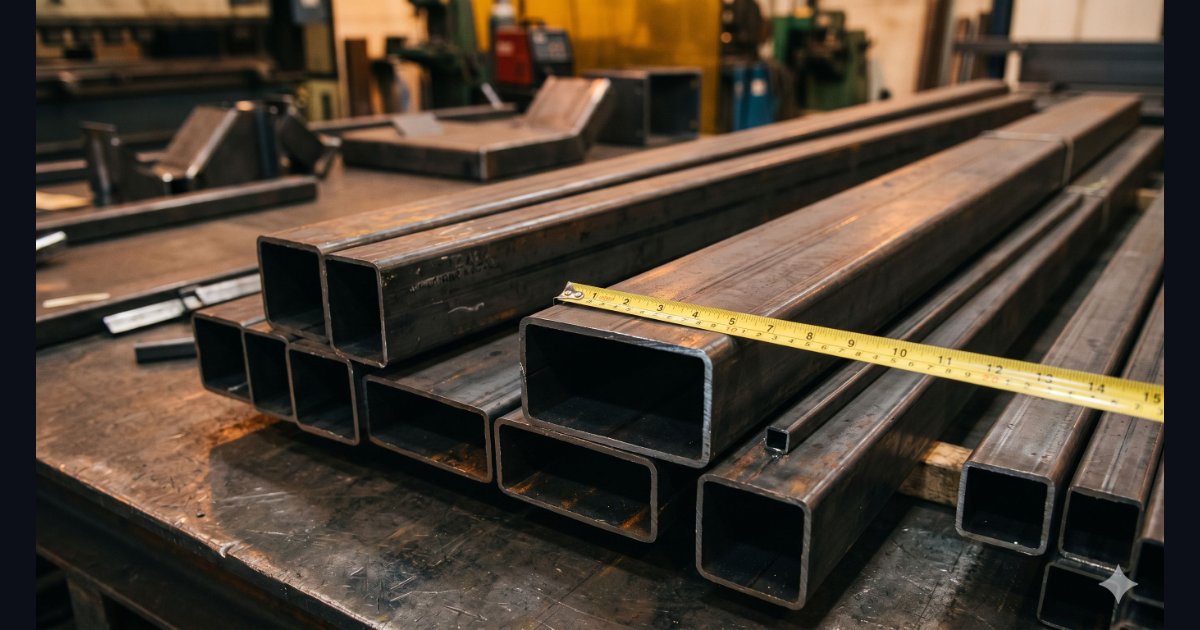
Tata Structura hollow section weight is identical across all YST grades for the same section size — the grade affects strength, not weight.
- SHS and RHS weights are calculated per IS:4923:1997 using steel density 7850 kg/m³
- Four YST grades are available: YST 210, YST 240, YST 310, and YST 355 — each with different yield strength and application range
- Tata Structura is produced at Tata Steel Long Products facilities and conforms to IS:4923:1997 and IS:1161:2014
Tata Structura weight chart queries usually come from one of two directions: fabricators who need the kg/m figure to estimate a job, and structural engineers who need to know which YST grade to specify. This article covers both. The weight tables below are drawn from IS:4923:1997 nominal dimensions. The YST grade comparison table tells you when to upgrade from YST 210 to YST 310 or YST 355.
Why YST Grade Does Not Change Section Weight
A common point of confusion on site is whether a higher-grade Tata Structura section weighs more. It does not. The YST grade (Yield Strength of Tubes) refers to the minimum yield strength of the steel, not to any change in dimensions or wall thickness. Two sections of the same size — say 75×75×4 mm — will weigh exactly the same whether they are YST 210 or YST 355. The difference is that YST 355 can carry a higher load before permanent deformation. Specifying a higher grade lets you use a lighter section for the same load, which is where the real weight saving comes from.
For Tata Structura hollow section ka weight, the formula is the same as for any steel hollow section. For SHS and RHS, it is:
Formula (SHS/RHS): Weight (kg/m) = 2 × (B + D − 2t) × t × 7.85 / 1000
- B
- Width of the section, in millimetres
- D
- Depth of the section, in millimetres (equals B for SHS)
- t
- Wall thickness, in millimetres
- 7.85
- Steel density in g/cm³ (7850 kg/m³), per IS:4923:1997
- 1000
- Unit conversion factor — converts g/mm to kg/m
Tata Structura SHS Weight Chart (IS:4923)
| Section (mm×mm) | Wall Thickness (mm) | Weight (kg/m) | YST 210 | YST 240 | YST 310 | YST 355 |
|---|---|---|---|---|---|---|
| 20×20 | 2.0 | 1.13 | ✓ | ✓ | — | — |
| 25×25 | 2.0 | 1.43 | ✓ | ✓ | — | — |
| 32×32 | 2.0 | 1.86 | ✓ | ✓ | ✓ | — |
| 40×40 | 2.6 | 3.03 | ✓ | ✓ | ✓ | — |
| 50×50 | 2.6 | 3.83 | ✓ | ✓ | ✓ | ✓ |
| 60×60 | 3.2 | 5.55 | ✓ | ✓ | ✓ | ✓ |
| 75×75 | 3.2 | 7.07 | ✓ | ✓ | ✓ | ✓ |
| 90×90 | 3.6 | 9.54 | ✓ | ✓ | ✓ | ✓ |
| 100×100 | 4.0 | 11.70 | ✓ | ✓ | ✓ | ✓ |
| 125×125 | 4.0 | 14.83 | ✓ | ✓ | ✓ | ✓ |
| 150×150 | 5.0 | 22.02 | ✓ | ✓ | ✓ | ✓ |
| 200×200 | 6.0 | 35.65 | — | — | ✓ | ✓ |
Section dimensions and weights per IS:4923:1997. ✓ = grade available in Tata Structura range; — = not standard in this grade. Tolerance on mass: ±6% per piece, ±4% per consignment per IS:4923. Confirm grade availability with your Tata Steel distributor before ordering.
Tata Structura RHS Weight Chart (IS:4923)
| Section (D×B mm) | Wall Thickness (mm) | Weight (kg/m) |
|---|---|---|
| 50×25 | 2.6 | 2.77 |
| 60×40 | 2.6 | 3.57 |
| 75×50 | 3.2 | 5.55 |
| 100×50 | 3.2 | 6.83 |
| 100×60 | 3.6 | 8.69 |
| 120×60 | 4.0 | 10.99 |
| 150×75 | 4.0 | 13.97 |
| 150×100 | 5.0 | 19.24 |
| 200×100 | 5.0 | 22.65 |
| 200×150 | 6.0 | 32.89 |
RHS weights calculated using IS:4923:1997 nominal dimensions and steel density 7850 kg/m³. Tolerance on mass: ±6% per piece. Tata Structura RHS is available in YST 240, YST 310, and YST 355 grades for most sizes — confirm with distributor.
YST Grade Comparison — Which Grade to Specify
| Grade | Min. Yield Strength (MPa) | Min. Tensile Strength (MPa) | Typical Application |
|---|---|---|---|
| YST 210 | 210 | 330 | Light furniture, display racks, non-structural enclosures |
| YST 240 | 240 | 410 | Agricultural equipment, light shelving, guardrails |
| YST 310 | 310 | 450 | Mezzanine floors, industrial shelving, bus body frames |
| YST 355 | 355 | 490 | Heavy structures, crane gantries, seismic-zone portal frames |
Minimum mechanical properties per IS:4923:1997 Table 2 and IS:1161:2014. YST 420 grade exists in the Tata Structura extended range for specialised structural applications — not covered here. All grades are weldable; YST 355 requires pre-heat for thicknesses above 12 mm.
Worked Example — Mezzanine Floor in RHS 100×50×3.2 mm, YST 310
A mezzanine floor contractor in Ahmedabad needs to frame a 6 m × 4 m storage platform using Tata Structura RHS 100×50×3.2 mm, YST 310. The engineer has specified YST 310 for the primary beams because the platform will carry pallet loads up to 500 kg/m².
Step 1 — Calculate weight per metre:
Weight = 2 × (100 + 50 − 2 × 3.2) × 3.2 × 7.85 / 1000
= 2 × 143.6 × 3.2 × 7.85 / 1000
= 7.21 kg/m
Step 2 — Estimate total steel for the frame:
Primary beams: 4 spans × 6 m = 24 m
Secondary beams: 8 spans × 4 m = 32 m
Total RHS length = 56 m
Total weight = 56 × 7.21 = 403.8 kg
Step 3 — Grade check:
The contractor confirms that using YST 310 instead of YST 210 allows the section size to stay at 100×50 without stepping up to 120×60. The weight saving by keeping the smaller section is approximately 3.76 kg/m × 56 m = 210 kg less steel — a meaningful cost saving at scale.
For Tata Structura hollow section ka weight on any size not listed above, use our free Hollow Section Weight Calculator with the exact dimensions.
How Tata Structura Compares to APL Apollo
Both Tata Structura and APL Apollo hollow sections conform to IS:4923:1997, so the nominal weight per metre is identical for the same section size and wall thickness. The practical differences are mill availability, regional distribution strength, and the YST grade range. APL Apollo offers a wider range of sizes in the smaller sections (below 40×40 mm), while Tata Structura tends to have better availability for YST 355 in larger sizes above 150×150 mm. For a full comparison of hollow section weights across brands, see our APL Apollo hollow section weight article and the companion Tata Structura hollow section weight chart.
Frequently Asked Questions
What is the weight of Tata Structura per metre?
Tata Structura weight per metre depends on the section size and wall thickness. Common examples: 50×50×2.6 mm SHS = 3.83 kg/m, 75×75×3.2 mm SHS = 7.07 kg/m, 100×50×3.2 mm RHS = 7.21 kg/m. All values are per IS:4923:1997 with steel density 7850 kg/m³.
What is the difference between YST 210 and YST 310?
YST 210 has a minimum yield strength of 210 MPa and is suited to light non-structural applications such as furniture and display racks. YST 310 has a minimum yield strength of 310 MPa and is used for load-bearing structures such as mezzanine floors and industrial shelving. Both grades have the same weight per metre for the same section dimensions — the grade only affects strength, not mass.
Tata Structura SHS ka weight kaise calculate karein?
Tata Structura SHS ka weight formula hai: Weight (kg/m) = 2 × (B + D − 2t) × t × 7.85 / 1000. Yahan B aur D section ka width aur depth hai millimetres mein aur t wall thickness hai. Ya to upar diye gaye chart se weight padh lo, ya MetalWeightPro ka free hollow section calculator use karo.
Which IS standard does Tata Structura follow?
Tata Structura hollow sections conform to IS:4923:1997 for dimensions, tolerances, and mass. The mechanical properties (yield strength, tensile strength) for each YST grade are defined in IS:1161:2014 (Steel Tubes for Structural Purposes). Both standards are published by the Bureau of Indian Standards.
What sizes does Tata Structura come in?
Tata Structura SHS ranges from 20×20 mm to 250×250 mm and RHS from 50×25 mm to 250×150 mm in the standard catalogue. Wall thicknesses range from 2.0 mm to 10.0 mm depending on section size. The full range varies by YST grade — larger sections and higher wall thicknesses are typically available in YST 310 and YST 355 only.
Calculate the exact weight for any Tata Structura SHS or RHS section — enter width, depth, wall thickness, and length in our free calculator.
Try the Free Hollow Section Weight Calculator →