ERW vs Seamless Pipe: Weight Difference and When It Matters
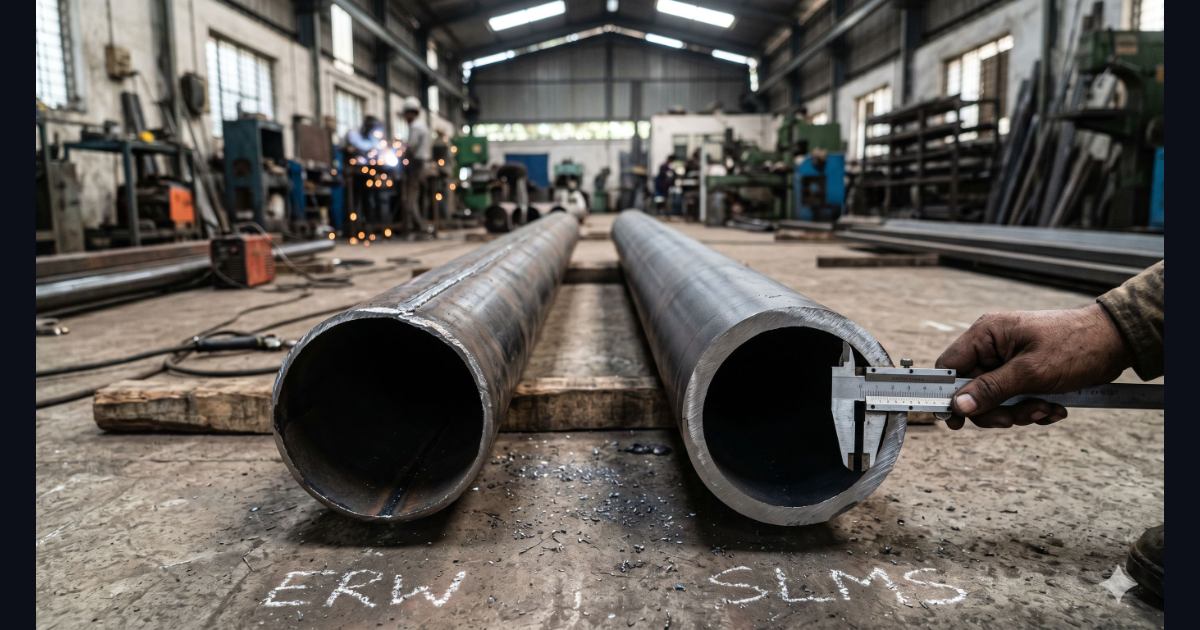
ERW and seamless pipes of the same nominal bore and wall thickness have identical theoretical weight per metre — but seamless pipes frequently arrive on site heavier because IS 1978 allows a +12.5% wall thickness tolerance, compared to ±10% for ERW under IS 3589. On a 100mm NB, 6mm wall pipe, this tolerance gap can add almost 2 kg per metre to a seamless pipe versus its ERW counterpart. Knowing this difference prevents invoice disputes, structural over-design and freight surprises.
Key Facts
- ERW standard: IS 3589 (water and sewage) / IS 1161 (structural) — wall tolerance ±10%
- Seamless standard: IS 1978 — wall tolerance +12.5% / −12.5%
- Nominal weight: Same formula for both — 0.02466 × t × (OD − t) kg/m
- Max real-world weight gap: Up to 12.5% higher for seamless vs ERW nominal
- Brand reference: Jindal SAW (ERW); Maharashtra Seamless Limited — MSL (seamless)
Manufacturing Difference — ERW vs Seamless
ERW pipe starts as flat steel strip — hot rolled coil from a mill like JSW or SAIL. The strip is fed through forming rolls that curve it into a tube, and the two edges are resistance-welded together using electrical current. The weld seam runs longitudinally along the pipe's full length and is clearly visible as a faint line on the pipe's interior surface. Post-weld, the seam is heat-treated and the pipe is sized to final OD tolerance.
Seamless pipe is pierced from a solid steel billet using a mandrel piercing mill. The billet is heated to rolling temperature and pushed over a pointed mandrel that opens a hollow through the centre. The tube is then rolled to final dimensions. Because there is no flat-strip starting point, the wall thickness is set by the rolling mill gap — and this gap is inherently harder to control precisely than the thickness of a pre-rolled strip. This is the root cause of the wider wall tolerance in IS 1978.
Wall Thickness Tolerance — Why Seamless Pipes Can Weigh More
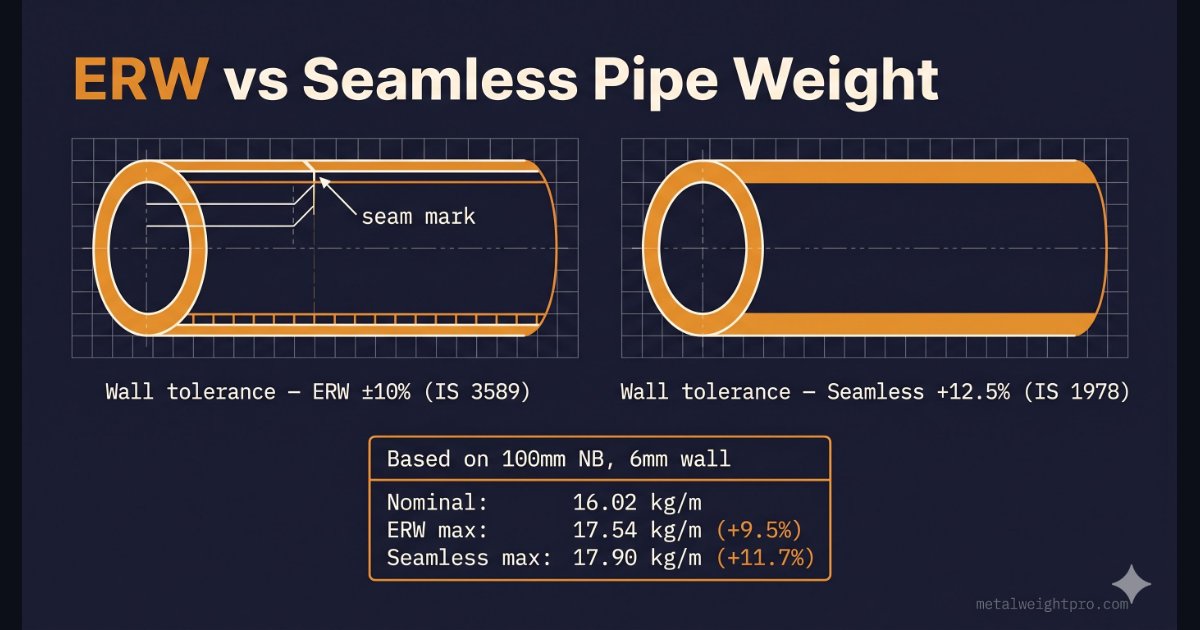
IS 3589 (ERW steel pipes for water and sewage) specifies wall thickness tolerance as ±10% of the nominal wall. Since ERW pipes are formed from steel strip of controlled thickness, mills can consistently hit the tighter tolerance. A 6mm nominal wall ERW pipe must fall between 5.40mm and 6.60mm actual wall thickness.
IS 1978 (seamless steel pipes) specifies wall thickness tolerance as ±12.5% of the nominal wall. A 6mm nominal wall seamless pipe must fall between 5.25mm and 6.75mm. In practice, seamless mills intentionally run at the positive end of this range to ensure that no cross-section falls below the minimum wall — a critical requirement for pressure containment. The result is that most seamless pipe from Maharashtra Seamless Limited (MSL) and other Indian seamless producers arrives with actual wall thickness closer to the +12.5% limit than the nominal.
| Standard | Pipe Type | Wall Tolerance | Min Wall (for 6mm nominal) | Max Wall (for 6mm nominal) |
|---|---|---|---|---|
| IS 3589 | ERW | ±10% | 5.40mm | 6.60mm |
| IS 1978 | Seamless | ±12.5% | 5.25mm | 6.75mm |
Worked Example: 100mm NB, 6mm Wall — ERW vs Seamless Weight
*ERW aur seamless pipe ka weight mein kya fark hota hai?* — here is the full calculation that answers this for a 100mm NB pipe with 6mm nominal wall, one of the most common sizes specified in industrial piping.
Given:
- Nominal bore: 100mm
- OD: 114.3mm
- Nominal wall thickness: 6mm
Nominal weight (both ERW and seamless):
Weight = 0.02466 × 6 × (114.3 − 6) = 0.02466 × 6 × 108.3 = 16.02 kg/m
ERW at maximum tolerance (+10%, t = 6.60mm):
Weight = 0.02466 × 6.60 × (114.3 − 6.60) = 0.02466 × 6.60 × 107.70 = 17.54 kg/m (+9.5% over nominal)
Seamless at maximum tolerance (+12.5%, t = 6.75mm):
Weight = 0.02466 × 6.75 × (114.3 − 6.75) = 0.02466 × 6.75 × 107.55 = 17.90 kg/m (+11.7% over nominal)
Practical impact: In a 6-metre pipe length, the nominal weight is 96.1 kg. A seamless pipe at maximum tolerance weighs 107.4 kg — a difference of 11.3 kg per piece. Over 100 pieces, that is 1.13 tonnes of unplanned weight that your structure supports and your vehicle carries.
For any weight-critical calculation, use actual wall thickness from the mill test certificate, not the nominal value. Enter the actual OD and actual wall thickness into the free Metal Weight Calculator → to get the real weight per metre for your specific pipe lot.
ERW vs Seamless Weight Comparison Table — Common Sizes
The table below shows nominal weight and maximum-tolerance weight for ERW and seamless pipe at five common sizes. All OD values follow IS standards. Use the nominal weight for general estimation and the maximum-tolerance weight for structural support and freight planning when actual mill certificates are not available.
| NB (mm) | OD (mm) | Nom. Wall (mm) | Nominal (kg/m) | ERW Max +10% (kg/m) | Seamless Max +12.5% (kg/m) |
|---|---|---|---|---|---|
| 50 | 60.3 | 4.0 | 5.53 | 6.07 | 6.22 |
| 80 | 88.9 | 5.0 | 10.22 | 11.22 | 11.49 |
| 100 | 114.3 | 6.0 | 16.02 | 17.54 | 17.90 |
| 150 | 168.3 | 7.0 | 27.71 | 30.42 | 31.17 |
| 200 | 219.1 | 8.0 | 41.63 | 45.75 | 46.91 |
Note: Maximum tolerance weights are calculated at the upper wall thickness limit for each standard. Actual pipe weights depend on the production lot — always request the mill test certificate for weight-critical applications.
When the Weight Difference Matters for Your Job
For most structural fabrication — hollow section frames, handrails, general pipe supports — the weight difference between ERW and seamless is irrelevant. You specify ERW (IS 3589 or IS 1161), order from Jindal SAW or a local ERW mill, and the nominal weight table is accurate enough for your purpose. Seamless pipe is not required and adds unnecessary cost — typically 30–50% more per tonne than equivalent ERW.
The weight difference matters in three specific situations. First, when ordering by weight — if your purchase order specifies 5 tonnes of 100mm NB seamless pipe at 6mm wall, a mill running at +12.5% tolerance delivers approximately 4,460 metres instead of 5,000 metres nominal. You get less pipe than expected. Second, when designing structural supports for a seamless pipe run — using nominal weight for pipe hanger design and receiving pipe at maximum tolerance means your hangers may be undersized by 12%. Third, in pressure piping under ASME B31.3 or IBR — where actual wall thickness must be verified against code minimum-wall calculations and the extra wall thickness changes your pressure rating.
For cutting waste and optimisation on any pipe procurement job, the free Pipe Cut List Optimizer → helps you plan stock lengths and minimise offcut waste.
Frequently Asked Questions
Does seamless pipe always weigh more than ERW pipe of the same size?
Not always, but seamless pipe frequently runs heavier in practice. Both pipe types share the same nominal (theoretical) weight per metre formula. The difference comes from wall thickness tolerances — IS 1978 (seamless) allows up to +12.5% on wall thickness, while IS 3589 (ERW) allows ±10%. A seamless pipe at maximum positive wall tolerance weighs up to 12.5% more than its nominal specification. In practice, seamless mills tend to run thick to ensure minimum wall is never violated, so seamless pipes commonly arrive heavier than nominal. ERW pipes, formed from strip of controlled thickness, tend to sit closer to nominal.
What is the wall thickness tolerance difference between IS 1978 and IS 3589?
IS 1978 (seamless steel pipes) specifies a wall thickness tolerance of ±12.5% of the nominal wall. IS 3589 (ERW steel pipes for water and sewage) specifies ±10%. For a 6mm nominal wall pipe, this means seamless pipe can range from 5.25mm to 6.75mm actual wall, while ERW pipe must fall between 5.40mm and 6.60mm. The tighter tolerance on ERW reflects the better dimensional control achievable when forming pipes from pre-rolled strip of known thickness, compared to the piercing and rolling process used for seamless pipe.
ERW aur seamless pipe mein practically weight ka fark kitna hota hai?
100mm NB, 6mm wall pipe ka nominal weight 16.02 kg/m hota hai — dono ERW aur seamless ke liye. Lekin jab actual mill production weights dekhte hain, toh seamless pipe IS 1978 ke +12.5% tolerance pe 17.90 kg/m tak pahunch sakti hai, aur ERW IS 3589 ke +10% tolerance pe 17.54 kg/m tak. Ek 6-metre seamless piece mein nominal se 11 kg zyada ho sakta hai. Isliye weight-critical applications mein — hanger design, freight planning, structural support — nominal value ki jagah mill test certificate ka actual weight use karo.
For structural applications, is ERW pipe or seamless pipe the better choice?
For structural applications — columns, trusses, frames, handrails and general fabrication — ERW pipe under IS 3589 or IS 1161 is the correct and more economical choice. ERW pipes from Jindal SAW and other domestic ERW mills are available in consistent dimensions and are typically 30–50% less expensive than equivalent seamless pipe. Seamless pipe should only be specified when required by engineering code — high-pressure steam lines, hydraulic systems, pressure vessels and process piping under ASME B31.3 or IBR (Indian Boiler Regulations). For structural hollow sections, IS 4923 is the governing standard and all IS 4923 sections are produced by ERW and cold-forming processes, not seamless.
Calculate exact pipe weights using actual OD and wall thickness from your mill certificate.
Try the Free Metal Weight Calculator →