Steel Density: Why 7.85 g/cm³ and How It Affects Weight Calculations
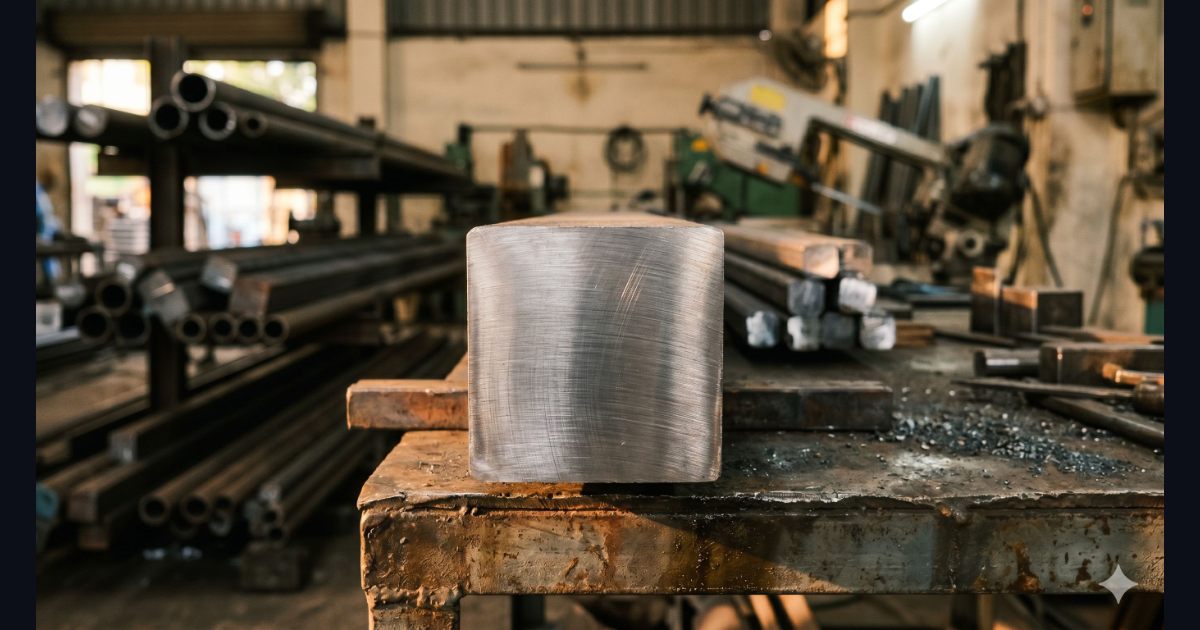
Steel density for mild steel is 7.85 g/cm³ (7,850 kg/m³), as standardised in IS 2062 and SP 6(1) — this single constant underpins every weight formula used in structural and fabrication engineering, from the D²/162 shortcut for TMT rebar to the 0.02466 pipe formula.
Key Facts
- Value: 7.85 g/cm³ = 7,850 kg/m³ = 7.85 t/m³
- Standard: IS 2062:2011 (Structural Steel) and SP 6(1):1964 (Handbook for Structural Engineers)
- Master formula: Weight (kg) = Volume (cm³) × 7.85 ÷ 1,000
- Applies to: All mild steel sections — round bar, pipe, flat bar, plate, angle, channel
Where Does 7.85 g/cm³ Come From?
Pure iron (Fe) has a density of 7.874 g/cm³. Mild steel is not pure iron — it is an alloy of iron with 0.15–0.30% carbon, up to 1.5% manganese, and up to 0.4% silicon, as specified for the E250 grade in IS 2062:2011. Each of these alloying elements has its own density:
- Iron carbide (Fe₃C), which forms from the carbon addition: ~7.69 g/cm³
- Manganese: 7.43 g/cm³
- Silicon: 2.33 g/cm³
The ferrite and pearlite microstructure that results from these additions has a slightly lower net density than pure iron. Working through the alloy compositions gives a density that rounds cleanly to 7.85 g/cm³ — the value that SP 6(1), India's definitive reference for structural steel section properties, tabulates throughout its weight tables.
The reason engineers use 7.85 rather than the more precise 7.874 is practical: the 0.3% difference is well within the dimensional tolerances of hot-rolled sections, which IS 2062 permits at ±2.5% on section weight. Using 7.85 g/cm³ produces results that match the published section property tables exactly.
How Steel Density Drives Every Weight Formula
Every weight formula you use on a steel job is a rearrangement of one master equation:
Weight (kg) = Volume (cm³) × 7.85 ÷ 1,000
The section-specific shortcut formulas are this equation with the geometry pre-simplified:
- Round bar: Volume = π/4 × D² × L, which simplifies to Weight = D² ÷ 162 × L(m). The constant 162 is derived from 4,000 ÷ (π × 7.85) = 161.97, rounded.
- Flat bar / plate: Volume = W × t × L, so Weight (kg) = W(mm) × t(mm) × L(m) × 7.85 ÷ 1,000,000.
- Hollow pipe: Volume = π/4 × (OD² − ID²) × L, which simplifies to Weight = 0.02466 × t × (OD − t) per metre. The constant 0.02466 = π × 7.85 ÷ 1,000.
If you encounter a formula using 7.80 or 7.83 — common errors in older site spreadsheets — recalculate with 7.85. For instant cross-checking across all section types, the free Metal Weight Calculator applies 7.85 g/cm³ consistently to every material and section.
Worked Example: 25 mm MS Round Bar, 6,000 mm Length
On a workshop floor you will often hear: "gol saria ka wajan kaise nikale?" — how to find the weight of a round bar? Here is the full calculation from first principles, so you can see exactly how density drives the result.
Given:
- Diameter (D): 25 mm = 2.5 cm
- Length (L): 6,000 mm = 600 cm
- Density: 7.85 g/cm³
Step 1 — Calculate volume:
Volume = π/4 × D² × L = 0.7854 × (2.5)² × 600 = 0.7854 × 6.25 × 600 = 2,945.24 cm³
Step 2 — Apply density:
Weight = 2,945.24 × 7.85 ÷ 1,000 = 23.12 kg
Step 3 — Cross-check with the D²/162 shortcut:
Weight = 25² ÷ 162 × 6 = 625 ÷ 162 × 6 = 3.858 × 6 = 23.15 kg
The 0.03 kg difference is purely rounding in the constant 162 (exact value: 161.97). For procurement, both results round to 23 kg per stick. Verify this — and any other section — with the free Metal Weight Calculator →
Density Values for Common Steels and Metals
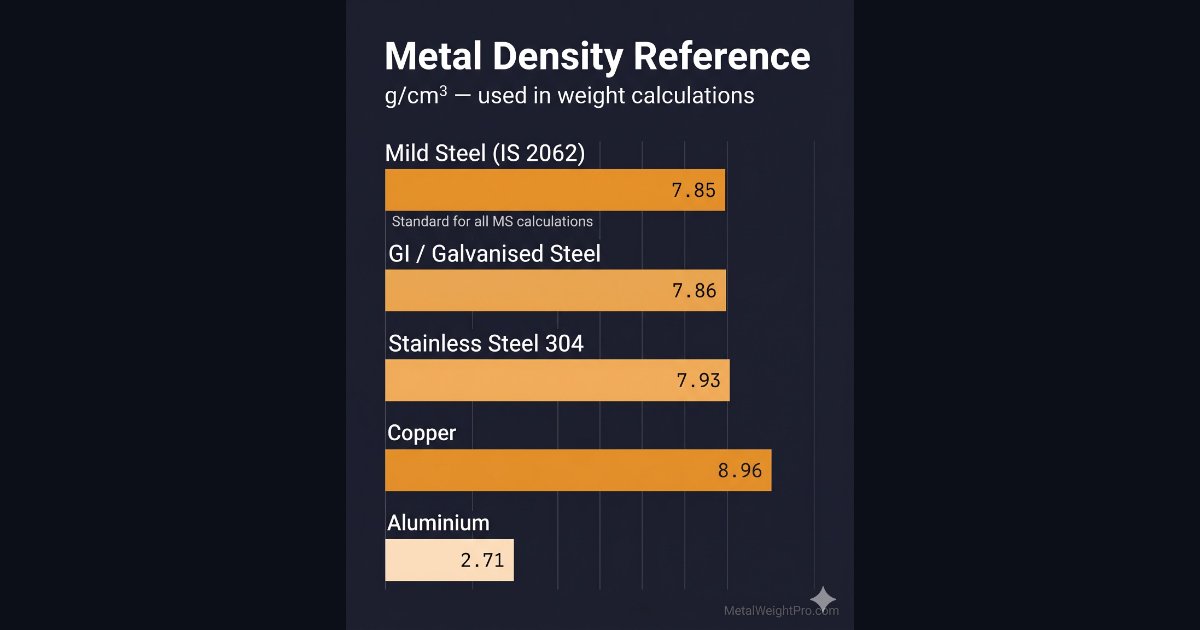
The 7.85 value applies to mild steel only. When working with stainless steel, aluminium, or copper sections, use the correct density for that material. The table below gives reference values for materials commonly specified in Indian fabrication. All MS pipe and IS 2062 structural calculations use the first row.
| Material | Density (g/cm³) | Density (kg/m³) | Notes |
|---|---|---|---|
| Mild Steel — IS 2062 E250 | 7.85 | 7,850 | Standard for all MS calculations |
| GI / Galvanised Steel | 7.86 | 7,860 | Zinc coating adds ~0.01 g/cm³ |
| Stainless Steel SS 304 | 7.93 | 7,930 | 18% Cr, 8% Ni increases density |
| Stainless Steel SS 316 | 7.98 | 7,980 | Mo addition raises density further |
| Cast Iron | 7.20 | 7,200 | Graphite lowers density vs steel |
| Aluminium | 2.71 | 2,710 | ~3.5× lighter than mild steel |
| Copper | 8.96 | 8,960 | ~14% heavier than mild steel |
Why Getting Density Wrong Is Expensive
A small error in density compounds quickly at procurement scale. Consider a fabricator using 7.80 g/cm³ instead of the correct 7.85 g/cm³ — a difference of just 0.64%.
On an order of 10,000 kg of MS sections, that error produces a shortfall of 64 kg. At ₹60 per kg for standard IS 2062 plates and sections, that is ₹3,840 in unplanned material cost — before factoring in delivery delays when you run short mid-job.
The more common version of this error is using the right density in the wrong unit. 7.85 t/m³ and 7.85 g/cm³ are the same value. But 7.85 kg/m³ is three orders of magnitude too small. If your weight column shows values like 0.023 kg for a full six-metre bar, check your unit conversion first.
The formulas in our MS pipe weight per metre reference embed 7.85 g/cm³ directly into the formula constant — so if you use the published formula with correct inputs, the density is already handled. The risk lives in custom spreadsheets where the density cell is an editable input that someone has quietly changed.
IS 2062 and SP 6(1) — The Two Authority Sources
IS 2062:2011 — Hot Rolled Medium and High Tensile Structural Steel. This standard specifies the chemical composition and mechanical properties for the E250, E300, E350, E410, and E450 grades of structural steel. Section property tables in IS 2062 are calculated using 7,850 kg/m³. The E250 grade covers standard mild steel used for fabricated structures, columns, beams, and base plates across the country.
SP 6(1):1964 — Indian Standard Handbook for Structural Engineers: Structural Steel Sections. SP 6(1) is the single most-used reference document on Indian structural drawing boards and shop desks. Every table of ISMC channel weights, ISMB beam weights, ISLB weights, and angle section weights in SP 6(1) is derived using 7,850 kg/m³. The handbook has not been revised since 1964 because the underlying material density has not changed.
When a client or inspection agency asks which standard your weight calculations are based on, the answer is IS 2062 with SP 6(1) section tables — density 7.85 g/cm³, no exceptions.
Frequently Asked Questions
What is the density of mild steel in kg/m³?
The density of mild steel is 7,850 kg/m³, which is the same value expressed as 7.85 g/cm³ or 7.85 t/m³. This value is standardised in IS 2062 and SP 6(1) and is used universally in Indian structural and fabrication calculations. For weight calculations: Weight (kg) = Volume (m³) × 7,850. For a volume in cm³, divide the result by 1,000 to get kg.
Why is steel density 7.85 g/cm³ and not exactly 7.87 like pure iron?
Pure iron has a density of approximately 7.874 g/cm³. Mild steel is an alloy — iron plus 0.15–0.30% carbon, small amounts of manganese (up to 1.5%), and silicon (up to 0.4%). Carbon forms iron carbide (Fe₃C), which has a lower density of about 7.69 g/cm³. Manganese (7.43 g/cm³) and silicon (2.33 g/cm³) also pull the net density below that of pure iron. The result of these alloying additions is a standardised density of 7.85 g/cm³ for mild steel — slightly lower than pure iron, but close enough that all IS weight tables use the rounded value.
Steel ka density kitna hota hai?
Mild steel (MS) ka density 7.85 g/cm³ hota hai, jo ki 7,850 kg/m³ ke barabar hai. Yeh value IS 2062 standard mein specified hai aur sabhi MS weight calculations ke liye use hoti hai — chahe pipe ho, round bar ho, flat bar ho, ya plate. Stainless steel ka density thoda zyada hota hai: SS 304 ke liye 7.93 g/cm³ aur SS 316 ke liye 7.98 g/cm³. Aluminium bahut halka hota hai — sirf 2.71 g/cm³, jo MS se lagbhag 3.5 guna kam hai.
Does density vary between different steel grades?
Yes, density varies across steel grades, though the differences are small for low-alloy steels. Mild steel (IS 2062 E250) is 7.85 g/cm³. Stainless steel SS 304 — which contains 18% chromium and 8% nickel — is 7.93 g/cm³. SS 316, which adds molybdenum, reaches 7.98 g/cm³. GI (galvanised) steel is effectively the same as the underlying MS pipe at 7.85–7.86 g/cm³ — the zinc coating is too thin to affect weight calculations significantly. For all standard mild steel calculations — IS 2062, IS 1239, IS 808 sections — use 7.85 g/cm³ without adjustment.
Save time on your next job — calculate exact weights in seconds.
Try the Free Metal Weight Calculator →