IS 1161 Structural Pipe Weight Chart — YST 210, 240, 310 and 355
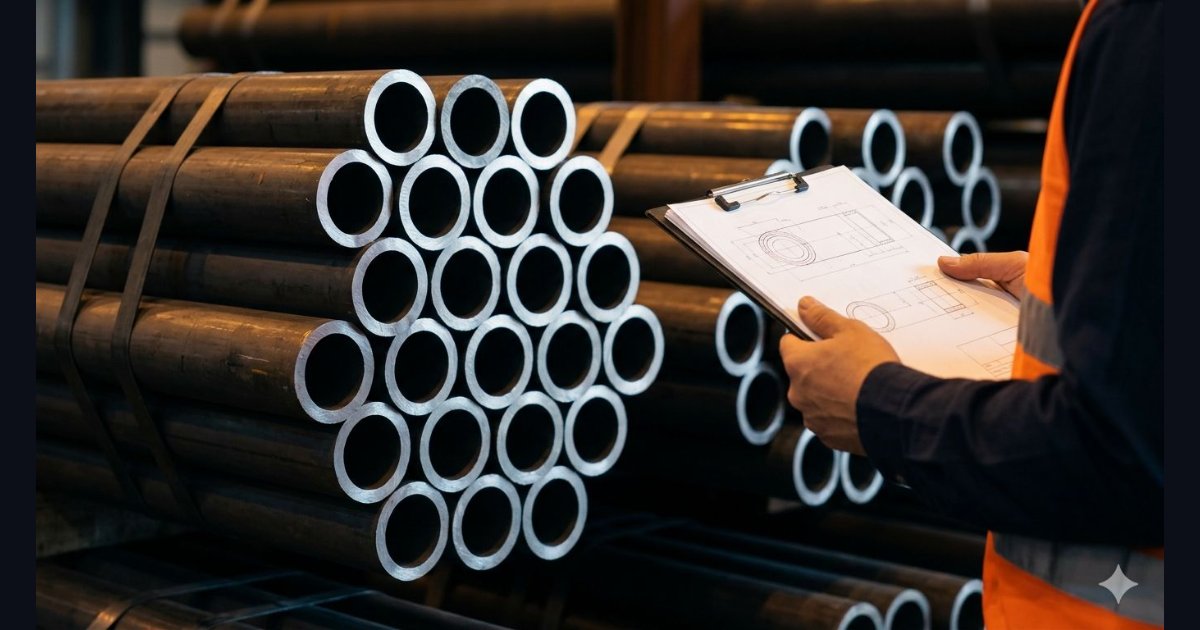
IS:1161:2014 is India's standard for structural steel tubes — a separate specification from IS:1239 plumbing pipes — covering four YST grades with OD and wall thickness data for 15 NB through 150 NB sizes.
- IS:1161 covers 16 NB sizes from 15 mm to 150 mm nominal bore, used in structural applications
- Four grades: YST 210, YST 240, YST 310, and YST 355 — yield strength in MPa
- Mass tolerance: ±7.5% per individual piece, ±5% per consignment as per IS:1161 Clause 10
IS 1161 pipe weight chart data tells you the outside diameter, wall thickness, and weight per metre for every standard NB size of structural steel tube. Structural pipe ka weight differs from plumbing pipe weight because IS:1161 specifies thicker walls and higher-strength grades than IS:1239 — a distinction that matters for load calculations, cost estimates, and procurement.
IS:1161 vs IS:1239 — Why the Difference Matters
IS:1239 covers steel tubes for water, gas, and steam supply — what most fabricators call plumbing pipe or GI pipe. IS:1161:2014 covers steel tubes for structural purposes — columns, handrails, roof purlins, bracings, and trusses. The two standards share the same NB sizing system and similar OD values, but differ on three points that directly affect your weight calculation and structural adequacy.

| Feature | IS:1161:2014 (Structural) | IS:1239 (Part 1):2004 (Plumbing) |
|---|---|---|
| Grade system | YST 210, 240, 310, 355 — yield strength | Class A (light), B (medium), C (heavy) — wall thickness class |
| Primary end use | Columns, handrails, trusses, purlins | Water, gas, steam supply |
| Wall thickness | Single thickness per NB size per grade | Three thicknesses (Light/Medium/Heavy) per NB size |
| Mass tolerance | ±7.5% per piece, ±5% per consignment | ±7.5% per piece, ±5% per consignment |
| Pressure rating | Not a pressure-rated standard | Tested to hydraulic pressure per IS:1239 |
IS:1161 ke anusar YST 310 grade structural columns aur handrails ke liye use hota hai. For hydraulic or gas service, always use IS:1239 — IS:1161 tubes are not hydraulic pressure tested.
IS:1161 YST Grade Properties
The four grades in IS:1161:2014 are differentiated by yield strength, tensile strength, and elongation. The OD and wall thickness dimensions are the same across all four grades for any given NB size — the grade affects the steel chemistry and mechanical properties, not the physical dimensions.
| Grade | Min. Yield Strength (MPa) | Min. Tensile Strength (MPa) | Min. Elongation (%) | Typical Structural Use |
|---|---|---|---|---|
| YST 210 | 210 | 330 | 20 | Light fabrication, non-structural members |
| YST 240 | 240 | 410 | 20 | General fabrication, gate frames, light trusses |
| YST 310 | 310 | 450 | 15 | Structural columns, handrails, roof purlins |
| YST 355 | 355 | 490 | 15 | Heavy structural work, high-load columns |
Mechanical properties as per IS:1161:2014 Table 2 (Fourth Revision). All four grades share identical OD and wall thickness dimensions for each NB size — grade selection affects strength, not section geometry.
IS:1161 Pipe Weight Chart — All NB Sizes
The following table gives the complete IS:1161 weight chart from 15 NB to 150 NB. The weight per metre value applies to all four YST grades for a given NB size — since dimensions are identical across grades, only the steel chemistry differs.
| NB Size (mm) | OD (mm) | Wall Thickness (mm) | Weight (kg/m) | Available YST Grades |
|---|---|---|---|---|
| 15 | 21.3 | 2.6 | 1.21 | 210, 240, 310, 355 |
| 20 | 26.9 | 2.6 | 1.56 | 210, 240, 310, 355 |
| 25 | 33.7 | 3.2 | 2.41 | 210, 240, 310, 355 |
| 32 | 42.4 | 3.2 | 3.10 | 210, 240, 310, 355 |
| 40 | 48.3 | 3.2 | 3.56 | 210, 240, 310, 355 |
| 50 | 60.3 | 3.6 | 5.03 | 210, 240, 310, 355 |
| 65 | 76.1 | 3.6 | 6.43 | 210, 240, 310, 355 |
| 80 | 88.9 | 4.0 | 8.51 | 210, 240, 310, 355 |
| 90 | 101.6 | 4.0 | 9.75 | 210, 240, 310, 355 |
| 100 | 114.3 | 4.5 | 12.21 | 210, 240, 310, 355 |
| 110 | 127.0 | 4.5 | 13.63 | 210, 240, 310, 355 |
| 125 | 139.7 | 4.5 | 15.04 | 210, 240, 310, 355 |
| 140 | 152.4 | 5.0 | 18.19 | 210, 240, 310, 355 |
| 150 | 165.1 | 5.0 | 19.74 | 210, 240, 310, 355 |
Outside diameter and wall thickness as per IS:1161:2014 Table 1 (Fourth Revision). Mass tolerance: ±7.5% for individual pieces, ±5% for consignments of 10 tonnes or more, as per IS:1161 Clause 10. Weight calculated using formula: (OD − WT) × WT × 0.02466. Verify with mill test certificate before use in structural design.
Weight Formula for IS:1161 Structural Tubes
The same formula used for all circular steel tubes applies to IS:1161 sections:
Weight (kg/m) = (OD − WT) × WT × 0.02466
- OD
- Outside diameter of tube, in millimetres — as per IS:1161:2014 Table 1 for the specified NB size
- WT
- Wall thickness, in millimetres — as per IS:1161:2014 Table 1
- 0.02466
- SI constant = π × 7850 / (4 × 1,000,000) — derived from steel density 7850 kg/m³; constant for all YST grades
Use our free Metal Weight Calculator to verify weight for any pipe size and material — enter OD, WT, and length to get an instant result.
Worked Example — 40 NB IS:1161 YST 310 Handrail
A structural fabricator in Ahmedabad is pricing a handrail system for an industrial mezzanine. The specification calls for 40 NB IS:1161 YST 310 tube throughout. The handrail run totals 24 linear metres. He needs the total tube weight to price the job and raise a material purchase order.
Step 1 — Read OD and WT from IS:1161 table:
40 NB IS:1161: OD = 48.3 mm, WT = 3.2 mm
Step 2 — Verify weight per metre using formula:
(48.3 − 3.2) × 3.2 × 0.02466
= 45.1 × 3.2 × 0.02466
= 144.32 × 0.02466
= 3.56 kg/m — confirms the IS:1161 table value exactly
Step 3 — Calculate total weight for 24 metres:
3.56 kg/m × 24 m = 85.4 kg
Step 4 — Apply ±7.5% tolerance for procurement buffer:
At the high end: 85.4 × 1.075 = 91.8 kg. Order 100 kg to account for site cuts and end waste — approximately 17 lengths of 6-metre random stock at 3.56 × 6 = 21.4 kg per length.
For a comparison with IS:1239 Class B pipe at the same 40 NB size (OD 48.3 mm, WT 3.2 mm — identical dimensions, different standard), see the IS 1239 pipe weight chart. Also see the MS pipe weight per metre guide for a broader pipe weight reference across all classes.
Frequently Asked Questions
What is IS 1161 standard for pipes?
IS:1161:2014 is the Bureau of Indian Standards specification titled "Steel Tubes for Structural Purposes." It covers circular steel tubes manufactured by electric resistance welding or seamless process for use in structural applications such as columns, handrails, trusses, purlins, and bracings. The standard defines four YST grades (YST 210, YST 240, YST 310, and YST 355) with specific yield strength, tensile strength, and elongation requirements. IS:1161 is the fourth revision of the standard, published in 2014.
What is the difference between IS 1161 and IS 1239?
IS:1161 covers steel tubes for structural purposes — columns, handrails, and trusses — while IS:1239 covers steel tubes for water, gas, and steam supply (plumbing and pipeline applications). The key differences are: IS:1161 uses a YST grade system (yield strength of the steel), whereas IS:1239 uses Class A/B/C (wall thickness class). IS:1239 tubes are hydraulic pressure tested; IS:1161 tubes are not. Both standards share the same NB sizing and similar OD values. For structural applications, always specify IS:1161; for fluid service, use IS:1239.
What are the YST grades in IS 1161?
IS:1161:2014 defines four YST grades. YST stands for Yield Strength of Tubes. YST 210 has a minimum yield strength of 210 MPa and tensile strength of 330 MPa, suited for light non-structural fabrication. YST 240 offers 240 MPa yield and 410 MPa tensile strength for general structural work. YST 310 provides 310 MPa yield and 450 MPa tensile strength, the most commonly specified grade for structural columns and handrails. YST 355 delivers 355 MPa yield and 490 MPa tensile strength for heavy structural applications. All four grades have identical OD and wall thickness dimensions for each NB size.
IS 1161 pipe ka weight per meter kitna hota hai?
IS:1161 pipe ka weight NB size ke hisaab se alag hota hai. Kuch common sizes: 25 NB (OD 33.7 mm, WT 3.2 mm) = 2.41 kg/m; 40 NB (OD 48.3 mm, WT 3.2 mm) = 3.56 kg/m; 50 NB (OD 60.3 mm, WT 3.6 mm) = 5.03 kg/m; 80 NB (OD 88.9 mm, WT 4.0 mm) = 8.51 kg/m; 100 NB (OD 114.3 mm, WT 4.5 mm) = 12.21 kg/m. Sabhi YST grades ke liye weight same hota hai — grade sirf steel ki strength change karta hai, dimensions nahi.
Which pipe standard is used for structural steel tubes in India?
IS:1161:2014, titled "Steel Tubes for Structural Purposes," is the Indian standard for structural steel tubes. It is published by the Bureau of Indian Standards (BIS) and is the fourth revision of the standard. For structural columns, handrails, trusses, and bracings, IS:1161 is the correct specification to reference. IS:1239 (plumbing pipes) and IS:3589 (large-diameter pipes) are separate standards for different applications. When preparing a structural drawing or purchase order for tubular sections, always cite IS:1161 and specify the required YST grade.
Use our free Metal Weight Calculator to compute exact pipe weight for any IS:1161 NB size — enter OD, wall thickness, and length for an instant result.
Calculate Pipe Weight Free →