How to Optimise a Cutting List in Steel Fabrication
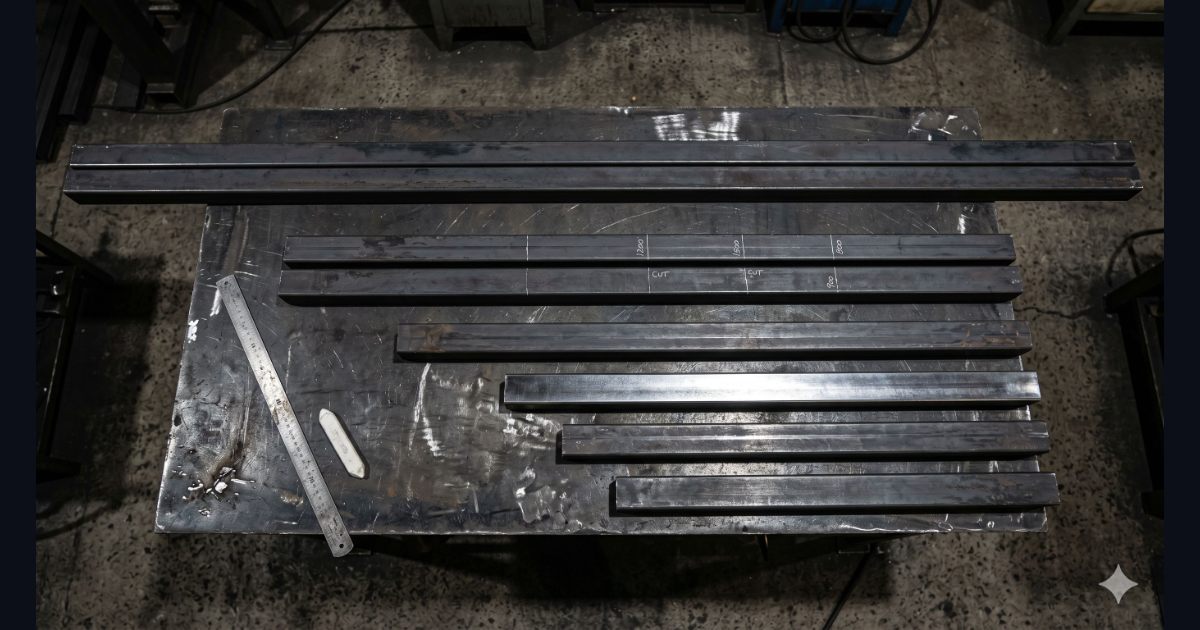
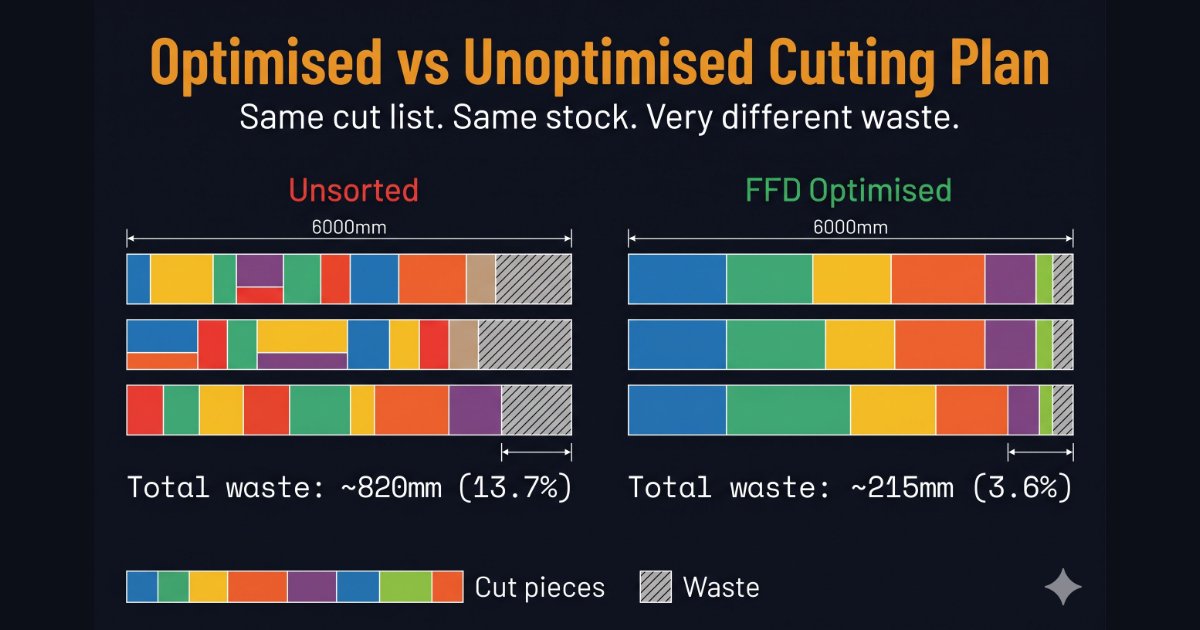
Optimising a cutting list in steel fabrication means sorting your required pieces from longest to shortest and filling each stock bar in sequence — this First-Fit Decreasing method consistently reduces cutting waste from a typical 8–15% down to 3–5% on the same job.
- APL Apollo and Tata Structura supply SHS and RHS in standard 6m and 12m lengths — these are your stock lengths for optimisation
- A 3mm saw kerf per cut means 20 cuts waste 60mm per bar — this must be accounted for in your plan
- Our free Pipe & Bar Cut List Optimizer runs the FFD algorithm automatically for any stock length and cut list
Why Cutting Waste Adds Up Faster Than You Think
On a structural steel job, the waste is usually invisible until you do the sums. You order 20 lengths of 6-metre Tata Structura 50×50×3 SHS, cut 60 pieces of various lengths, and end up with a pile of offcuts that are too short to reuse and too heavy to throw away without noticing the cost.
On a 120m total job with 8–15% unoptimised waste, you are throwing away 9.6 to 18 metres of stock. At ₹85/kg for IS 4923 SHS and 4.25 kg/m for 50×50×3, that is ₹3,468 to ₹6,503 of material in the scrap bin per job.
The problem is almost never the quantity of material. It is the cutting sequence. When you cut pieces in the order they appear on the drawing — rather than sorted by length — short remnants pile up at the end of each bar and cannot be combined to fill another piece.
The First-Fit Decreasing Method
First-Fit Decreasing (FFD) is the standard algorithm for the 1D cutting stock problem. It does not require software — you can run it manually on any cutting list in five minutes. Steel cutting list kaise banate hain using FFD:
Step 1: List every required piece with its length and quantity.
Step 2: Sort all pieces from longest to shortest — ignoring quantity groupings. Treat 3 pieces of 2400mm as three separate 2400mm entries in the sorted list.
Step 3: Open Bar 1. Try to fit the longest remaining piece. If it fits, assign it. Subtract the piece length and one kerf (e.g. 3mm) from the bar's remaining capacity.
Step 4: Continue filling Bar 1 with the next longest piece that will fit. Repeat until nothing else fits in Bar 1.
Step 5: Open Bar 2. Repeat the process with the remaining unassigned pieces.
Step 6: Continue opening new bars as needed until all pieces are assigned.
The result is the minimum number of stock bars and the waste amount per bar. This method will not always find the absolute mathematical optimum — but in practice it gets within 1–2% of optimum for typical fabrication cut lists.
Accounting for Kerf Allowance
Every cut removes material equal to the blade or disc width. For a horizontal bandsaw or cold saw, typical kerf is 2.5–3.0mm. For an angle grinder with a cutting disc, it is 3.0–4.5mm. For a plasma cutter on tube, allow 3.0–5.0mm depending on material thickness.
This matters most when a bar has many short cuts. Consider a 6000mm bar cut into twelve 490mm pieces: without kerf, 12 × 490 = 5880mm, leaving 120mm waste. With 3mm kerf per cut (12 cuts = 36mm total kerf): usable length = 6000 − 36 = 5964mm, fitting only 12 pieces of 490mm = 5880mm with 84mm remaining. The kerf alone consumed 36mm — over half the apparent waste figure.
Always include kerf in your plan. If you are using our Cut List Optimizer, enter the kerf value in the Blade Width field and it is automatically deducted from each cut position.
Worked Example: FFD on a Real Cut List
Here is a realistic cut list for an equipment frame in 50×50×3 SHS to IS 4923:1997, with stock length 6000mm from APL Apollo and 3mm kerf:
Required pieces: 2400mm × 3, 1850mm × 2, 1600mm × 4, 900mm × 6, 500mm × 8
Sorted list (longest first): 2400, 2400, 2400, 1850, 1850, 1600, 1600, 1600, 1600, 900, 900, 900, 900, 900, 900, 500, 500, 500, 500, 500, 500, 500, 500
Total material required (ignoring kerf): (3×2400) + (2×1850) + (4×1600) + (6×900) + (8×500) = 7200 + 3700 + 6400 + 5400 + 4000 = 26,700mm = 4.45 bars minimum (theoretical)
FFD result (with 3mm kerf):
Bar 1: 2400 + 3 + 2400 + 3 + 900 + 3 = 5709mm used → 291mm waste
Bar 2: 2400 + 3 + 1850 + 3 + 1600 + 3 = 5859mm used → 141mm waste
Bar 3: 1850 + 3 + 1600 + 3 + 1600 + 3 + 900 + 3 = 5962mm used → 38mm waste
Bar 4: 1600 + 3 + 900 + 3 + 900 + 3 + 900 + 3 + 500 + 3 + 500 + 3 = 5918mm used → 82mm waste
Bar 5: 900 + 3 + 900 + 3 + 500 + 3 + 500 + 3 + 500 + 3 + 500 + 3 + 500 + 3 + 500 = 5912mm used → 88mm waste
Result: 5 bars, total waste = 640mm, utilisation = 97.9%
An unsorted random cutting sequence on the same list typically uses 6–7 bars with 13–20% waste. FFD saved one full bar — at ₹1,530 per 6m bar of APL Apollo SHS, that is a direct cost saving on a single frame job.
How the Cut List Optimizer Tool Works
Our Pipe & Bar Cut List Optimizer runs the FFD algorithm automatically. Enter your stock length, blade kerf, and the required piece lengths and quantities. The tool outputs the number of bars needed, a bar-by-bar cutting plan, total waste in mm and percentage, and a visual diagram of each bar.
It works for any straight-cut stock: round bar, square bar, flat bar, angle, channel, SHS, RHS, or pipe. The only requirement is that all pieces are cut from the same stock cross-section and material.
When to Use Remnant Tracking
On large projects or ongoing production, it pays to keep a remnant log — a simple spreadsheet listing every offcut by length. Any offcut shorter than 300mm is typically not worth retrieving (unless the material is expensive stainless or aluminium). Any offcut 300mm or longer should be logged, tagged, and stored in a clearly labelled remnants rack.
Before ordering new stock for the next job, run the cut list against your remnants inventory. Steel wastage kaise kam kare: even recovering 2–3 remnant pieces per job can eliminate one full stock bar from a purchase order over the course of a month.
Frequently Asked Questions
What is a cutting list in steel fabrication?
A cutting list (also called a cut list or BOM cut schedule) is a table listing every piece of steel section required for a fabrication job, with its length, cross-section, material grade, and quantity. For example: 12 pieces of 50×50×3 SHS at 2400mm, 8 pieces at 1600mm, 6 pieces at 900mm. The cutting list is the input to the optimisation process — the output is a cutting plan that tells you which pieces to cut from each stock bar to minimise waste.
Steel cutting mein kerf allowance kitna rakhna chahiye?
Cutting method ke hisaab se kerf allowance alag hoti hai: horizontal bandsaw ya cold saw ke liye 2.5–3.0mm, angle grinder cutting disc ke liye 3.0–4.5mm, aur plasma cutting ke liye 3.0–5.0mm. Most fabrication shops mein standard 3mm use karte hain. Yeh chhota lagta hai, lekin ek bar mein 20 cuts hain toh 60mm waste ho jaata hai sirf kerf se — isliye planning mein zaroor include karo.
How does First-Fit Decreasing reduce cutting waste?
First-Fit Decreasing (FFD) reduces waste by filling each bar with the largest possible pieces first, then fitting smaller pieces into the remaining space. This avoids the common mistake of cutting pieces in drawing order, which creates many small unusable remnants at the end of each bar. FFD typically achieves 94–98% material utilisation on real fabrication cut lists, compared to 82–92% for random or drawing-order cutting.
Can I use the cut list optimizer for rectangular hollow sections?
Yes. The Cut List Optimizer works for any straight-cut linear stock including RHS (Rectangular Hollow Section), SHS (Square Hollow Section), round bar, flat bar, angle, and channel. Enter the stock length (e.g. 6000mm for standard APL Apollo or Tata Structura stock), the kerf width, and your required pieces. The tool handles any combination of lengths and quantities and outputs a bar-by-bar cutting plan with waste percentage.
Run your cut list through our free optimizer — enter your stock length, pieces, and kerf, and get an instant cutting plan.
Try the Free Cut List Optimizer →