Aluminium Weight Calculator: Density, Formulas and Section Types
The aluminium weight calculator formula uses a density of 2.71 g/cm³ for most structural alloys — exactly one-third the weight of mild steel — making aluminium section weights predictable once you know the cross-section dimensions.
- Standard aluminium density: 2.71 g/cm³ (6063 alloy — the most common structural extrusion grade in India)
- A 25mm MS round bar weighs 3.85 kg/m; the same size in aluminium weighs 1.44 kg/m
- IS 733:1983 covers wrought aluminium bars, rods and sections; IS 1285:2002 covers extruded tubes
Aluminium Density: Which Value to Use
The aluminium density you need depends on the alloy. For most Indian fabrication and construction work, you will be using 6063-T5 extrusions — window frames, door frames, structural angles, flat bars. Hindalco Industries, India's largest aluminium producer, supplies these alloys and their density is 2.69 g/cm³.
For general structural work and weight estimation, I use 2.71 g/cm³ as the standard value — it is the IS 733 reference density and gives results within 0.7% for all common structural alloys. The table below covers the alloys you are most likely to encounter:
| Alloy | Density (g/cm³) | Temper | Common Use in India |
|---|---|---|---|
| Pure Al (1100) | 2.70 | H14 | Chemical equipment, food industry |
| 6061 | 2.70 | T6 | Structural, marine, aerospace |
| 6063 | 2.69 | T5/T6 | Extrusions — windows, doors, frames |
| 6082 | 2.71 | T6 | Heavy structural, bridges |
| 7075 | 2.81 | T6 | Aerospace, high-stress components |
| IS 733 reference | 2.71 | — | General estimation (all structural alloys) |
Weight Formulas by Section Type
The formula structure is identical to steel — volume multiplied by density. Aluminium ka weight kaise nikale: measure or look up your cross-section dimensions, multiply volume in mm³ by 2.71, then divide by 1,000,000 to get kilograms.
Round bar:
Weight (kg/m) = D² ÷ 162 × (2.71 ÷ 7.85)
= D² ÷ 162 × 0.3452
Or more directly: Weight (kg/m) = D² × 0.002130
Flat bar:
Weight (kg/m) = W × T × 2.71 ÷ 1,000
Where W is width in mm and T is thickness in mm. Result is kg per metre of length.
Sheet / plate:
Weight (kg) = L × W × T × 2.71 ÷ 1,000,000
Where L, W, T are all in mm. For a 1mm thick sheet, weight per m² = 2.71 kg — roughly one-third of the 7.85 kg/m² for a 1mm steel sheet.
Square hollow section (SHS):
Weight (kg/m) = 4 × (A − T) × T × 2.71 ÷ 1,000
Where A is the external side length in mm and T is wall thickness in mm.
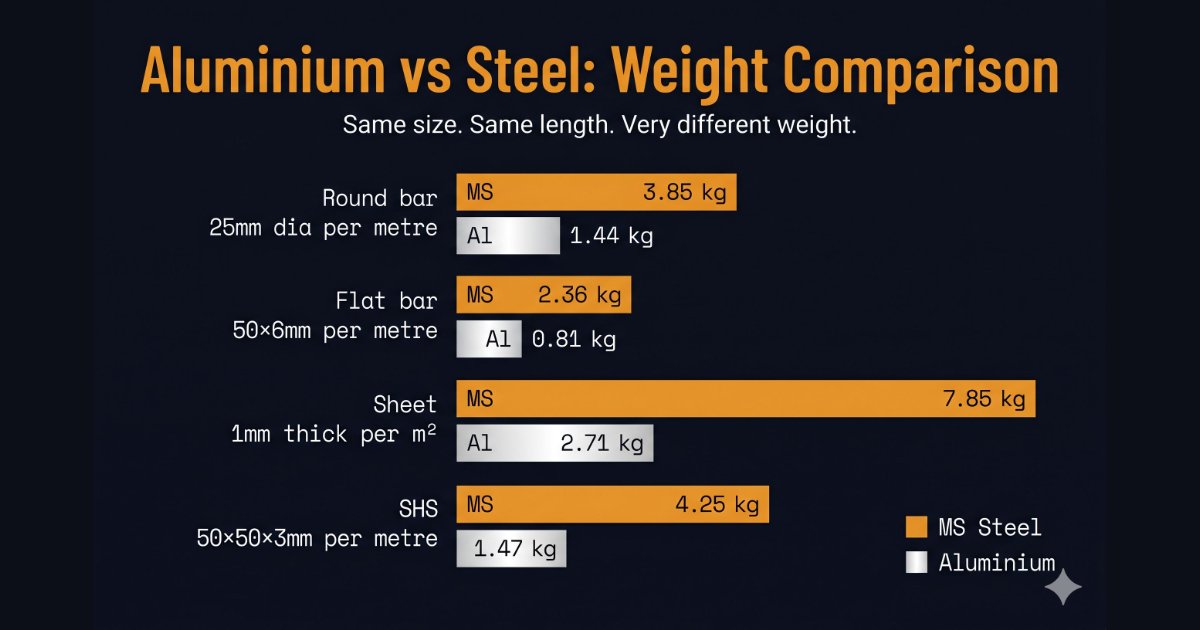
Aluminium vs Steel Weight Comparison
This is where aluminium's advantage becomes concrete. If you are designing a structure where self-weight is critical — a canopy, a mezzanine floor, a vehicle body — these comparisons matter:
| Section | Size | MS Weight (kg/m) | Al Weight (kg/m) | Weight Saving |
|---|---|---|---|---|
| Round bar | 25mm dia | 3.85 | 1.33 | 65% |
| Flat bar | 50 × 6mm | 2.36 | 0.81 | 66% |
| SHS | 50 × 50 × 3mm | 4.25 | 1.47 | 65% |
| Sheet (1mm) | per m² | 7.85 kg | 2.71 kg | 65% |
For all section types, aluminium is consistently about 65% lighter than the equivalent steel section. You can verify any of these values using our free Metal Weight Calculator — select Aluminum as the material and enter your section dimensions.
Worked Example: Hindalco 6063 Flat Bar
I was recently pricing a roof canopy frame using 6063-T5 flat bar from Hindalco. The cut list called for flat bar 50mm wide × 6mm thick in 6000mm lengths.
Weight per piece = 50 × 6 × 6000 × 2.69 ÷ 1,000,000
= 1,800,000 × 2.69 ÷ 1,000,000
= 4.84 kg per piece
With 36 pieces on the cut list, total material weight = 36 × 4.84 = 174.3 kg. At ₹280/kg for 6063 extrusion, that's ₹48,800 in material before cutting and wastage. Had I mistakenly used steel density (7.85), I would have estimated 510 kg and overquoted the job significantly.
IS 733 and IS 1285: What They Cover
IS 733:1983 (Wrought Aluminium and Aluminium Alloy Bars, Rods and Sections) specifies dimensions and tolerances for extruded bar, rod, and structural sections. IS 1285:2002 covers extruded tubes — relevant when you need hollow rectangular or round aluminium extrusions.
Both standards are applicable to the alloys listed in the table above. When purchasing from Hindalco or NALCO (National Aluminium Company), ask for mill test certificates that reference the IS standard and quote the temper designation — this confirms the alloy chemistry and therefore the density you should use for weight calculations.
Also see our article on stainless steel weight calculation — the formula approach is identical; only the density value changes.
Frequently Asked Questions
What is the density of aluminium for weight calculations?
Use 2.71 g/cm³ as the standard density for aluminium weight calculations — this is the IS 733 reference value and applies to most common structural alloys including 6061 and 6082. For 6063 extrusions (the most common in India for windows, frames, and sections), use 2.69 g/cm³. For high-strength 7075 alloy, use 2.81 g/cm³. Pure aluminium (1100 series) is 2.70 g/cm³.
Aluminium ka wajan steel se kitna kam hota hai?
Aluminium ka wajan steel se approximately 65% kam hota hai. Iska reason yeh hai ki aluminium ki density 2.71 g/cm³ hai aur mild steel ki density 7.85 g/cm³ — yaani steel aluminium se almost 3 guna bhaari hai. For example, 25mm round bar mein: MS = 3.85 kg/m, aluminium = 1.33 kg/m.
How do I calculate aluminium flat bar weight per metre?
Multiply the width (mm) by the thickness (mm) by the density (2.71 g/cm³) and divide by 1,000 to get kg per metre. For example, a 40mm × 5mm aluminium flat bar: 40 × 5 × 2.71 ÷ 1,000 = 0.542 kg/m. For a 6 metre length, total weight = 0.542 × 6 = 3.25 kg.
Does aluminium alloy grade affect the weight calculation?
Yes, but only slightly for most common grades. The difference between 6063 (2.69 g/cm³) and 6082 (2.71 g/cm³) is less than 1% — negligible for most estimation work. However, 7075 alloy at 2.81 g/cm³ is about 3.7% heavier than 6063 for the same section. If you are working with aerospace alloys or high-strength structural grades, always check the specific alloy density rather than using the standard 2.71 value.
Calculate the exact weight for any aluminium section — flat bar, round bar, sheet, or hollow section — in seconds.
Try the Free Metal Weight Calculator →