Bend Allowance in Steel Fabrication — The K-Factor Guide
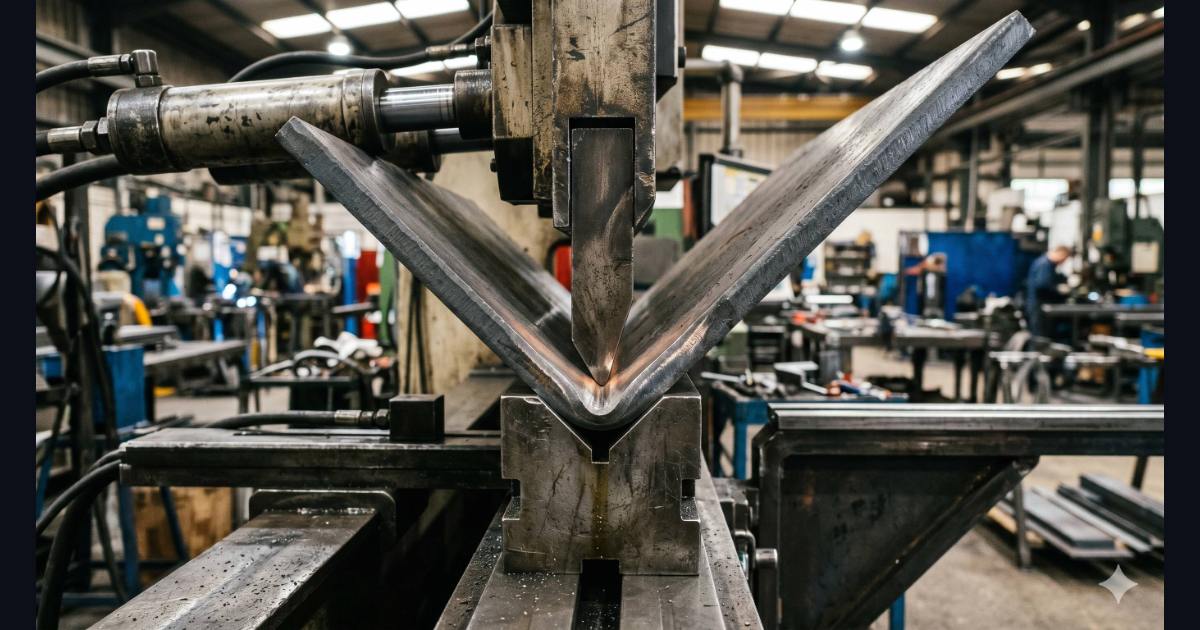
The "Bend Allowance" is the arc length of the bend as measured along the neutral axis of the material. K-Factor is the ratio that defines exactly where this neutral axis sits inside the plate thickness.
- For Mild Steel, the standard K-Factor is typically between 0.38 and 0.45.
- If you ignore bend allowance, your fabricated part will end up too long after folding.
- Use the flat pattern length to accurately calculate pre-fabrication MS plate weight.
A common mistake made by junior draftsmen and fabricators is assuming that folding a piece of steel doesn't change its length. In India, the base material for press brake work is typically hot rolled MS sheet supplied to IS 1079:2009 (Hot Rolled Carbon Steel Sheet and Strip), with a standard density of 7,850 kg/m³. Because metal stretches during the bending process, you cannot simply add the final leg dimensions together to find the required flat plate length. Understanding the mathematics of bend allowance in steel fabrication allows you to calculate the precise "flat pattern" size before cutting, virtually eliminating dimensional scrap waste on the press brake.
Standard K-Factor Chart for Sheet Metal
The K-Factor shifts depending on the material's hardness and the radius of the bend (relative to the material thickness, "T"). Below is an empirical K-Factor chart used in standard air-bending operations.
| Material Type | Bend Radius = 1T | Bend Radius = 2T | Bend Radius = 3T |
|---|---|---|---|
| Mild Steel (MS) | 0.38 | 0.43 | 0.50 |
| Stainless Steel (SS) | 0.40 | 0.45 | 0.50 |
| Aluminum (Soft) | 0.33 | 0.40 | 0.50 |
| Aluminum (Hard) | 0.38 | 0.45 | 0.50 |
| Copper / Brass | 0.35 | 0.42 | 0.50 |
Note: K-Factor represents the location of the neutral axis. These are empirical baseline values for air bending; actual values may vary slightly based on the V-die width and specific alloy temper.
Worked Example: Calculating the Flat Pattern Length
A press brake operator needs to fabricate an L-shaped bracket from 5mm thick Mild Steel (MS). The final part requires two legs (Leg A and Leg B), both measuring 100mm from the outside corner after a 90-degree bend. The inside bend radius is 5mm (which equals 1T).
1. Identify the K-Factor: From the chart, MS with a 1T bend radius has a K-Factor of roughly 0.38.
2. Calculate Bend Allowance (BA): The formula for BA at 90 degrees is: BA = (π / 2) × (Inside Radius + (K-Factor × Thickness)).
- BA
- Bend Allowance — the arc length of material consumed in the bend, in mm
- π / 2
- Radian value for a 90-degree bend (= 1.5708)
- Inside Radius
- The inner bend radius set on the press brake die, in mm
- K-Factor
- Neutral axis ratio — typically 0.38–0.45 for Mild Steel air bending
- Thickness
- Material thickness, in mm
BA = 1.57 × (5 + (0.38 × 5)) = 1.57 × (5 + 1.9) = 1.57 × 6.9 = 10.83 mm.
3. Calculate Flat Length: The flat length is the sum of the straight flat legs plus the Bend Allowance.
Flat Leg A = 100 - 5 (thickness) - 5 (radius) = 90 mm.
Flat Leg B = 100 - 5 (thickness) - 5 (radius) = 90 mm.
Total Flat Length = 90 + 90 + 10.83 = 190.83 mm.
If the operator had blindly added 100 + 100, they would have cut the flat plate at 200mm. After bending, the part would have been nearly 10mm oversized and rejected by quality control. By calculating the exact flat length (190.83 mm), the operator can also input this exact dimension into the Metal Weight Calculator to predict the precise component weight before the steel is even cut.
Frequently Asked Questions
How to calculate bend allowance for MS plate?
To calculate the bend allowance, use the formula: BA = Bend Angle in radians × (Inside Radius + (K-Factor × Material Thickness)). The Bend Angle in radians for a 90-degree fold is approximately 1.5708. Add this BA to the flat straight lengths of your legs to get the total flat pattern length.
What is K-factor in sheet metal?
When sheet metal is bent, the inside compresses and the outside stretches. There is a theoretical line inside the metal that neither compresses nor stretches, called the neutral axis. The K-factor is a ratio (usually between 0.3 and 0.5) that represents how far inside the material this neutral axis sits, measured from the inside bend radius.
Bending allowance kaise nikale?
Bending allowance nikalne ke liye aapko plate ki thickness (motai), bend ka angle (jaise 90 degree), inside bend radius, aur material ka K-Factor pata hona chahiye. Mild steel ka standard K-Factor 0.40 se 0.45 ke beech hota hai. In values ko BA = (Angle × π / 180) × (Radius + (K × Thickness)) formula mein daal kar exact allowance nikala jata hai.
Once you calculate your flat pattern length, find out exactly how much the MS plate weighs.
Use the MS Plate Weight Calculator →