How to Reduce Rebar Cutting Waste on Construction Sites

Rebar cutting waste of 5–15% is normal on Indian construction sites, but with an optimised cutting list prepared before steel arrives, you can bring that figure down to 2–3% on most jobs. For a mid-size residential project consuming 40 tonnes of Tata Tiscon TMT Fe 500D, even a 5% improvement in cutting efficiency saves 2 tonnes of steel — at ₹55,000 per tonne, that is ₹1.1 lakh saved before you've changed a single process on site.
Key Facts
- Typical site waste: 8–15% without optimisation
- Target with optimisation: 2–5%
- Standard bar length: 12,000mm (Tata Tiscon, JSW Neo Steel)
- Tool: Free Cut List Optimizer handles rebar →
Why Rebar Waste Happens
The root cause on most sites is simple: cutting begins before the bar bending schedule (BBS) is complete. Rebar is cut in response to immediate demand — "we need stirrups for the columns, cut 50 pieces of 800mm" — without knowing what other pieces still need to come from the same bars. The result is a yard full of 200–500mm stub pieces that cannot match any required length and end up as scrap.
The second cause is ordering by rule of thumb — "add 10% to the BBS tonnage for waste" — rather than running the cut list through an optimiser and ordering the precise quantity. The 10% buffer is sometimes justified; often it is not, and it becomes waste.
The third cause is mixing diameter sizes on one order and cutting them without coordinating. A 16mm bar and a 12mm bar sitting in the same bundle will be cut to the wrong lengths if the cutting crew is not working from a labelled plan.
Understanding Bar Bending Schedule (BBS) and Cutting Lengths
A bar bending schedule per IS 2502 lists each rebar piece by its type, diameter, shape code, and cutting length. The cutting length is the straight bar length before bending — it includes the bend allowances calculated from the bar diameter and mandrel size. This is the number you feed into the cut list.
One common omission: lap splice length. IS 456 specifies a minimum lap length of 40D for tension laps in Fe 500 bars (where D = bar diameter). For a 16mm bar, that is 640mm extra per lap. If your BBS omits the lap allowance, your cutting lengths will be systematically short by 640mm per spliced bar — and no amount of cut list optimisation will fix this.
Always verify the BBS includes: (a) the full cutting length per bar, (b) lap splice additions, and (c) hook/bend allowances per IS 2502, before running the optimisation.
Standard Rebar Lengths in India
Tata Tiscon Fe 500D TMT bars are supplied in 12-metre standard lengths from the mill and its authorised distribution network. JSW Neo Steel also supplies 12m standard lengths for diameters 8mm through 32mm. Some distributors cut 6m lengths on request, but 12m is preferred for cutting efficiency — more combinations fit into a 12m bar than a 6m bar, giving the optimiser more flexibility to reduce waste.
For rebar ka cutting waste kaise kam kare on a 12m bar: a 12,000mm bar gives 8 pieces of 1,500mm with no waste, or 5 pieces of 2,000mm with 2,000mm waste — the mix of lengths in your actual BBS determines the outcome, which is why optimisation is needed rather than simple arithmetic.
Worked Example: Mixed Cut List from 12m Tata Tiscon Bars
A slab reinforcement job required the following cutting lengths from 16mm Tata Tiscon Fe 500D bars (12,000mm each):
- 10 pieces × 3,500mm
- 8 pieces × 2,800mm
- 12 pieces × 1,200mm
Naive plan (cutting one size per bar):
- 3,500mm pieces: 3 per bar → ⌈10/3⌉ = 4 bars (last bar has 1 piece, 8,497mm waste)
- 2,800mm pieces: 4 per bar → ⌈8/4⌉ = 2 bars (last bar has 0 waste — exactly 4 fit)
- 1,200mm pieces: 9 per bar → ⌈12/9⌉ = 2 bars (second bar has 3 pieces, 8,397mm waste)
- Total: 8 bars
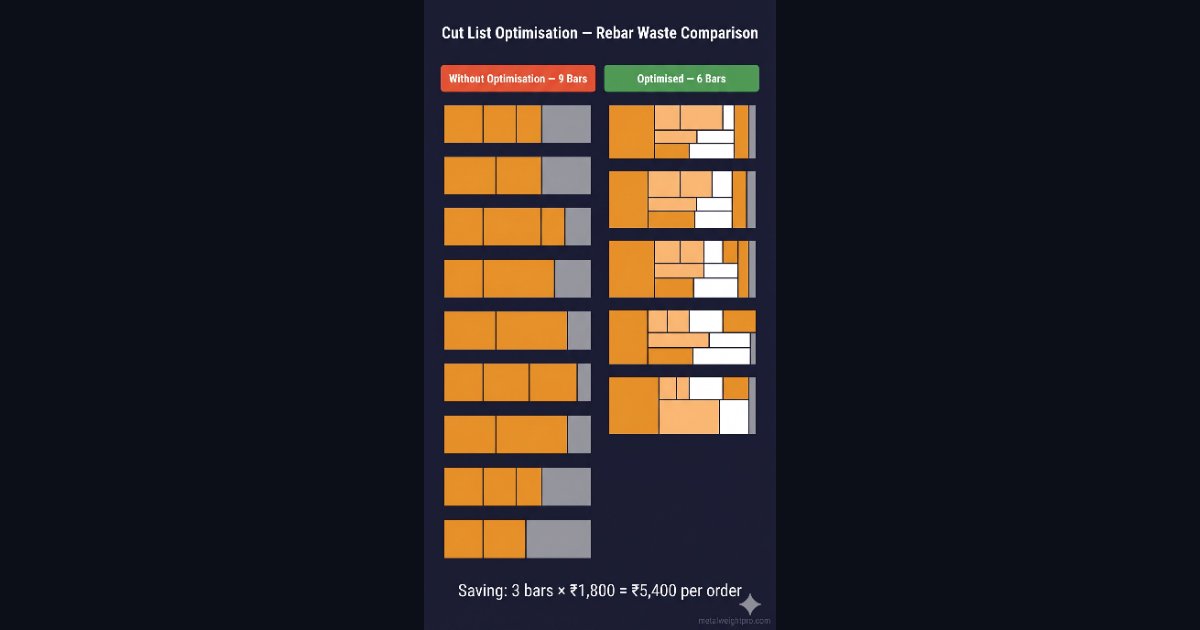
Optimised plan (mixing lengths per bar, First-Fit Decreasing):
- Bar 1: 3,500 + 3,500 + 2,800 = 9,800mm used, 2,200mm remaining → add 1,200 + 1,000mm offcut
- Bars 2–3: similar mixed loading
- Total: 6 bars (saving 2 bars)
At ₹1,800 per 12m bar of 16mm Fe 500D, saving 2 bars = ₹3,600 on this one diameter alone. A full-floor BOM with 5–6 diameters, run through the optimiser, routinely saves 8–15 bars per floor.
Using the Cut List Optimizer for Rebar
The Pipe Cut List Optimizer works for any bar section including round bar rebar. Set stock length to 12,000mm. Enter each cutting length and quantity. Set kerf to 3mm (abrasive cut-off on site). The optimizer uses First-Fit Decreasing (FFD) logic — it sorts all pieces from longest to shortest, then packs each piece into the first bar that has enough remaining space. This algorithm consistently achieves near-optimal results for typical BBS cut lists.
The output is a bar-by-bar cutting plan showing which pieces go on which bar and how much waste remains at the end of each bar. Print it, label it by diameter, and give one copy to the cutting crew. The cutting crew should cut from the plan — not from memory or ad-hoc requests.
For related detail on how kerf affects the cut list calculation, see What is Kerf Allowance and Why It Matters in Steel Cutting →
Site Practices That Reduce Rebar Cutting Waste
Cut longest pieces first. The FFD logic starts with the longest pieces because they are hardest to fit. On site, cutting longest-first mirrors this logic and reduces the chance of a long piece being stranded without a bar that can accommodate it.
Tag every offcut. Any piece above 500mm that comes off a bar should be tagged with its length and set aside in a labelled "offcuts" rack. Before cutting a new bar for a short piece, check the offcuts rack first. A 600mm offcut can satisfy a 580mm requirement and saves cutting into a new 12m bar.
Coordinate with the BBS engineer. Many times, a cutting length of 3,450mm could just as well be 3,400mm if the structural designer confirms the 50mm is a rounding margin, not a structural requirement. A 50mm reduction in 20 pieces gives you one extra piece from a bar that would otherwise waste 500mm.
IS 1786 Grade Fe 500D — Cutting Note
Tata Tiscon Fe 500D complies with IS 1786:2008, which specifies minimum yield strength of 500 MPa, UTS of 565 MPa, and elongation of 12% minimum. These properties do not change how you cut the bar — but the higher strength means Fe 500D bars have slightly more springback when bent, so cutting lengths from the BBS must use Fe 500D bend allowances, not the older Fe 415 values. Using Fe 415 bend allowances on Fe 500D bars will give systematically longer than needed cutting lengths, adding to waste.
Frequently Asked Questions
What is an acceptable rebar cutting waste percentage on a construction site?
An acceptable rebar cutting waste percentage is 3–5% for a well-managed site with an optimised cutting list. Without any optimisation, waste on Indian construction sites typically runs 8–15% — driven by unoptimised cut lists, random leftover pieces that don't match required lengths, and cutting before the BBS is finalised. Some project specifications and QA plans set a maximum allowable waste of 5% by weight. Anything above 8% is a clear signal that the cutting list needs to be optimised before cutting begins, as the excess waste directly adds to steel procurement cost.
Can I use the Cut List Optimizer for TMT bars?
Yes. The Pipe Cut List Optimizer at MetalWeightPro works for any bar or section that comes in standard stock lengths — including TMT rebar. Enter your standard bar length (typically 12000mm for Tata Tiscon or JSW Neo Steel), add each cut length and quantity from your BBS, set kerf to 3mm for a standard abrasive cut-off, and the tool generates a bar-by-bar cutting plan using the First-Fit Decreasing algorithm. The tool is labelled 'pipe and bar' because it handles both — round bar rebar is just a round bar with specific cut lengths.
What is the standard length of Tata Tiscon TMT bars in India?
Tata Tiscon TMT bars are supplied in standard lengths of 12 metres (12000mm). Some distributors also stock 6-metre lengths, particularly for smaller projects or where site storage space is limited. The 12-metre standard length is preferred for cutting efficiency — longer bars give more combinations when cutting mixed-length pieces, which reduces the number of short offcuts that cannot be reused. Tata Tiscon Fe 500D bars comply with IS 1786:2008 and are available in diameters from 8mm to 32mm in 12m lengths from their authorised distribution network.
How does bar bending schedule (BBS) affect cutting waste?
A bar bending schedule (BBS) per IS 2502 specifies the cutting length of each rebar piece — this is the straight length of bar needed before bending, including the bend allowances. Cutting waste is directly tied to how well the cutting lengths from the BBS can be combined to fill standard 12m bars with minimal offcuts. If the BBS is finalised and optimised before ordering, you can run it through a cut list optimizer, calculate the exact number of bars required, and order precisely — reducing over-ordering waste. A BBS issued late (after steel is already on site and being cut informally) almost always results in higher waste because pieces are cut ad-hoc without a plan.
Run your BBS through the optimizer and see exactly how many bars you need — before ordering.
Try the Free Cut List Optimizer →