IS 1239 Pipe Weight Chart — Part 1 and Part 2 Complete Reference
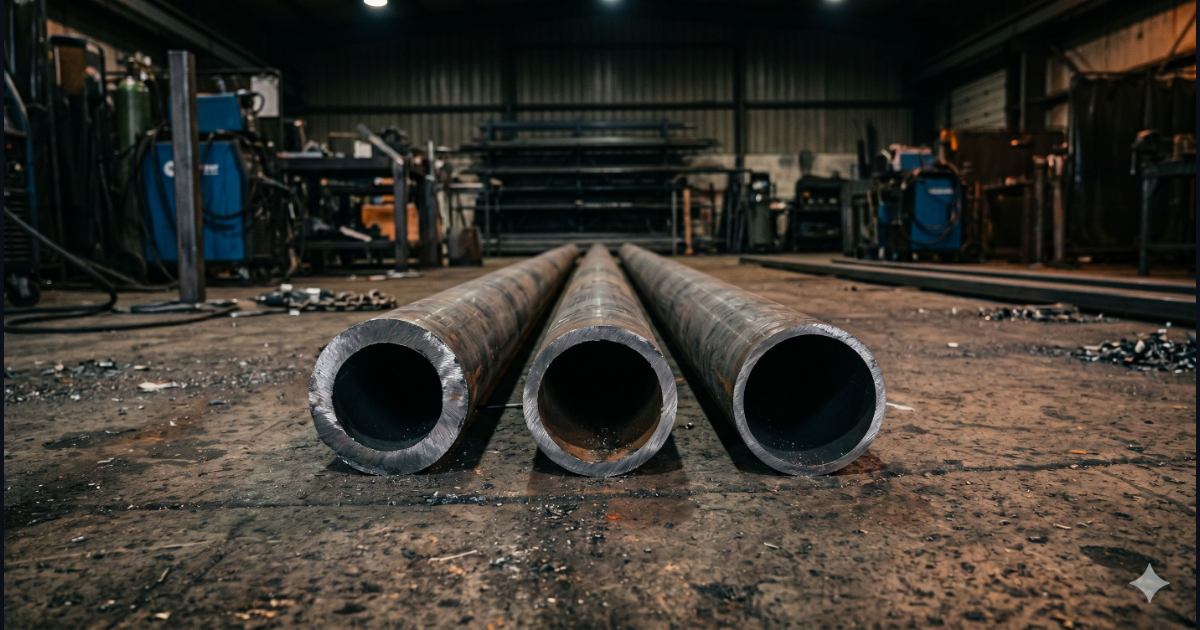
The IS 1239 pipe weight chart gives you the weight per metre for every standard nominal bore (NB) size of mild steel and GI pipe manufactured under BIS specification IS 1239, covering Light, Medium and Heavy class in Part 1, and the heavier-walled threading-grade pipes in Part 2.
Key Facts at a Glance
- Standard: IS 1239 Part 1: 2004 (MS & GI pipes — water, gas, steam)
- NB range covered: 15mm to 150mm (Part 1); 15mm to 50mm (Part 2)
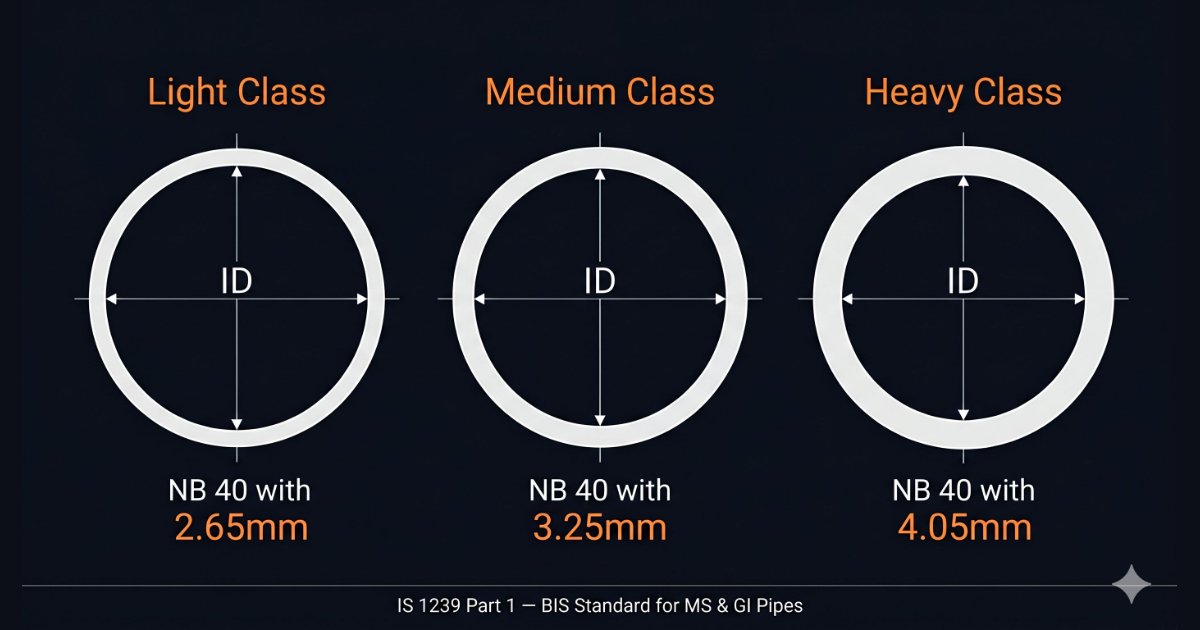
- Three classes: Light, Medium, Heavy — same OD, different wall thickness
- Weight formula: W (kg/m) = 0.02466 × t × (OD − t)
- Tolerance: ±10% on wall thickness (Clause 6, IS 1239 Part 1: 2004)
What IS 1239 Covers — Part 1 vs Part 2
IS 1239 is the BIS standard for welded steel tubes used in water supply, gas distribution, steam and structural applications. In my experience as a fabricator, the single most common source of procurement errors is confusing Part 1 and Part 2 — so let me be direct about the difference.
IS 1239 Part 1: 2004 covers mild steel (MS) and galvanised iron (GI) tubes intended for plumbing, water mains, gas lines, steam, irrigation and general structural use. This is the version every hardware shop stocks. Sizes run from NB 15mm to NB 150mm. The pipes are available in three wall-thickness classes — Light, Medium and Heavy — all sharing the same outer diameter within a given NB. The standard is produced by manufacturers such as APL Apollo Tubes, Zenith Birla, and Tata Steel ERW plants.
IS 1239 Part 2 covers tubes specifically intended for screwed and socketed joints — pipes that will have NPT or BSP threads cut directly into the wall. To allow thread-cutting without reducing the remaining wall below safe limits, Part 2 specifies a heavier wall than Part 1 Medium class for the same NB. This is the pipe you use when making threaded fittings connections in compressed air lines, firefighting pipework, and similar applications. IS 1239 ka Part 2 sirf chhote sizes mein available hota hai — typically NB 15 to NB 50 — because larger threaded pipe joints are uncommon in Indian practice.
Both parts use identical outer diameters for each nominal bore. The weight difference comes entirely from the wall thickness. You cannot identify Part 1 from Part 2 by OD alone — always check the mill test certificate or ask the supplier to confirm the part number.
IS 1239 Part 1 Pipe Weight Chart — Light, Medium and Heavy Class
The table below covers NB 15mm to NB 150mm — the full range of IS 1239 Part 1. All weights are calculated using W = 0.02466 × t × (OD − t) with the wall thicknesses specified in IS 1239 Part 1: 2004, Table 1. Values are rounded to two decimal places. Use these numbers directly for material procurement, freight estimation and bill-of-material preparation.
| NB (mm) | OD (mm) | Light WT (mm) | Light (kg/m) | Med WT (mm) | Med (kg/m) | Heavy WT (mm) | Heavy (kg/m) |
|---|---|---|---|---|---|---|---|
| 15 | 21.3 | 2.0 | 0.95 | 2.3 | 1.08 | 3.2 | 1.43 |
| 20 | 26.9 | 2.3 | 1.39 | 2.6 | 1.56 | 3.2 | 1.87 |
| 25 | 33.7 | 2.6 | 1.99 | 3.2 | 2.41 | 4.0 | 2.93 |
| 32 | 42.4 | 2.6 | 2.55 | 3.2 | 3.09 | 4.0 | 3.79 |
| 40 | 48.3 | 2.9 | 3.25 | 3.2 | 3.56 | 4.0 | 4.37 |
| 50 | 60.3 | 2.9 | 4.11 | 3.6 | 5.03 | 4.5 | 6.19 |
| 65 | 76.1 | 3.2 | 5.75 | 3.6 | 6.44 | 4.5 | 7.95 |
| 80 | 88.9 | 3.2 | 6.76 | 4.0 | 8.38 | 4.85 | 10.05 |
| 100 | 114.3 | 3.6 | 9.82 | 4.5 | 12.18 | 5.4 | 14.49 |
| 125 | 139.7 | 4.0 | 13.41 | 5.0 | 16.60 | 5.4 | 17.87 |
| 150 | 165.1 | 4.0 | 15.90 | 5.0 | 19.73 | 5.4 | 21.25 |
Source: IS 1239 Part 1: 2004, Table 1. W = 0.02466 × t × (OD − t). NB = Nominal Bore; WT = Wall Thickness; weights in kg/m.
How the IS 1239 Pipe Weight is Calculated
The weight formula for any hollow round section is derived from the cross-sectional area of steel times the density of mild steel (7.85 g/cm³):
W (kg/m) = π × (OD − t) × t × ρ / 1000
Where OD and t are in millimetres and ρ = 7.85 g/cm³. Simplifying the constants: π × 7.85 / 1000 = 0.02466. This gives the familiar shop-floor formula:
W (kg/m) = 0.02466 × t × (OD − t)
One thing I always tell juniors: never use the nominal bore as your diameter in this formula. NB is a pipe identification number — not an actual dimension. For NB 50 pipe, the real OD is 60.3mm. Using 50mm would give you a result that is 17% too low. Always look up the OD from the IS 1239 table or the mill certificate.
The IS 1239 Clause 6 tolerance on wall thickness is ±10%, which means a nominally 3.6mm wall pipe could measure anywhere from 3.24mm to 3.96mm at the mill. This can shift the actual weight per metre by up to ±10% from the chart value — important to know when you're working to tight weight limits on a structural project.
Worked Example — NB 50 Medium Class Water Line
A common scenario: a plumbing contractor needs to estimate the total steel weight for a domestic water supply ring main using 24 sticks of NB 50 Medium class IS 1239 Part 1 pipe, each 6 metres long.
Step 1 — Identify the pipe dimensions: From the IS 1239 Part 1 table, NB 50 Medium class has OD = 60.3mm and wall thickness t = 3.6mm.
Step 2 — Calculate weight per metre:
W = 0.02466 × 3.6 × (60.3 − 3.6) = 0.02466 × 3.6 × 56.7 = 5.03 kg/m
Step 3 — Calculate weight per 6m stick:
5.03 × 6 = 30.18 kg per stick
Step 4 — Calculate total order weight:
30.18 × 24 sticks = 724.3 kg ≈ 0.72 tonnes
This figure goes directly onto the freight calculation and supplier invoice verification. If the supplier's invoice shows 24 sticks at a total weight of 780 kg, that is a 7.7% discrepancy — worth querying before you pay. Cross-check quickly using the Metal Weight Calculator → with section type Hollow Round, OD 60.3mm, WT 3.6mm, length 6000mm, quantity 24.
You can also use the MS Pipe Weight Per Metre guide → for a deeper walkthrough of the formula and class comparison.
IS 1239 Part 2 — Pipe Weight Chart for Threading-Grade Sizes
Part 2 specifies heavier wall thicknesses to allow full thread cutting without the remaining wall dropping below 1.5mm. The table below covers NB 15 to NB 50 — the sizes where threaded connections are most commonly used in Indian fabrication practice. Note that Part 2 ODs are identical to Part 1 for each NB — the weight difference is purely from the thicker wall.
| NB (mm) | OD (mm) | Wall Thickness (mm) | Weight (kg/m) | vs Part 1 Medium (kg/m) |
|---|---|---|---|---|
| 15 | 21.3 | 3.2 | 1.43 | +0.35 vs 1.08 |
| 20 | 26.9 | 3.2 | 1.87 | +0.31 vs 1.56 |
| 25 | 33.7 | 4.0 | 2.93 | +0.52 vs 2.41 |
| 32 | 42.4 | 4.0 | 3.79 | +0.70 vs 3.09 |
| 40 | 48.3 | 4.0 | 4.37 | +0.81 vs 3.56 |
| 50 | 60.3 | 4.5 | 6.19 | +1.16 vs 5.03 |
Source: IS 1239 Part 2: 2003. Weights calculated using W = 0.02466 × t × (OD − t). Compare column shows extra weight vs Part 1 Medium class.
The practical takeaway: if you accidentally order Part 2 pipe when your design calls for Part 1 Medium, you'll pay for material that is 15–23% heavier than needed — and potentially run into clearance issues in tight conduit runs.
APL Apollo, Zenith Birla and IS 1239 — Reading the Mill Certificate
When sourcing IS 1239 pipe in India, you will typically deal with APL Apollo Tubes (the largest ERW pipe manufacturer in the country), Zenith Birla, or JSW Steel's tube division. All three manufacture to IS 1239 Part 1: 2004, and their mill test certificates (MTCs) will state the NB, class, OD, actual wall thickness measured, and the test weight per bundle or stick.
One thing I always verify on incoming material: the actual OD and WT measurements on the MTC against the IS 1239 table. APL Apollo, for example, lists 5.03 kg/m for NB 50 Medium class — exactly matching the formula output. If the MTC shows a measured wall of 3.45mm instead of 3.6mm (within the ±10% tolerance), the actual weight per metre will be 4.83 kg/m — a 4% deviation. Over a large order this is meaningful. If your project has a structural load calculation that relied on the nominal 5.03 kg/m, cross-check whether 4.83 kg/m is still within your safety margin.
For GI (galvanised) pipe under IS 1239 Part 1, add approximately 60–80 grams per metre for the zinc coating weight — the coating mass depends on the zinc thickness class (typically 340g/m² to 460g/m² for standard GI pipe). This is usually small enough to ignore in rough estimates but matters in detailed bill-of-material calculations for large infrastructure orders.
Frequently Asked Questions
What is the difference between IS 1239 Part 1 and Part 2?
IS 1239 Part 1: 2004 covers mild steel (MS) and GI welded tubes for general use — water supply, gas, steam and structural applications — in three wall-thickness classes: Light, Medium and Heavy. IS 1239 Part 2: 2003 covers the same outer diameters but with a heavier wall specifically to allow NPT or BSP threads to be cut without the remaining wall becoming too thin to hold pressure. Part 2 pipes are only available from NB 15 to NB 50 because larger-diameter threaded connections are not standard Indian practice. If your pipes will be threaded at site, specify Part 2. If they will be welded, flanged or push-fit, Part 1 is sufficient and lighter.
What does NB mean in IS 1239 pipe sizes?
NB stands for Nominal Bore. It is a pipe identification number — not an actual measured dimension. For IS 1239 pipe, the nominal bore is approximately equal to the internal diameter of a Medium class pipe, but this varies slightly across sizes. The outer diameter (OD) is fixed and precise for each NB regardless of class — for example, all NB 50 IS 1239 pipes have an OD of exactly 60.3mm whether Light, Medium or Heavy class. Always use the OD from the IS 1239 table, not the NB, when calculating pipe weight using the formula W = 0.02466 × t × (OD − t).
Is IS 1239 pipe the same as GI pipe?
IS 1239 covers both MS (mild steel, uncoated or black) and GI (galvanised iron — actually galvanised mild steel) pipes. Both are made from the same base ERW tube; the GI version simply has a zinc coating applied by hot-dip galvanising after forming. The OD, wall thickness and weight class designations are identical between MS and GI versions for any NB. GI pipe adds approximately 60–80 grams per metre for the zinc coating depending on the coating class. In India, IS 1239 GI pipes are commonly referred to as GI pipes or nali in Hinglish — the same IS 1239 pipe weight chart applies to both MS and GI, with the small zinc coating mass added separately for GI.
How do I convert kg/m pipe weight to total weight for my project?
To get total weight from the kg/m figure: multiply the weight per metre by the pipe length in metres, then multiply by the number of pipes (sticks). For example, NB 50 Medium class pipe weighs 5.03 kg/m. A 6-metre stick weighs 5.03 × 6 = 30.18 kg. An order of 24 sticks weighs 30.18 × 24 = 724.3 kg = 0.72 tonnes. To convert to tonnes, divide by 1,000. This total is what you submit on a freight waybill, use to specify crane lift capacity, or cross-check against a supplier's quoted bundle weight. The free Metal Weight Calculator on this site automates this calculation — enter OD, WT, length and quantity and it returns the total instantly.
Need the total weight for your pipe order? Calculate in seconds — no spreadsheet needed.
Try the Free Metal Weight Calculator →