MS Round Bar Weight Per Metre — Formula, Chart and Calculator

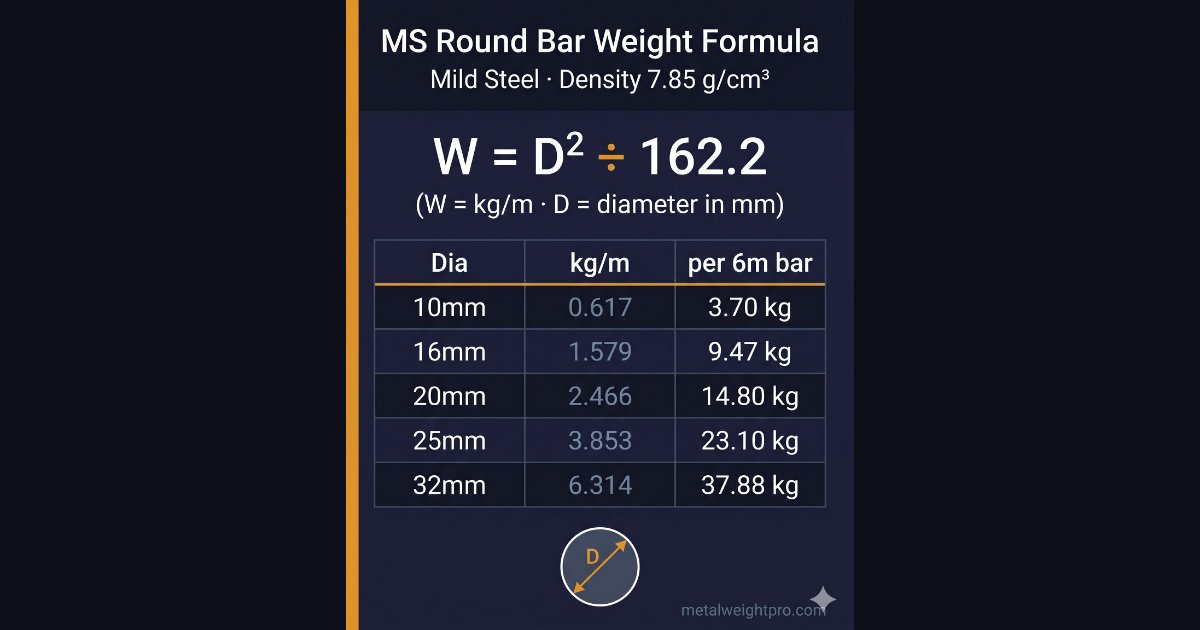
MS round bar weight per metre is calculated using the formula W = D² ÷ 162.2, where D is the bar diameter in millimetres and W is the weight in kilograms per metre. A 20mm diameter bar weighs 2.47 kg/m; a 25mm bar weighs 3.85 kg/m; a 32mm bar weighs 6.31 kg/m. The formula is exact — derived directly from the density of mild steel (7.85 g/cm³) — and applies to every IS 2062 E250 round bar regardless of length or supplier.
Key Facts
- Formula: W (kg/m) = D² ÷ 162.2 · D in mm
- Standard: IS 1732:1989 (dimensions) · IS 2062 E250 (material grade)
- Unit: kg per metre (kg/m)
- Density used: 7.85 g/cm³ for mild steel
The D² ÷ 162.2 Formula — Where It Comes From
The formula is not an industry rule-of-thumb — it falls directly out of the geometry of a cylinder and the fixed density of mild steel. Here is the full derivation so you can trust it and, if needed, adapt it for other metals.
For a 1-metre length of round bar with diameter D (in mm):
- Cross-sectional area in cm²: (π ÷ 4) × (D ÷ 10)² = 0.7854 × D² ÷ 100
- Volume for a 1-metre (100 cm) bar: 0.7854 × D² ÷ 100 × 100 = 0.7854 × D² cm³
- Weight in grams at ρ = 7.85 g/cm³: 0.7854 × D² × 7.85 = 6.162 × D² g
- Convert to kg (÷ 1000): W = D² × 0.006162 kg/m = D² ÷ 162.2 kg/m
The constant 162.2 is simply 1 ÷ 0.006162. It stays fixed for mild steel because IS 2062 E250 specifies a density of 7.85 g/cm³ by definition. If you are working with stainless steel (7.93 g/cm³) or aluminium (2.71 g/cm³), the constant changes — the formula structure stays the same but you substitute the correct density.
Worked Example — 25mm MS Round Bar, 6-Metre Length
Let us walk through a real calculation: a 25mm diameter MS round bar, standard 6-metre mill length, ordered in a bundle of 20 bars. This is a common requisition for fabricating machine guards and structural frames.
Given:
- Diameter (D): 25 mm
- Bar length: 6,000 mm (6 m)
- Quantity: 20 bars
Step 1 — Weight per metre:
W = D² ÷ 162.2 = 25² ÷ 162.2 = 625 ÷ 162.2 = 3.853 kg/m
Step 2 — Weight of one 6-metre bar:
3.853 × 6 = 23.12 kg per bar
Step 3 — Weight of the full bundle:
20 × 23.12 = 462.4 kg
Before loading this bundle onto a vehicle, verify the gross vehicle weight does not breach axle limits — a common check at dispatch gates. You can confirm this result instantly using the free Metal Weight Calculator →
MS Round Bar Weight Per Metre Chart — 8mm to 50mm
This table covers every standard nominal diameter from 8mm to 50mm as listed in IS 1732:1989. The "per 6m bar" column reflects the standard mill length supplied by SAIL and Tata Steel. Screenshot or bookmark this chart — fabricators share it on WhatsApp more than any other reference on the shop floor.
| Dia (mm) | D² | Weight (kg/m) | Weight per 6m bar (kg) |
|---|---|---|---|
| 8 | 64 | 0.395 | 2.37 |
| 10 | 100 | 0.617 | 3.70 |
| 12 | 144 | 0.888 | 5.33 |
| 16 | 256 | 1.579 | 9.47 |
| 20 | 400 | 2.466 | 14.80 |
| 25 | 625 | 3.853 | 23.12 |
| 28 | 784 | 4.834 | 29.00 |
| 32 | 1024 | 6.314 | 37.88 |
| 36 | 1296 | 7.990 | 47.94 |
| 40 | 1600 | 9.864 | 59.18 |
| 45 | 2025 | 12.485 | 74.91 |
| 50 | 2500 | 15.414 | 92.48 |
IS 1732:1989 — What the Standard Actually Covers
IS 1732:1989 (Hot Rolled Round and Hexagonal Bars for General Engineering Purposes — Dimensions) is the Bureau of Indian Standards specification that governs the nominal diameters, length tolerance, and straightness requirements for the type of bars this article covers. It defines diameters from 5mm up to 250mm in preferred nominal sizes — the 8mm–50mm range in the table above represents the sizes most commonly stocked in Indian fabrication yards.
The weight formula is independent of IS 1732 — it comes from basic physics. What IS 1732 matters for is dimensional tolerances: a bar labelled 25mm may have an actual diameter anywhere from 24.6mm to 25.4mm depending on the tolerance class. For weight estimation and purchase planning, using the nominal diameter in D² ÷ 162.2 is universally accepted practice and matches the published weight tables of both SAIL and Tata Steel to within ±1%.
The material standard is separate: IS 2062 E250 specifies the chemical composition, tensile strength, and yield strength for structural mild steel. It is IS 2062 that fixes the density at 7.85 g/cm³ and therefore the 162.2 constant. If you are specifying round bar for a structural application, your purchase order should reference both IS 1732 (dimensions) and IS 2062 E250 (material).
Three Practical Uses on the Workshop Floor
On any busy fabrication floor you will hear someone ask, "gol saria ka wajan kitna hoga?" — how much does this round bar weigh? The answer matters for three specific situations.
1. Transport weight check before dispatch. Most workshop trucks have a 5-tonne or 7-tonne axle limit. Before loading a mixed batch of MS round bars, sum the weights of each diameter and length using D² ÷ 162.2, add tare weight of the vehicle, and confirm the total is within the legal limit. This calculation takes two minutes with a phone calculator and saves a roadside inspection fine.
2. Bar scheduling and purchase planning. A structural frame design lists required cut lengths — say, forty pieces of 600mm at 25mm diameter and sixty pieces of 450mm at 20mm diameter. Calculate the total weight of each size (before kerf losses), then add 5–8% for cutting waste. Your purchase order quantity in kg is now accurate. Over-ordering by 20% ties up working capital; under-ordering halts production.
3. Delivery reconciliation. When a truck arrives from a SAIL or Tata Steel stockist, the challan states the total weight. Before signing off, count the bars, spot-check three diameters against the chart above, and compare to the challan figure. A discrepancy of more than 2% warrants a reweigh. This check has recovered short-supply on more than one occasion in my experience — a bundle that looks right on the challan can still be short a bar or two.
Frequently Asked Questions
What is the formula for MS round bar weight per metre?
The formula is W = D² ÷ 162.2, where W is the weight in kilograms per metre and D is the diameter of the round bar in millimetres. For example, a 20mm diameter MS round bar weighs 400 ÷ 162.2 = 2.47 kg/m. The constant 162.2 is derived from the density of mild steel (7.85 g/cm³) and does not change for any IS 2062 E250 grade bar.
How do I calculate the weight of a 20mm round bar per metre?
Square the diameter: 20² = 400. Divide by 162.2: 400 ÷ 162.2 = 2.466 kg/m, rounded to 2.47 kg/m. For a standard 6-metre bar: 2.466 × 6 = 14.80 kg. For a bundle of 50 bars: 50 × 14.80 = 740 kg. This calculation applies to any mild steel round bar — SAIL, Tata Steel, or any IS 2062-compliant supplier.
Gol saria ka wajan kaise nikale?
Gol saria (MS round bar) ka wajan nikalne ke liye formula hai: W = D² ÷ 162.2. Yahan D bar ki diameter millimetres mein hai aur W result kg per meter mein aata hai. Example: 25mm gol saria ka wajan = 625 ÷ 162.2 = 3.85 kg/m. 6 meter lambi ek bar ka total wajan = 3.85 × 6 = 23.1 kg. Yahi formula SAIL aur Tata Steel ke weight charts mein bhi use hota hai.
Does the IS 2062 grade affect the weight per metre of an MS round bar?
No. IS 2062 grade (E250, E350, E410) specifies the mechanical properties — yield strength, tensile strength, and elongation — not the density. All IS 2062 grades share the same density of 7.85 g/cm³, so the D² ÷ 162.2 formula gives the same weight per metre regardless of which grade you specify. Grade selection affects structural design and weld procedure, not weight estimation.
Save time on your next estimate — calculate exact bar weights in seconds.
Try the Free Metal Weight Calculator →