Hollow Section vs I-Beam Weight and Section Modulus Compared
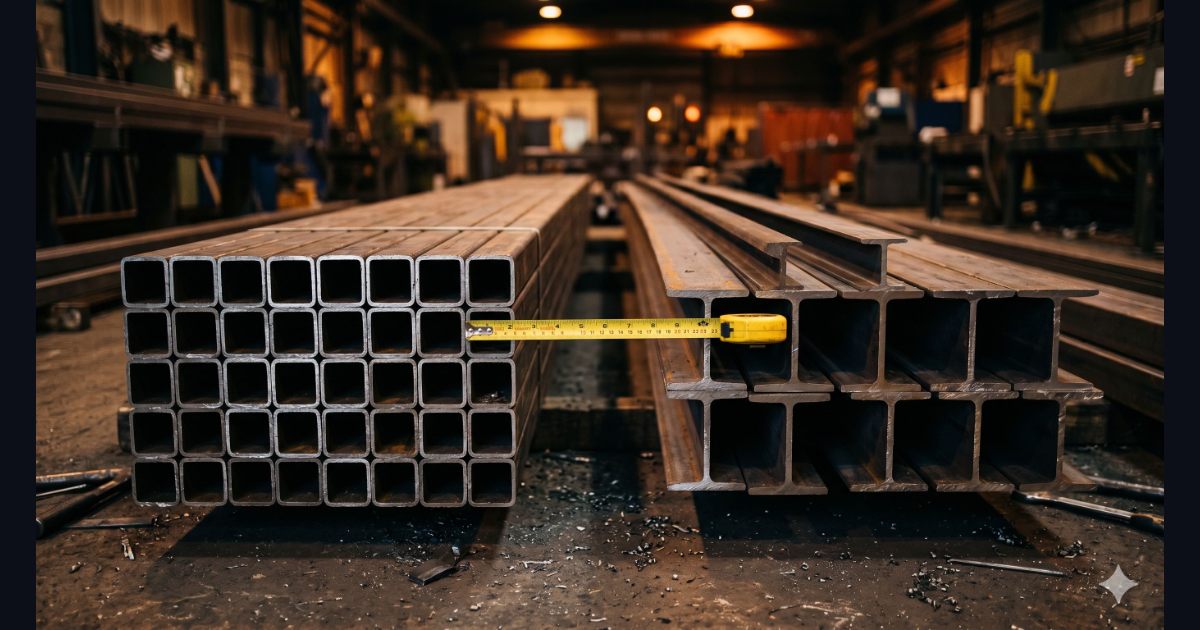
For columns, a square hollow section (SHS) is structurally more efficient than an ISMB of similar weight because its closed shape gives a higher radius of gyration in both axes — but for beams carrying bending loads, an ISMB of equal weight delivers more section modulus about the major axis.
- SHS 100×100×4 weighs 11.9 kg/m and has a radius of gyration of 39.0 mm in both axes — ISMB 100 weighs 8.9 kg/m but its weak-axis radius of gyration is only 14.6 mm.
- ISMB 200 at 25.4 kg/m gives a section modulus (Zx) of 223 cm³ — a comparable-weight RHS 150×100×5 at 18.7 kg/m gives only 103 cm³ about the major axis.
- IS:4923:1997 governs hollow sections; IS:808:1989 governs ISMB sections — both are available from Tata Steel and APL Apollo.
The hollow section vs I-beam weight comparison comes up constantly in fabrication — whenever a designer or contractor asks "which is better, SHS or I-beam?" the honest answer is: it depends entirely on whether the member is a column or a beam. Hollow sections win on columns. I-beams win on beams. The table below gives the numbers that make this concrete, using nearest-equivalent pairs from IS:4923:1997 and IS:808:1989.
The Core Structural Difference — Columns vs Beams
A column resists axial (compressive) loads. Its critical failure mode is buckling, and buckling resistance is governed by the radius of gyration (r) — the higher the radius of gyration, the more buckling-resistant the section for a given weight. Because an SHS distributes material equally in all directions from the centroid, it has the same radius of gyration about both axes. An I-beam has a high radius of gyration about its strong axis but a low one about its weak axis — which is why unbraced I-beam columns buckle sideways.
A beam resists bending loads. Its critical measure is the section modulus (Z) — the higher the section modulus, the more bending moment the section can carry before yielding. I-beams concentrate material at the top and bottom flanges, far from the neutral axis, which maximises section modulus per kilogram of steel. For example, a standard ISMB 250 at 37.3 kg/m or ISMB 300 at 46.1 kg/m provides a much higher section modulus than a similar-weight hollow section. Hollow sections spread material uniformly and cannot match this efficiency for pure bending.
This is why you see SHS columns and ISMB beams in the same mezzanine structure — each section is doing what it does best.
Key Section Properties — Formula Definitions
Radius of gyration: r = √(I / A)
- I
- Second moment of area (moment of inertia), in cm⁴ — measures how far the cross-sectional area is distributed from the neutral axis.
- A
- Cross-sectional area, in cm² — directly proportional to weight per metre for a given steel grade.
- r
- Radius of gyration, in cm or mm — the key parameter for column buckling per IS:800:2007 (Limit State Method).
Section modulus: Z = I / y
- I
- Second moment of area about the bending axis, in cm⁴.
- y
- Distance from neutral axis to the extreme fibre, in cm — half the depth for symmetric sections.
- Z
- Elastic section modulus, in cm³ — the key parameter for beam bending capacity per IS:800:2007.
Hollow Section vs I-Beam — Side-by-Side Comparison Table
The table below pairs nearest-equivalent sections from IS:4923:1997 (SHS/RHS) and IS:808:1989 (ISMB) to show weight, section modulus, and radius of gyration side by side. Hollow section vs I-beam weight aur structural properties ek saath compare karein.
| Designation | Type | kg/m | Ix (cm⁴) | Zx (cm³) | rx (mm) | ry (mm) | Best Use |
|---|---|---|---|---|---|---|---|
| ISMB 100 | I-Beam | 8.9 | 257 | 51.5 | 41.6 | 14.6 | Beam |
| SHS 90×90×4 | SHS | 10.6 | 200 | 44.4 | 34.4 | 34.4 | Column |
| ISMB 150 | I-Beam | 14.9 | 726 | 96.9 | 62.0 | 21.4 | Beam |
| SHS 120×120×4 | SHS | 14.4 | 480 | 80.0 | 57.7 | 57.7 | Column |
| ISMB 200 | I-Beam | 25.4 | 2235 | 223 | 83.7 | 28.4 | Beam |
| RHS 150×100×5 | RHS | 18.7 | 776 | 103 | 64.4 | 46.0 | Beam/Col |
| SHS 150×150×5 | SHS | 22.3 | 1120 | 149 | 70.8 | 70.8 | Column |
| ISMB 250 | I-Beam | 37.3 | 5132 | 411 | 104 | 35.1 | Beam |
ISMB properties per IS:808:1989. SHS/RHS properties per IS:4923:1997. rx = radius of gyration about strong axis; ry = about weak axis. Weights and properties from Tata Steel and APL Apollo published section tables. Verify against current mill certificates for structural design.
Worked Example — 3-Metre Column, SHS vs ISMB
A mezzanine structure requires internal columns at 3-metre height carrying an axial load of 150 kN. The designer is choosing between SHS 100×100×4 and ISMB 100. Here is the comparison:
Option A — SHS 100×100×4 (IS:4923:1997):
Weight = 11.9 kg/m → 3-metre column = 35.7 kg
ry = 39.0 mm (same in both axes — no weak direction)
Slenderness ratio (KL/r) at 3 m = (1.0 × 3000) / 39.0 = 76.9
This falls well within the IS:800:2007 limit of 180 for compression members.
Option B — ISMB 100 (IS:808:1989):
Weight = 8.9 kg/m → 3-metre column = 26.7 kg
ry (weak axis) = 14.6 mm — this is the governing direction for buckling
Slenderness ratio (KL/r) at 3 m = (1.0 × 3000) / 14.6 = 205.5
This exceeds the IS:800:2007 limit of 180. The ISMB 100 fails the slenderness check as an unbraced column at 3 metres.
Conclusion: The ISMB 100 is 25% lighter and therefore cheaper in material cost, but it cannot be used as a 3-metre unbraced column without lateral bracing at mid-height. The SHS 100×100×4 — though heavier at 11.9 kg/m vs 8.9 kg/m — passes the slenderness check in both axes with no bracing required. For columns, hollow section aur I-beam ka weight difference se zyada radius of gyration matter karta hai.
To get the weight of any hollow section or I-beam section instantly, use our free Metal Weight Calculator. For a full SHS and RHS weight reference, see our Hollow Section Weight Calculator article.
Quick Selection Guide — Column or Beam?
Use this as a practical rule of thumb on site or in a fabrication quote:
Choose SHS or RHS (hollow section) when: The member is primarily a column carrying axial compression; the member is exposed and appearance matters (hollow sections paint and finish better); the member needs to resist loads from multiple directions; or the span is short and torsional stiffness is required.
Choose ISMB (I-beam) when: The member is primarily a beam carrying bending loads over a long span; the member sits on brackets and the web can carry shear efficiently; weight and material cost per unit of bending strength is the primary constraint; or the section will be encased in concrete or hidden behind cladding.
In practice, most mezzanine structures use SHS 100×100×4 or SHS 120×120×5 for columns and ISMB 200 or ISMB 250 for primary beams — a combination that gives good structural efficiency at a competitive fabricated cost.
Frequently Asked Questions
Is hollow section stronger than I-beam?
It depends on the load type. For column (axial compression) applications, a square hollow section (SHS) is stronger than an I-beam of similar weight because its closed shape gives equal buckling resistance in all directions. For beam (bending) applications, an ISMB I-beam is stronger per kilogram because its flanges are positioned far from the neutral axis, maximising section modulus. Neither section type is universally stronger — the answer depends on whether the member is a column or a beam.
Which is cheaper — hollow section or I-beam for the same strength?
For beam applications, ISMB I-beams are cheaper because they deliver more bending strength per kilogram of steel. For column applications, SHS hollow sections are more cost-effective because they eliminate the need for lateral bracing — the bracing cost often exceeds the extra material cost of the heavier hollow section. At current Indian mill prices of approximately ₹55–65/kg for both section types, the structural efficiency difference is the deciding factor, not the per-kg price.
Hollow section aur I-beam ka weight comparison kaise karein?
Hollow section aur I-beam ka weight compare karne ke liye dono sections ke kg/m values IS:4923:1997 (hollow sections) aur IS:808:1989 (ISMB) se lein. Is article ke upar diye gaye comparison table mein nearest-equivalent pairs already listed hain. For example, SHS 120×120×4 at 14.4 kg/m aur ISMB 150 at 14.9 kg/m approximately same weight ke hain — lekin column mein SHS behtar hai aur beam mein ISMB.
What is the section modulus of SHS 100×100×4?
SHS 100×100×4 per IS:4923:1997 has an elastic section modulus (Zx) of approximately 55.4 cm³ about both axes, a second moment of area (Ix = Iy) of approximately 277 cm⁴, and a radius of gyration of 39.0 mm in both axes. Its weight is 11.9 kg/m. For comparison, ISMB 100 has a section modulus (Zx) of 51.5 cm³ but a weak-axis section modulus of only 8.04 cm³.
Get the exact weight per metre for any SHS, RHS or ISMB section in seconds — all IS:4923 and IS:808 sizes are pre-loaded.
Try the Free Metal Weight Calculator →