Stainless Steel Weight Calculator: SS 304, 316, 202 Density Values
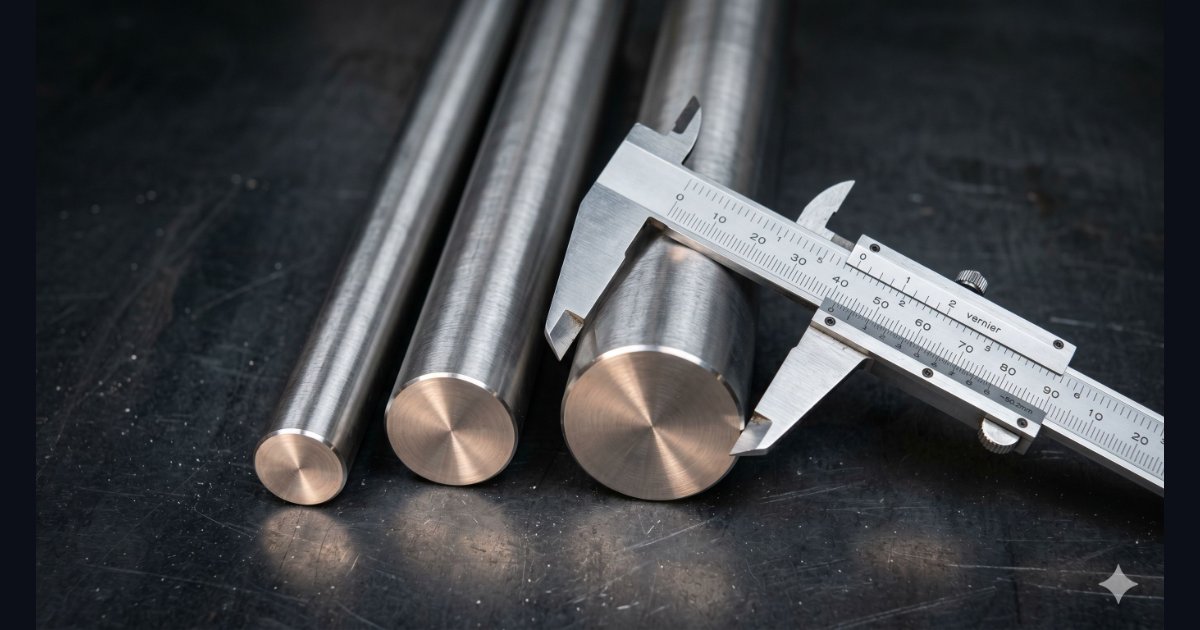
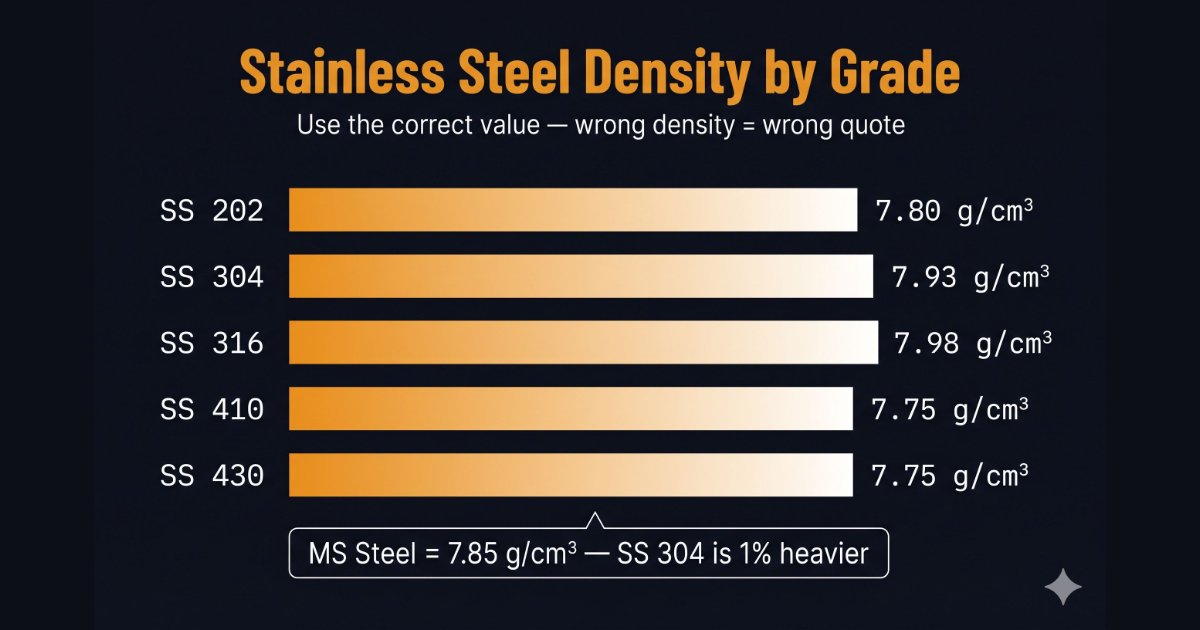
A stainless steel weight calculator must use the correct density for the grade — SS 304 and SS 316 are 7.93–7.98 g/cm³, while SS 202 and SS 430 are closer to 7.75–7.80 g/cm³, meaning the same bar cross-section gives a different weight depending on grade.
- SS 304 density: 7.93 g/cm³ — the most common austenitic grade in Indian fabrication
- Using mild steel density (7.85) for SS 304 underestimates weight by about 1% — small but it adds up on large orders
- SS 202 is 1.7% lighter than SS 304 for the same cross-section — relevant when substituting grades
Why SS Density Varies by Grade
When I first started working with stainless steel, I made the mistake of using 7.85 g/cm³ — the mild steel density — for all my weight estimates. For a 50 kg job that error is negligible. On a 2-tonne kitchen equipment fabrication order, it means your material cost is off by 20 kg before you've even placed a purchase order.
The density difference comes from the alloying elements. Chromium (10.5–26% depending on grade) and nickel (up to 22% in SS 316L) both have higher atomic masses than iron. That pushes the density of austenitic grades above 7.85. Ferritic grades like SS 430 contain less nickel, which brings their density back down closer to 7.75.
IS 6603:2001 (Stainless Steel Bars and Flats) and IS 6911:1992 (Stainless Steel Plates, Sheets and Strips) are the relevant BIS standards for material supplied in India. Jindal Stainless — India's largest stainless steel producer — follows these standards for their domestic product range.
SS Grade Density Comparison Table
Use this table to choose the correct density before you run any stainless steel weight calculation. The stainless steel ka wajan directly depends on which grade you're working with.
| Grade | Type | Density (g/cm³) | Typical Indian Application |
|---|---|---|---|
| SS 202 | Austenitic | 7.80 | Kitchen utensils, decorative sections |
| SS 304 | Austenitic | 7.93 | Food processing, pharma, handrails |
| SS 316 | Austenitic | 7.98 | Coastal structures, chemical equipment |
| SS 410 | Martensitic | 7.75 | Cutlery, pump shafts, valves |
| SS 430 | Ferritic | 7.75 | Automotive trim, home appliances |
Weight Formulas for Stainless Steel Sections
The weight formula structure is the same as for mild steel — volume multiplied by density. The only change is the density value you plug in.
Round bar:
Weight (kg) = (D² ÷ 162) × (ρ ÷ 7.85) × L_metres
Where D is diameter in mm, ρ is the grade density in g/cm³, and L is length in metres. The factor (ρ ÷ 7.85) adjusts the standard steel formula for the actual grade density.
Flat bar / plate:
Weight (kg) = W × T × L × ρ ÷ 1,000,000
Where W is width in mm, T is thickness in mm, L is length in mm, and ρ is density in g/cm³.
Round pipe / tube:
Weight (kg/m) = (OD − WT) × WT × 0.0246615 × (ρ ÷ 7.85)
Where OD is outer diameter in mm and WT is wall thickness in mm. For SS 304, the correction factor is 7.93 ÷ 7.85 = 1.0102 — just over 1% heavier than the same MS pipe size.
Worked Examples
Example 1: SS 304 round bar, 25mm diameter, 3000mm length
Weight = (25² ÷ 162) × (7.93 ÷ 7.85) × 3.0
= (625 ÷ 162) × 1.0102 × 3.0
= 3.858 × 1.0102 × 3.0
= 11.69 kg
The same bar in mild steel would weigh 11.57 kg — a difference of 0.12 kg per piece. Across 500 pieces, that's 60 kg unaccounted for.
Example 2: SS 316 seamless pipe, OD 60.3mm, WT 3.65mm, length 6000mm
Weight/m = (60.3 − 3.65) × 3.65 × 0.0246615 × (7.98 ÷ 7.85)
= 56.65 × 3.65 × 0.0246615 × 1.01656
= 5.24 kg/m → total for 6m = 31.42 kg
You can verify this — and calculate weights for any section type or material — using our free Metal Weight Calculator.
Jindal Stainless Grade Availability and IS 6603
Most stainless steel bar and flat stock in India is produced to IS 6603:2001. Jindal Stainless supplies SS 202, SS 304, SS 304L, SS 316, and SS 316L in round bar, flat bar, hexagonal bar, and angle sections from their Hisar and Jajpur plants.
For plates and sheets, the reference standard is IS 6911:1992. If your supplier's test certificate quotes ASTM A276 (bar) or ASTM A240 (sheet), the density values above still apply — ASTM and IS grades share the same chemistry specifications for these common austenitic grades.
One practical note: SS 202 is often sold as a cheaper substitute for SS 304 in Indian markets. The density is 7.80 vs 7.93 — a 1.7% difference in weight. More importantly, SS 202 has lower nickel content and significantly lower corrosion resistance. Don't confuse a lower weight estimate with a comparable material.
Using Our Calculator for Stainless Steel
Our Metal Weight Calculator includes stainless steel as a material option with a density of 7.93 g/cm³ — correct for SS 304 and close enough for SS 316 (0.6% error). If you are working with SS 202 or ferritic grades, use the flat bar formula manually with 7.80 or 7.75 g/cm³ respectively.
For pipe weights, also see our article on MS pipe weight per metre (IS 1239) — the pipe weight formula is the same structure; only the density changes.
Frequently Asked Questions
What density should I use for stainless steel weight calculations?
Use 7.93 g/cm³ for SS 304 and SS 304L, 7.98 g/cm³ for SS 316 and SS 316L, 7.80 g/cm³ for SS 202, and 7.75 g/cm³ for SS 410 and SS 430. Do not use the mild steel density of 7.85 g/cm³ for stainless steel — it will underestimate weight for austenitic grades and overestimate for ferritic grades.
Stainless steel ka wajan mild steel se zyada kyun hota hai?
SS 304 aur SS 316 mein chromium aur nickel hota hai, jo iron se zyada dense hain. Isliye inki density 7.93–7.98 g/cm³ hoti hai — mild steel ki 7.85 g/cm³ se thodi zyada. Iska matlab hai ki same size ka SS 304 round bar, MS round bar se approximately 1% bhaari hota hai. SS 202 ki density 7.80 hai isliye woh MS se thoda halka hota hai.
Is SS 202 lighter than SS 304?
Yes. SS 202 has a density of 7.80 g/cm³ versus 7.93 g/cm³ for SS 304 — making SS 202 approximately 1.7% lighter for the same cross-section and length. For example, a 25mm diameter SS 202 round bar in 6000mm length weighs 18.14 kg, while the same bar in SS 304 weighs 18.46 kg. However, SS 202 has significantly lower corrosion resistance than SS 304, so the weight saving should not be the primary reason for grade selection.
How do I calculate the weight of a stainless steel sheet?
Use the formula: Weight (kg) = Length (mm) × Width (mm) × Thickness (mm) × Density (g/cm³) ÷ 1,000,000. For a SS 304 sheet of 2000mm × 1000mm × 2mm: Weight = 2000 × 1000 × 2 × 7.93 ÷ 1,000,000 = 31.72 kg. For SS 316, substitute 7.98 in place of 7.93.
Calculate the exact weight for any stainless steel section — round bar, flat bar, pipe, or sheet — in seconds.
Try the Free Metal Weight Calculator →