Fish Mouth Cut Pipe Formula — Layout, Template and Worked Example

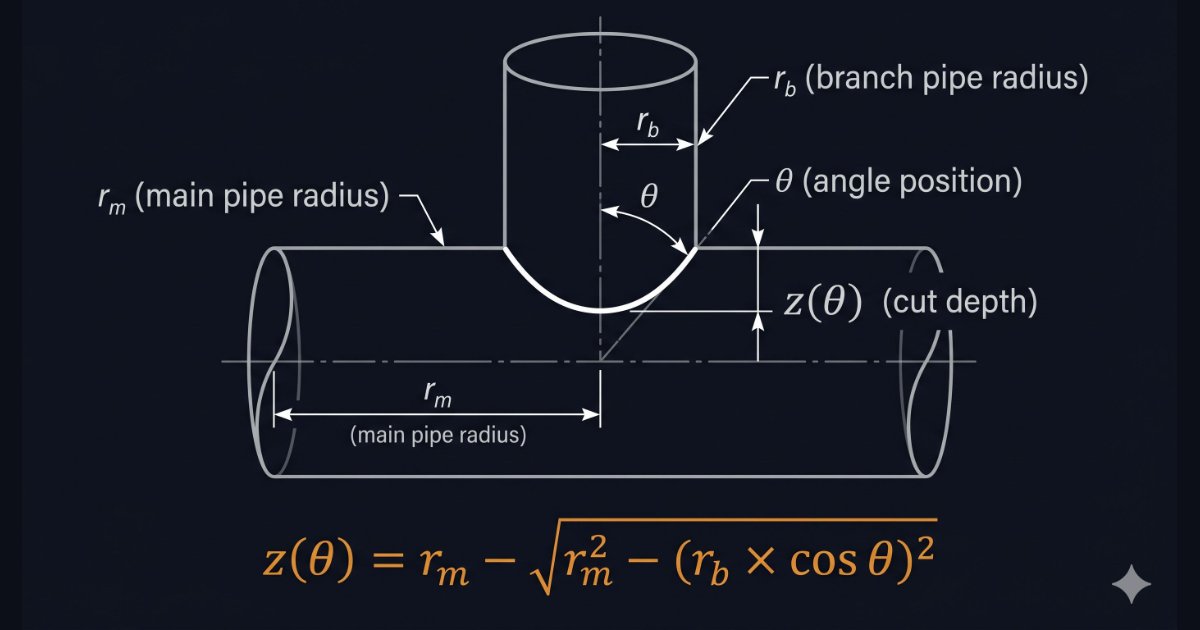
The fish mouth cut formula is z(θ) = r_m / sin α − √(r_m² − (r_b × cos θ × sin α)²) / sin α — for a 90° T-joint this simplifies to z(θ) = r_m − √(r_m² − (r_b × cos θ)²).
- For 40 NB branch (OD = 48.3 mm) onto 100 NB main (OD = 114.3 mm) at 90°, maximum saddle depth at θ = 0° is approximately 5.35 mm.
- At θ = 90° and 270° (the pipe sides), z = 0 for all cases — no material is removed at the neutral axis.
- Fish mouth cut ka formula aur template — dono IS:1239 OD values use karke calculate hote hain, NB size se nahi.
The fish mouth cut pipe formula gives the depth of material to remove at each point around a branch pipe's circumference so the cut end sits flush against the curved surface of a larger main pipe. It is the mathematical foundation behind every saddle cut template — whether marked by hand or generated by a notching calculator. This article derives the formula, explains every variable, and works through a real example using IS:1239 pipe OD values.
What Is a Fish Mouth Cut and When Is It Used?
A fish mouth cut — also called a saddle cut or cope cut — is the curved profile cut at the end of a branch pipe where it meets a larger main pipe at an angle. The cut allows the branch pipe end to nest snugly against the curved outer surface of the main pipe, producing a tight joint that requires minimal filler weld and eliminates gaps that cause weld defects. It is standard in handrail fabrication, pipe rack construction, structural tube framing, and process piping across India.
Fish mouth cut ka formula aur template banane ki zaroorat tab padti hai jab branch pipe ka OD main pipe ke OD se chhota ho. The same mathematics applies at any intersection angle — 90°, 45°, or any value — through the sin α term in the full formula.
The Fish Mouth Cut Formula — Variables and Derivation
Full formula (any intersection angle):
z(θ) = r_m / sin α − √(r_m² − (r_b × cos θ × sin α)²) / sin α
Simplified formula (90° T-joint only, sin α = 1):
z(θ) = r_m − √(r_m² − (r_b × cos θ)²)
- z(θ)
- Cut depth at angular position θ, in millimetres — material to remove from the branch pipe end at that point. Maximum at θ = 0° (crown) and θ = 180° (saddle). Zero at θ = 90° and 270° (the neutral axis sides).
- r_m
- Radius of the main pipe = OD_main ÷ 2, in millimetres. Always use IS:1239 OD values, not NB sizes.
- r_b
- Radius of the branch pipe = OD_branch ÷ 2, in millimetres.
- α
- Intersection angle between branch and main pipe axes, in degrees. For a right-angle T-joint α = 90°, sin α = 1.
- θ
- Angular position around the branch pipe circumference, 0° at the crown, sweeping to 360°. Calculate at 0°, 30°, 60°, 90°, 120°, 150°, 180° — the second half (180°–360°) mirrors the first.
Cut-Mark Depth Table — Common IS:1239 Branch Sizes onto 100 NB Main at 90°
The table below pre-calculates saddle cut depths at four key angular positions for common branch NB sizes joining a 100 NB main pipe (OD = 114.3 mm) at 90°. Use these values to mark a paper wrap-around template directly on the pipe.
| Branch NB | Branch OD (mm) | z at 0° (mm) | z at 30° (mm) | z at 60° (mm) | z at 90° (mm) | Max depth (mm) |
|---|---|---|---|---|---|---|
| 15 NB | 21.3 | 0.50 | 0.43 | 0.25 | 0.00 | 0.50 |
| 20 NB | 26.9 | 0.80 | 0.69 | 0.40 | 0.00 | 0.80 |
| 25 NB | 33.7 | 1.25 | 1.08 | 0.63 | 0.00 | 1.25 |
| 32 NB | 42.4 | 2.00 | 1.73 | 1.00 | 0.00 | 2.00 |
| 40 NB | 48.3 | 5.35 | 3.97 | 1.29 | 0.00 | 5.35 |
| 50 NB | 60.3 | 8.54 | 6.34 | 2.07 | 0.00 | 8.54 |
| 65 NB | 76.1 | 14.1 | 10.4 | 3.37 | 0.00 | 14.1 |
| 80 NB | 88.9 | 19.6 | 14.5 | 4.67 | 0.00 | 19.6 |
Main pipe: 100 NB, OD = 114.3 mm. Intersection angle: 90°. OD values per IS:1239 (Part 1):2004. Calculated using z(θ) = r_m − √(r_m² − (r_b × cos θ)²). For angles other than 90° or for a full 360° printable template, use our free Pipe Notching Calculator.
Worked Example — 40 NB Branch onto 100 NB Main at 90°
A handrail frame requires a 40 NB Medium Class MS branch pipe to meet a 100 NB Medium Class MS main pipe at 90°. The fabricator needs to mark the saddle cut on the branch pipe end before cutting with an angle grinder.
Inputs from IS:1239 (Part 1):2004:
Main: 100 NB → OD = 114.3 mm → r_m = 57.15 mm
Branch: 40 NB → OD = 48.3 mm → r_b = 24.15 mm
α = 90° → use simplified formula: z(θ) = r_m − √(r_m² − (r_b × cos θ)²)
Calculation at 6 positions:
θ = 0°: z = 57.15 − √(3266.1 − 583.2) = 57.15 − 51.80 = 5.35 mm
θ = 30°: z = 57.15 − √(3266.1 − 437.2) = 57.15 − 53.18 = 3.97 mm
θ = 60°: z = 57.15 − √(3266.1 − 145.8) = 57.15 − 55.86 = 1.29 mm
θ = 90°: z = 57.15 − √(3266.1 − 0) = 57.15 − 57.15 = 0.00 mm
θ = 120°: mirror of 60° = 1.29 mm
θ = 150°: mirror of 30° = 3.97 mm
θ = 180°: mirror of 0° = 5.35 mm
Marking the template: Wrap a paper strip around the 40 NB branch pipe end. The full circumference = π × 48.3 = 151.7 mm. Divide into 6 equal arcs of 25.3 mm. At each division, measure the z value from the pipe end and mark the point. Connect all points with a smooth curve. Cut along this line with a grinder or plasma cutter. The maximum cut depth is 5.35 mm at the crown and saddle points.
For a full SVG template generated automatically for any pipe size and angle from 15° to 90°, use our Pipe Notching / Saddle Cut Calculator. For the broader theory of saddle joints in fabrication, see our Pipe Notching and Saddle Cuts guide.
Frequently Asked Questions
What is a fish mouth cut on a pipe?
A fish mouth cut — also called a saddle cut or cope cut — is the curved profile cut at the end of a branch pipe where it intersects a larger main pipe. The cut removes material in a curved shape so the branch pipe end fits snugly against the curved outer surface of the main pipe. The resulting joint has minimal gap and requires less weld filler. It is standard in handrail fabrication, pipe racks, and structural tube framing.
How do you calculate a fish mouth pipe cut?
Use the saddle cut formula: for a 90° joint, z(θ) = r_m − √(r_m² − (r_b × cos θ)²). Calculate z at θ = 0°, 30°, 60°, 90°, 120°, 150°, and 180° using IS:1239 OD values for both pipes (r_m = OD_main ÷ 2, r_b = OD_branch ÷ 2). Plot these depths on a paper wrap-around template to produce the cut line. For other angles, use the full formula with sin α.
Fish mouth cut ka formula kya hota hai?
Fish mouth cut ka formula hai: z(θ) = r_m − √(r_m² − (r_b × cos θ)²) — yeh 90° intersection ke liye simplified version hai. Yahaan r_m main pipe ka radius (OD ÷ 2) hai, r_b branch pipe ka radius hai, aur θ branch pipe ke circumference par angle hai. IS:1239 table se OD values leke har θ par z calculate karein aur paper template par mark karein.
What is the formula for pipe saddle cut?
The pipe saddle cut formula at any angle α is: z(θ) = r_m / sin α − √(r_m² − (r_b × cos θ × sin α)²) / sin α. At 90°, sin α = 1 and the formula simplifies to z(θ) = r_m − √(r_m² − (r_b × cos θ)²). Maximum saddle depth occurs at θ = 0° and 180°. At θ = 90° and 270°, z = 0 — no material is removed at the neutral axis points.
Generate a complete printable saddle cut template for any pipe size and intersection angle — no manual calculation needed.
Open Pipe Notching Calculator →