GI Pipe Weight Chart: IS 1239 Galvanised Pipe All Sizes
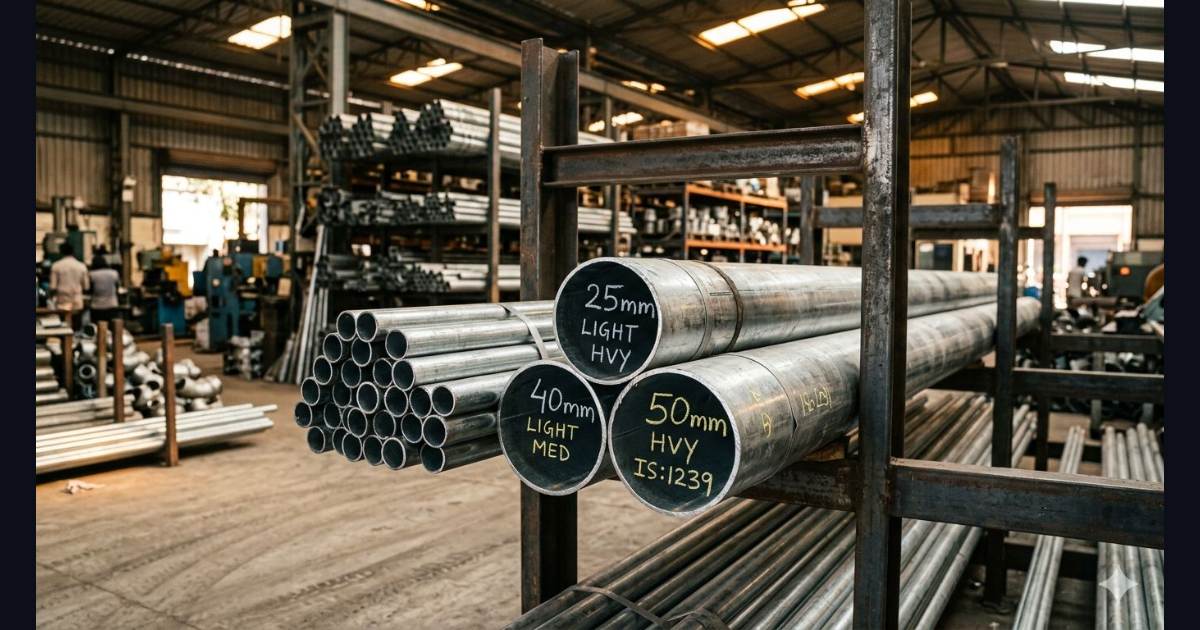
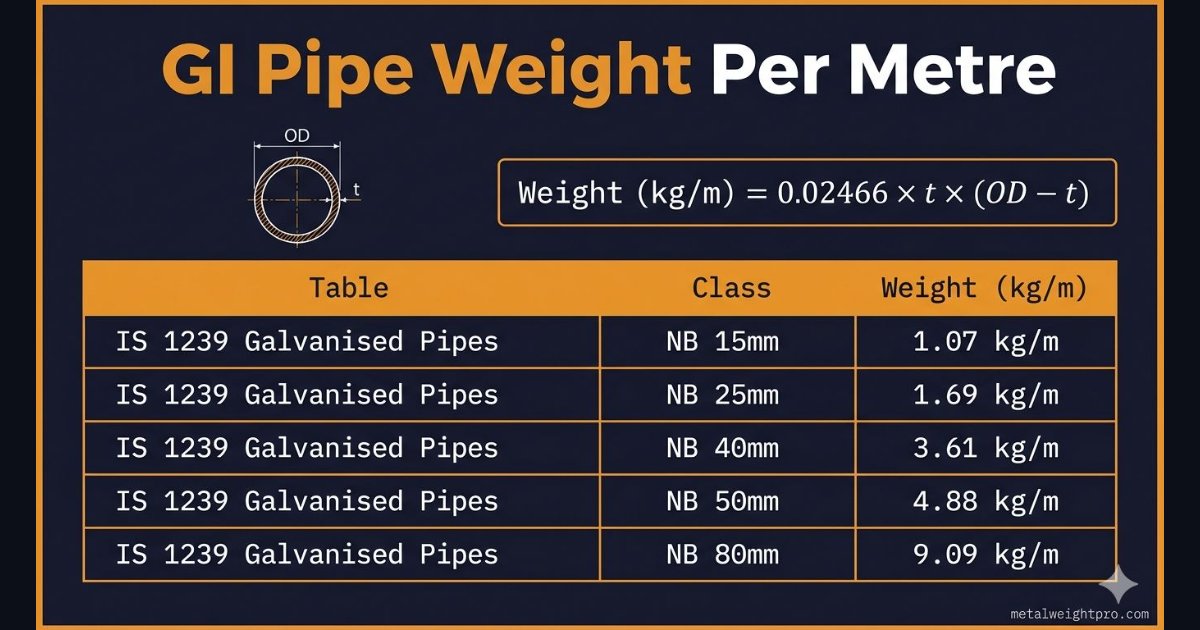
The GI pipe weight chart for IS 1239 covers nominal bore sizes from 15mm to 100mm across three wall-thickness classes — light, medium and heavy — with weights ranging from 0.80 kg/m up to 14.21 kg/m. Every value in this chart is calculated from the same formula used for MS pipe: Weight (kg/m) = 0.02466 × t × (OD − t), where OD is the outer diameter and t is the wall thickness, both in millimetres.
Key Facts
- Formula: Weight (kg/m) = 0.02466 × t × (OD − t)
- Standard: IS 1239 Part 1 — Light, Medium and Heavy class
- Galvanising standard: IS 4736 (zinc coating weight)
- Weight vs MS pipe: GI is <0.5% heavier — treated as equal in practice
- Sizes covered: 15mm NB to 100mm NB
What Is GI Pipe and Why Does the Weight Matter
GI pipe — galvanised iron pipe — is a mild steel tube that has been hot-dip galvanised to provide corrosion resistance. The base pipe is identical to a standard MS pipe under IS 1239; the difference is the zinc coating applied after manufacture. This coating, typically between 45 and 85 grams per square metre of pipe surface as specified in IS 4736, adds a negligible amount to the total weight per metre.
You need the correct weight per metre for three practical reasons. First, freight — GI pipes are priced and transported by weight, and over-ordering by even 5% on a large plumbing project means paying for dead stock. Second, structural support — any GI pipe run through a building needs to be suspended from hangers rated for the filled-pipe load, which requires knowing the pipe's own weight plus the weight of the water inside. Third, procurement — supply invoices from distributors like APL Apollo and Jindal Pipes list total tonnage, not piece count, so you need to convert your cut list into kilograms.
GI Pipe Weight Formula Under IS 1239
IS 1239 Part 1 uses the standard hollow circular section formula derived from steel's density of 7.85 g/cm³:
Weight (kg/m) = 0.02466 × t × (OD − t)
The constant 0.02466 combines the density of steel (7.85 g/cm³) and the unit conversion factor. OD is the outer diameter in millimetres, and t is the wall thickness in millimetres. For a given nominal bore, IS 1239 specifies a fixed OD — the wall thickness varies between the three classes. This is an important distinction: the OD stays constant across all three classes for any given NB size. Only the wall thickness changes.
For galvanised pipe, the zinc coating contributes a theoretical extra weight. On a 40mm NB pipe, the coating area per metre is roughly 0.152 m², and at 60 g/m² of zinc this adds about 9 grams per metre — well under 0.3% of the pipe's weight. For all practical engineering purposes, GI pipe weight per metre equals MS pipe weight per metre of the same class.
Worked Example: 40mm NB Medium Class GI Pipe
On most Indian sites, *GI nali ka wajan kitna hoga* — how much does one metre of GI pipe weigh — is a daily question for store managers and site engineers. Here is the full calculation for a 40mm nominal bore medium class GI pipe, one of the most common sizes in building plumbing.
Given:
- Nominal bore: 40mm
- Class: Medium
- OD (from IS 1239 table): 48.3mm
- Wall thickness (t): 3.25mm
Step 1 — Apply the formula:
Weight = 0.02466 × t × (OD − t)
Step 2 — Substitute values:
Weight = 0.02466 × 3.25 × (48.3 − 3.25)
Weight = 0.02466 × 3.25 × 45.05
Weight = 0.08015 × 45.05
Weight = 3.61 kg/m
Step 3 — Cross-check: A 6-metre length of this pipe weighs 3.61 × 6 = 21.66 kg. A bundle of 18 pieces (108 metres) would weigh approximately 390 kg — close to a standard half-tonne transit load.
You can verify this instantly using the free Metal Weight Calculator → — select Pipe, enter OD 48.3mm and wall thickness 3.25mm, set length to 1000mm, and the result will match.
Complete GI Pipe Weight Chart — IS 1239 Part 1
The table below covers nominal bore sizes from 15mm to 100mm. All OD values and wall thicknesses are per IS 1239 Part 1. Weights are in kilograms per metre (kg/m), calculated using the formula above. APL Apollo and Jindal Pipes manufacture GI pipes to these exact specifications with BIS mark certification.
| NB (mm) | OD (mm) | Light WT (mm) | Light (kg/m) | Medium WT (mm) | Medium (kg/m) | Heavy WT (mm) | Heavy (kg/m) |
|---|---|---|---|---|---|---|---|
| 15 | 21.3 | 2.00 | 0.80 | 2.65 | 1.07 | 3.25 | 1.22 |
| 20 | 26.9 | 2.35 | 1.15 | 2.65 | 1.30 | 3.25 | 1.56 |
| 25 | 33.7 | 2.65 | 1.69 | 3.25 | 2.00 | 4.05 | 2.41 |
| 32 | 42.4 | 2.65 | 2.17 | 3.25 | 2.59 | 4.05 | 3.14 |
| 40 | 48.3 | 2.65 | 2.50 | 3.25 | 3.61 | 4.05 | 4.37 |
| 50 | 60.3 | 2.90 | 4.11 | 3.65 | 4.88 | 4.50 | 6.07 |
| 65 | 76.1 | 3.25 | 5.71 | 3.65 | 6.42 | 4.50 | 7.83 |
| 80 | 88.9 | 3.25 | 6.72 | 4.05 | 8.36 | 4.85 | 9.90 |
| 100 | 114.3 | 3.65 | 9.75 | 4.50 | 11.97 | 5.40 | 14.21 |
| 125 | 139.7 | 4.05 | 13.30 | 4.85 | 15.82 | 5.40 | 17.52 |
| 150 | 165.1 | 4.05 | 15.82 | 4.85 | 18.84 | 5.40 | 20.87 |
Note: Light class is used for low-pressure water supply. Medium class is the most common for general plumbing. Heavy class is used for high-pressure and gas applications. All values assume steel density of 7.85 g/cm³; zinc coating weight is excluded as per standard engineering practice.
APL Apollo and Jindal GI Pipe — Brand-Specific Notes
APL Apollo Tubes manufactures GI pipes under IS 1239 with BIS certification. Their medium class pipes are the dominant choice for building plumbing in India — the 25mm and 40mm NB sizes account for the majority of residential construction pipe requirements. APL Apollo's GI pipe specifications match the IS 1239 Part 1 dimensions exactly; the only difference from the standard table values is in the zinc coating grade, which APL Apollo supplies at a minimum of 60 g/m² (meeting IS 4736 Class A requirements).
Jindal Pipes — a division of the Jindal Group — is the other major IS 1239 GI pipe manufacturer in India. Their heavy class GI pipes are commonly specified for natural gas distribution and fire-fighting ring mains, where the higher wall thickness provides both pressure rating and mechanical protection. For procurement purposes, the weight values in the table above apply to both brands without adjustment — the IS 1239 dimensions are fixed by the standard, not by the manufacturer.
For a cutting and procurement plan on your next GI pipe job, use the free Pipe Cut List Optimizer → — enter your stock length, cut list and quantity, and it will calculate total pipe required, cutting plan and waste percentage in seconds.
How to Use This Chart in Practice
The most common practical application is freight and transport estimation. If you are ordering 500 metres of 50mm NB medium class GI pipe for a project, multiply 500 by 4.88 kg/m = 2,440 kg or approximately 2.44 tonnes. This tells you whether you need a full truck or a part-load arrangement.
The second application is hanger spacing. A water-filled 50mm NB medium pipe contains approximately 1.5 kg/m of water plus 4.88 kg/m of pipe = 6.38 kg/m total. At a hanger spacing of 1.8 metres, each hanger carries 6.38 × 1.8 = 11.5 kg. This figure directly determines the hanger bracket rating you need to specify.
For a detailed breakdown of how the IS 1239 formula works and how the three pipe classes are defined, see our article on MS pipe weight per metre → — the methodology is identical for GI pipe.
Frequently Asked Questions
What is the weight of 15mm GI pipe per metre?
A 15mm nominal bore GI pipe under IS 1239 weighs 0.80 kg/m (light class), 1.07 kg/m (medium class) or 1.22 kg/m (heavy class). These values are for the pipe itself including the zinc coating but excluding fittings and threads. The outer diameter of a 15mm NB pipe is 21.3mm across all three classes — only the wall thickness changes between classes.
Is GI pipe heavier than MS pipe of the same size?
GI pipe is marginally heavier than an equivalent bare MS pipe because the hot-dip galvanising process adds a zinc coating that typically weighs between 45 and 85 grams per square metre of pipe surface as specified in IS 4736. On a 40mm NB medium class pipe, this adds roughly 9 grams per metre — less than 0.3% of the pipe weight of 3.61 kg/m. For all practical purposes — freight, structural calculations and quantity estimates — engineers treat GI and MS pipe weights as identical.
GI pipe ka weight kaise calculate karte hain?
GI nali ka wajan nikalne ke liye yeh formula use karo: Weight (kg/m) = 0.02466 × t × (OD − t). Yahan t wall thickness hai aur OD outer diameter hai, dono millimetres mein. For example, ek 40mm NB medium class GI pipe ka OD 48.3mm hai aur wall thickness 3.25mm hai, toh weight hoga: 0.02466 × 3.25 × (48.3 − 3.25) = 3.61 kg/m. Iske baad multiply karo pipe ki length se to total weight milega.
Which IS standard governs GI pipe sizes and weights in India?
Galvanised iron pipes for plumbing and general engineering in India are governed by IS 1239 Part 1, which specifies outer diameter, wall thickness and weight per metre for nominal bore sizes from 6mm to 150mm in light, medium and heavy classes. The zinc coating on GI pipes must additionally conform to IS 4736, which sets the minimum coating weight at 45 g/m² for Class B and 60 g/m² for Class A. BIS-certified GI pipes from APL Apollo and Jindal Pipes carry both markings.
Save time on your next GI pipe job — calculate exact weights and lengths in seconds.
Try the Free Metal Weight Calculator →