Pipe Bending Radius Chart — IS:1239 NB Sizes and Minimum Bend Radii
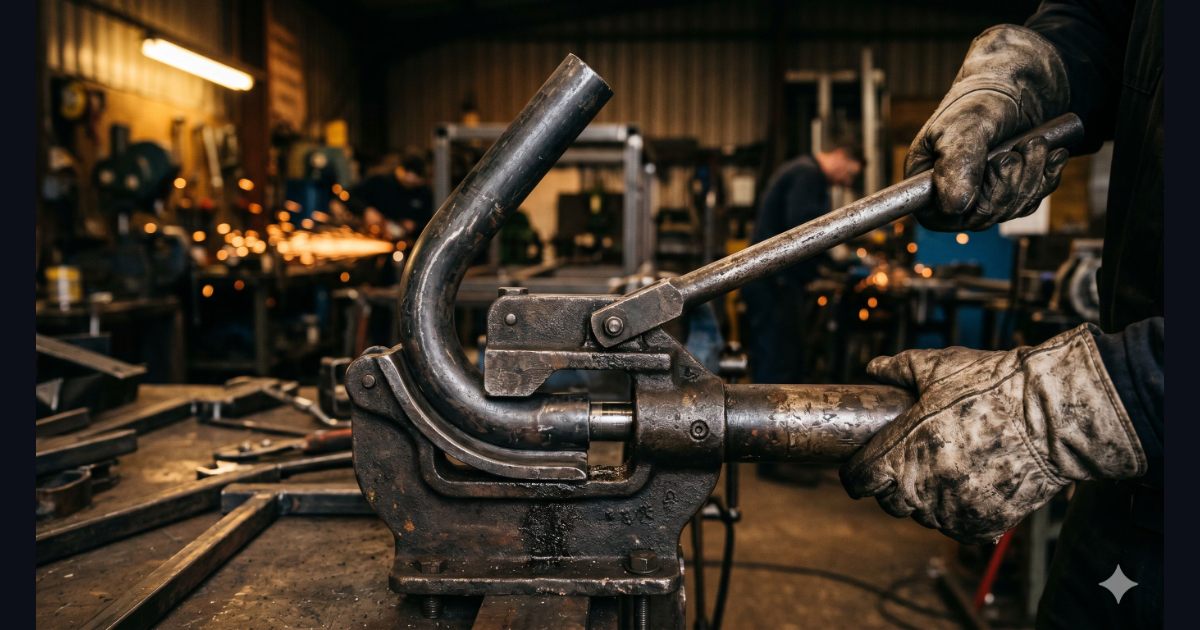
The minimum bending radius for MS pipe is expressed as a multiple of the pipe outside diameter — 3D for cold bending, 5D for hot bending, and 10D for tight mandrel bending — where D is the OD from IS:1239 (Part 1):2004.
- For 50 NB Medium Class pipe (OD = 60.3 mm), minimum cold bend radius = 3 × 60.3 = 180.9 mm ≈ 181 mm.
- A 90° cold bend on 50 NB pipe consumes π × 181 ÷ 2 = approximately 284 mm of pipe length — this must be allowed for when cutting blanks.
- Pipe bending radius kaise calculate karein — formula hai: R = n × OD, jahan n = 3 (cold), 5 (hot), ya 10 (mandrel bend).
The pipe bending radius chart gives the minimum radius at which an MS pipe can be bent without kinking, wall thinning beyond acceptable limits, or ovality distortion that would prevent pipe-end fitting. The radius is always expressed as a multiple of the pipe OD — the 3D, 5D, and 10D conventions — which automatically scales the limit to each pipe size. This page provides a complete IS:1239 NB-anchored chart and the arc length formula needed to cut accurate pipe blanks before bending.
The 3D, 5D and 10D Bending Radius Convention — What the Numbers Mean
The bending radius multiplier (n in R = n × OD) reflects the risk of pipe wall buckling and ovality distortion. A tighter bend (smaller n) puts more stress on the outer wall and more compression on the inner wall. Below the minimum radius, the pipe kinks or develops flat spots that reduce flow area and weaken the joint.
- 3D (Cold bend, no mandrel): The minimum radius achievable on a standard hydraulic pipe bender without internal mandrel support. The pipe wall may show slight ovality but remains within IS:1239 dimensional tolerances. Used for handrails, furniture frames, and non-pressure structural bends.
- 5D (Hot bend or induction bend): The standard for hot bending where the pipe is heated to 800–1000°C before bending. Also used as a conservative minimum for cold bending on pressure-bearing pipe systems. Produces less ovality than 3D cold bending.
- 10D (Mandrel bend, tight bend): The tightest bend achievable with a mandrel inserted inside the pipe to prevent collapse. Required for tight bends on thin-wall pipe or where zero ovality is specified. Common in automotive and precision structural work.
Bending Radius Formula and Arc Length Calculation
Minimum bending radius: R = n × OD
Arc length consumed by a bend:
Arc length = (θ / 360°) × 2π × R
For a 90° bend: Arc length = (90/360) × 2π × R = π × R / 2 = 1.5708 × R
- R
- Bending radius, in millimetres — measured to the pipe centreline (not the inner or outer surface).
- n
- Bending multiplier — 3 for cold bend, 5 for hot bend, 10 for mandrel bend.
- OD
- Outside diameter of the pipe in millimetres — from IS:1239 (Part 1):2004 for the relevant NB size.
- θ
- Bend angle in degrees — 90° for a right-angle bend, 45° for a mitre, etc.
- Arc length
- The length of pipe consumed by the bent section, in millimetres. This must be deducted from the straight blank length before cutting.

Pipe Bending Radius Chart — IS:1239 NB Sizes
The table below gives minimum cold bend (3D), hot bend (5D), and mandrel bend (10D) radii for all standard IS:1239 NB sizes, plus the arc length consumed by a 90° cold bend at the minimum 3D radius. Use the arc length column to calculate pipe blank lengths before cutting.
| NB Size (mm) | OD (mm) | Medium WT (mm) | Min Cold Bend R — 3D (mm) | Hot Bend R — 5D (mm) | Mandrel Bend R — 10D (mm) | Arc Length, 90° at 3D (mm) |
|---|---|---|---|---|---|---|
| 15 NB | 21.3 | 2.6 | 64 | 107 | 213 | 101 |
| 20 NB | 26.9 | 2.6 | 81 | 135 | 269 | 127 |
| 25 NB | 33.7 | 3.2 | 101 | 169 | 337 | 159 |
| 32 NB | 42.4 | 3.2 | 127 | 212 | 424 | 200 |
| 40 NB | 48.3 | 3.2 | 145 | 242 | 483 | 228 |
| 50 NB | 60.3 | 3.6 | 181 | 302 | 603 | 284 |
| 65 NB | 76.1 | 3.6 | 228 | 381 | 761 | 359 |
| 80 NB | 88.9 | 4.0 | 267 | 445 | 889 | 419 |
| 100 NB | 114.3 | 4.5 | 343 | 572 | 1,143 | 539 |
| 125 NB | 139.7 | 4.8 | 419 | 699 | 1,397 | 659 |
| 150 NB | 165.1 | 4.8 | 495 | 826 | 1,651 | 779 |
OD and Medium Class WT values per IS:1239 (Part 1):2004. Bending radii calculated using R = n × OD (centreline radius). 3D cold bend is the industry minimum for standard hydraulic benders without mandrel. For pressure-bearing pipe systems, always verify with a piping engineer against the applicable design code. Arc length = π × R / 2 for a 90° bend.
Worked Example — 50 NB Handrail with 90° Cold Bends
A fabrication shop is making a staircase handrail using 50 NB Medium Class IS:1239 MS pipe. The design calls for 90° cold bends at each end of a horizontal run. The bending machine has a 200 mm radius shoe — is this within the minimum, and how much pipe length does each bend consume?
Step 1 — Verify minimum cold bend radius:
OD = 60.3 mm (50 NB, IS:1239)
Minimum 3D radius = 3 × 60.3 = 180.9 mm ≈ 181 mm
Machine shoe radius = 200 mm → 200 mm > 181 mm ✅ — within limit, proceed.
Step 2 — Calculate arc length consumed per 90° bend at 200 mm R:
Arc length = π × R / 2 = π × 200 / 2 = 314.2 mm per bend
Step 3 — Calculate pipe blank length:
Finished handrail length (straight portion) = 2,400 mm
Two 90° bends consume: 2 × 314.2 = 628.4 mm
Pipe blank to cut = 2,400 + 628 = 3,028 mm
Without this calculation, a fabricator cutting 2,400 mm blanks would find the finished handrail comes up 628 mm short — a costly mistake on a bespoke railing job. Pipe bending radius kaise calculate karein — R = n × OD aur phir arc length = π × R × (θ/360) — yeh do formulas yaad rakhein aur blank cutting mein galti nahi hogi.
For the full weight of the finished handrail (bends + straight runs), use our free Metal Weight Calculator. For pipe cutting list planning before fabrication, see our Steel Cutting Waste Calculation article.
Frequently Asked Questions
What is the minimum bending radius for MS pipe?
The minimum cold bending radius for MS pipe is 3 times the pipe outside diameter (3D). For IS:1239 pipe, this means: 15 NB (OD 21.3 mm) = 64 mm minimum, 25 NB (OD 33.7 mm) = 101 mm, 50 NB (OD 60.3 mm) = 181 mm, 100 NB (OD 114.3 mm) = 343 mm. Bending tighter than 3D without a mandrel risks kinking and wall collapse. For pressure-bearing applications, a 5D hot bend minimum is recommended.
How do you calculate pipe bending radius?
Pipe bending radius is calculated as R = n × OD, where OD is the pipe outside diameter in millimetres from IS:1239 and n is the bending multiplier: 3 for cold bending, 5 for hot bending, and 10 for mandrel bending. R is measured to the pipe centreline. To find the arc length consumed by a bend of angle θ degrees: Arc length = (θ ÷ 360) × 2π × R. For a 90° bend: Arc length = π × R ÷ 2.
What is the 3D bending radius rule for pipes?
The 3D bending radius rule states that the minimum centreline bending radius for cold bending a pipe without a mandrel is 3 times the pipe's outside diameter. For example, a 50 NB MS pipe with OD = 60.3 mm has a minimum cold bend radius of 3 × 60.3 = 180.9 mm. Bending to a tighter radius risks wall collapse, ovality, and kinking. The 5D rule (radius = 5 × OD) applies for hot bending and is used for pressure piping where ovality limits are strict.
Pipe bending radius kaise calculate karein?
Pipe bending radius calculate karne ke liye formula hai: R = n × OD. Yahaan OD pipe ka outside diameter millimetres mein hai (IS:1239 table se), aur n = 3 (cold bend), 5 (hot bend), ya 10 (mandrel bend). Example: 50 NB pipe (OD = 60.3 mm) ka cold bend minimum radius = 3 × 60.3 = 181 mm. 90° bend mein jo pipe length use hogi woh hai: π × 181 ÷ 2 = 284 mm. Blank cutting se pehle yeh calculation zaroor karein.
Calculate the exact weight of your bent pipe run — straight lengths plus bend arcs — using the free Metal Weight Calculator.
Try the Free Metal Weight Calculator →