IS 2062 Grade Chart — E165 to E550 Sub-Quality Decoder and Weight Properties

IS:2062:2011 defines seven structural steel grades — E165, E250, E300, E350, E410, E450, and E550 — all with the same density of 7850 kg/m³, meaning grade selection affects strength, not weight.
- E250 (previously Fe 410) is the most widely used grade for general structural fabrication in India
- Sub-quality suffix A, B, or C indicates Charpy impact test requirement — A needs no impact test, C needs testing at −40°C
- Yield strength ranges from 165 MPa (E165) to 550 MPa (E550) — the grade number equals the minimum yield strength in MPa
IS 2062 ka grade chart is what structural engineers, fabricators, and procurement teams need when specifying hot-rolled steel plates, sections, and flats. The standard covers seven grades — but most purchase orders still say "IS:2062 steel" without a grade suffix, leaving the supplier to default to E250A. This article decodes the full grade system, explains the A/B/C sub-quality logic, and shows which grade to specify for your application.
How IS:2062 Grades Are Named — Reading the Code
Every IS:2062 grade designation follows the same pattern: the letter E (for steel) followed by the minimum yield strength in MPa, followed by a sub-quality letter A, B, or C. So E350B means: structural steel with a minimum yield strength of 350 MPa, manufactured to sub-quality B (Charpy impact tested at 0°C).
The grade number is the yield strength — not the tensile strength. E250 steel has a minimum yield strength of 250 MPa and a minimum tensile strength of 410 MPa. This is why older drawings sometimes reference "Fe 410" — Fe 410 was the previous designation for the same material, now replaced by E250 in IS:2062:2011. Structural kaam ke liye konsa grade sahi hai depends on three factors: design load, impact risk, and service temperature — the grade-selector below addresses all three.
IS:2062 Grade Comparison Chart — All Seven Grades
| Grade | Min. Yield Strength (MPa) | Min. Tensile Strength (MPa) | Min. Elongation (%) | Typical Application | Weight Implication |
|---|---|---|---|---|---|
| E165 | 165 | 290 | 23 | Light secondary members, purlins, non-structural cladding supports | Same density as all grades — 7850 kg/m³. Thicker sections needed due to lower strength. |
| E250 | 250 | 410 | 23 | General structural fabrication — beams, columns, plates, angles, channels | Standard reference grade. Weight per metre is the same as any other grade at identical dimensions. |
| E300 | 300 | 440 | 22 | Industrial structures, crane girders, medium-load columns | Higher strength allows thinner sections — potential weight saving vs E250 for same load. |
| E350 | 350 | 490 | 22 | Heavy industrial structures, high-load trusses, overhead cranes | Meaningful section reduction possible; total structure weight lower than E250 equivalent. |
| E410 | 410 | 540 | 20 | High-strength applications, long-span structures, offshore platforms | Significant weight saving potential in optimised designs. |
| E450 | 450 | 570 | 20 | Bridges, heavy lifting equipment, high-stress fabricated sections | Premium grade — weight savings must be weighed against higher material cost per tonne. |
| E550 | 550 | 650 | 16 | Special high-strength applications, mining equipment, defence fabrications | Highest strength, least elongation — not suitable for applications requiring significant cold forming. |
Mechanical properties as per IS:2062:2011 Table 1 (Sixth Revision). Properties shown are for thickness up to 20 mm — yield strength reduces slightly for thicker plates as per IS:2062 Table 1 footnotes. Density is 7850 kg/m³ for all grades.
IS:2062 Sub-Quality A / B / C — The Charpy Impact Decoder
The sub-quality suffix is the part of the IS:2062 grade designation that most fabricators ignore — and the one that matters most for structures in cold environments or subject to dynamic loading. Sub-quality defines whether the steel has been Charpy impact tested and at what temperature.
| Sub-quality | Charpy Impact Test Required? | Test Temperature | Min. Impact Energy (Joules) | Typical Use |
|---|---|---|---|---|
| A | No | — | — | Indoor structures, non-impact loading, ambient temperature service. The default when sub-quality is not specified. |
| B | Yes | 0°C | 27 J minimum | Outdoor structures in moderate climates, structures subject to vibration or minor dynamic loads. |
| C | Yes | −40°C | 27 J minimum | Cold-climate structures, cryogenic applications, structures with significant dynamic or impact loading. |
Sub-quality definitions and impact test requirements as per IS:2062:2011 Table 2 (Sixth Revision). Impact energy values for longitudinal Charpy specimens. For structures in India where service temperatures remain above 0°C and loading is predominantly static, sub-quality A is generally acceptable — confirm with the project structural engineer.
Grade Selector — Which IS:2062 Grade Should You Specify?
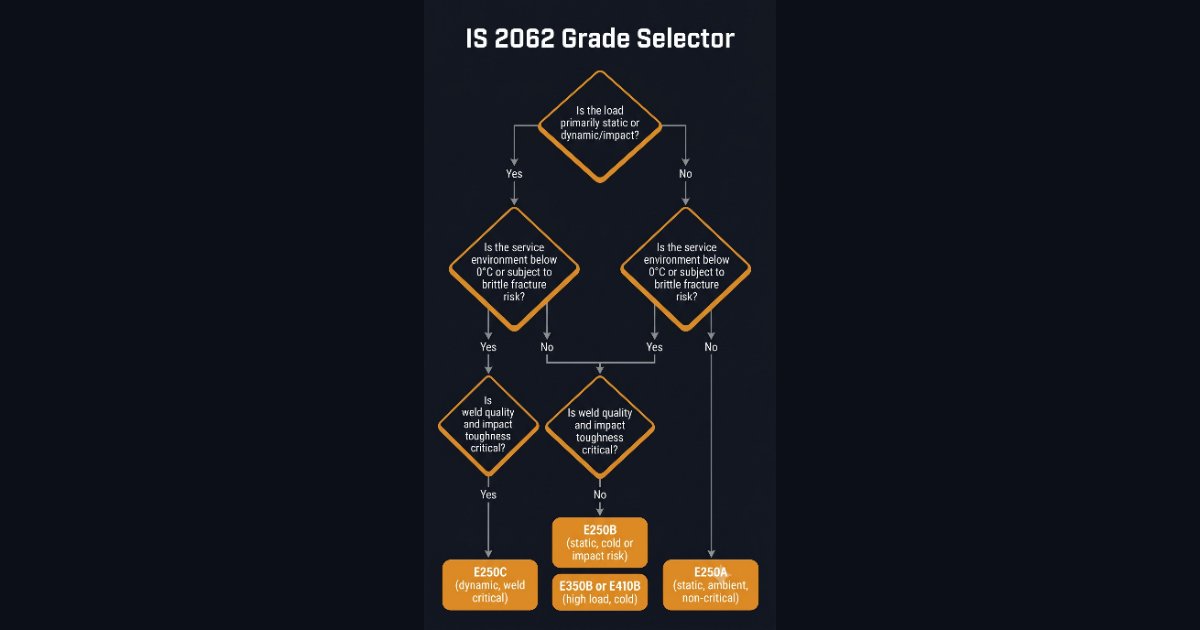
Use this decision sequence when preparing a drawing specification or purchase order:
- What is the design load type?
Static loads only (dead load + imposed load, no dynamic) → E250 is the baseline.
Dynamic, cyclic, or impact loads → consider E300 or E350, and sub-quality B or C. - Is there a risk of brittle fracture?
Indoor, ambient temperature, static loads → sub-quality A is sufficient.
Outdoor in moderate climate or vibrating machinery → specify sub-quality B.
Cold climate or cryogenic service → specify sub-quality C. - Is weight optimisation a priority?
Budget project, standard fabrication → E250A. Simple to source, widely available from JSW, SAIL, Tata Steel.
Span or load demands thinner sections → step up to E350 or E410 — the higher yield allows a thinner plate for the same load, reducing total steel weight and potentially overall cost despite a higher per-tonne price.
Weight Calculation — Grade Does Not Change Density
A common misconception in fabrication shops is that higher-grade steel is "denser" or "heavier." It is not. All IS:2062 grades — from E165 to E550 — have the same density of 7850 kg/m³. The weight per metre of a 10 mm plate in E250 is identical to the weight per metre of a 10 mm plate in E550. What changes with grade is the allowable stress in design — which means you can use a thinner plate in E550 to carry the same load as a thicker E250 plate.
Worked Example — Mezzanine Floor Plate Specification, Mumbai
A structural consultant in Mumbai is specifying 10 mm thick floor plate for a mezzanine in a warehouse. His load calculation shows a minimum required yield strength of 250 MPa. The structure is indoors, statically loaded, and ambient temperature throughout the year.
Step 1 — Select grade from IS:2062 table:
Minimum yield strength required: 250 MPa → E250 meets this exactly.
E300 would also work but costs more per tonne with no structural benefit at this load level.
Step 2 — Select sub-quality:
Indoor, static loading, ambient temperature → sub-quality A. No Charpy impact test required.
Full specification: IS:2062 E250A, 10 mm plate
Step 3 — Calculate plate weight:
Formula: Weight (kg) = Length (m) × Width (m) × Thickness (mm) × 7.85
Plate size: 3000 mm × 1500 mm × 10 mm
Weight = 3.0 × 1.5 × 10 × 7.85 = 353.25 kg per plate
Step 4 — Verify with calculator:
Use our free Metal Weight Calculator — select Flat Bar / Plate, enter 1500 mm width, 10 mm thickness, 3000 mm length, Mild Steel material → result: 353.25 kg. The grade (E250, E350, or any other IS:2062 designation) does not change this result.
For a detailed breakdown of E250 specifically — including carbon equivalent, weldability, and IS:2062 clause-by-clause explanation — see the companion article: IS 2062 E250 Structural Steel: Weight, Properties and Applications.
Frequently Asked Questions
What are the grades of IS 2062 steel?
IS:2062:2011 defines seven grades of hot-rolled structural steel: E165, E250, E300, E350, E410, E450, and E550. The number in each grade designation equals the minimum yield strength in MPa for plates up to 20 mm thickness. Each grade is further divided into sub-qualities A, B, and C based on Charpy impact test requirements — sub-quality A requires no impact test, B requires testing at 0°C, and C requires testing at −40°C. E250 is the most commonly specified grade for general structural fabrication in India and was previously known as Fe 410 under the older IS:2062 designation system.
What is the difference between IS 2062 E250A and E250B?
IS:2062 E250A and E250B have identical chemical composition and identical minimum yield strength (250 MPa) and tensile strength (410 MPa). The only difference is the sub-quality suffix, which defines the Charpy impact test requirement. E250A has no Charpy impact test requirement and is suitable for indoor structures with static loading at ambient temperatures. E250B requires a Charpy impact test at 0°C with a minimum energy absorption of 27 Joules, making it suitable for outdoor structures in moderate climates or structures subject to vibration. E250B costs marginally more than E250A due to the additional testing requirement.
Which IS 2062 grade is equivalent to Fe 410?
Fe 410 under the older IS:2062 designation system is equivalent to E250 in the current IS:2062:2011 (Sixth Revision). The previous designation "Fe 410" referred to the minimum tensile strength (410 MPa), whereas the current designation "E250" refers to the minimum yield strength (250 MPa) — a more practically useful property for structural design. When reviewing older drawings or purchase orders that specify Fe 410, substitute E250A for general indoor structural use, or E250B for outdoor or dynamically loaded structures. Similarly, Fe 540 (old designation) is equivalent to the current E350, and Fe 490 is equivalent to E300.
IS 2062 grade chart mein konsa grade use karein structural work ke liye?
Structural work ke liye IS:2062 grade ka selection teen factors pe depend karta hai. Pehla: design load — agar normal static load hai toh E250A sufficient hai jo India mein sabse zyada use hoti hai. Doosra: impact risk — agar structure outdoor hai ya dynamic load hai toh E250B ya E300B specify karein. Teesra: weight optimisation — agar span bada hai ya weight kam karni hai toh E350 ya E410 use karein jo zyada yield strength deta hai aur thinner section allow karta hai. Sabhi grades ki density same hai — 7850 kg/m³ — isliye ek hi dimension ke plate ka weight sabhi grades mein same hoga.
What is the yield strength of IS 2062 E350 steel?
IS:2062 E350 steel has a minimum yield strength of 350 MPa and a minimum tensile strength of 490 MPa for plates up to 20 mm thickness, as per IS:2062:2011 Table 1. For plates between 20 mm and 40 mm thickness, the minimum yield strength reduces to 330 MPa. For plates above 40 mm thickness, the minimum yield strength is 320 MPa. The minimum elongation is 22% for E350. This grade is suitable for heavy industrial structures, crane girders, and high-load trusses where the higher yield strength allows a reduction in section size compared to E250, potentially reducing total structure weight.
Use our free Metal Weight Calculator to compute plate, section, or bar weight for any IS:2062 grade — all grades share the same 7850 kg/m³ density.
Calculate Steel Weight Free →