Pipe Weight Chart: MS, GI and Stainless Steel Comparison
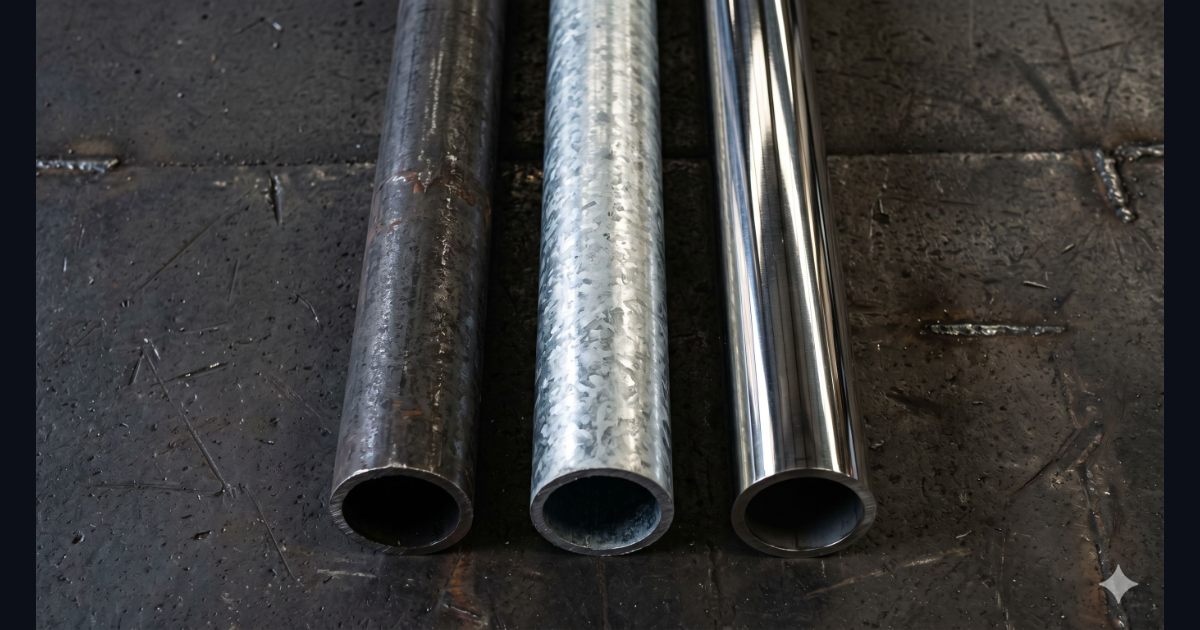
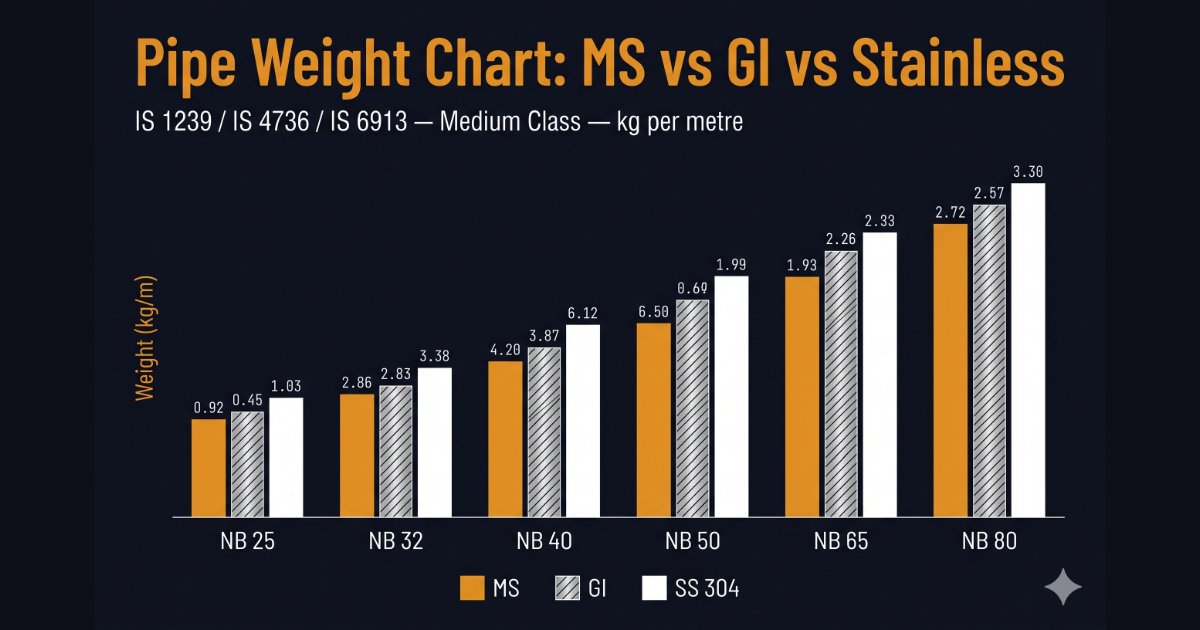
A pipe weight chart for MS, GI and stainless steel shows that for the same NB size and wall thickness, GI pipe is 5–8% heavier than MS pipe due to the zinc coating, and SS 304 pipe is about 1% heavier than MS for the same OD and WT.
- MS pipe standard: IS 1239:2004 (Part 1) — covers NB 6 to NB 150, three classes
- GI pipe standard: IS 4736:1986 — same OD and WT as MS, but zinc coat adds ~400–600 g/m depending on size
- SS 304 pipe: IS 6913:2002 — schedule 10 to schedule 80; density 7.93 g/cm³ vs 7.85 for MS
Why Pipe Weight Differs Between MS, GI and Stainless
I get asked this on almost every plumbing and structural estimation job. All three pipe types use the same OD and similar wall thicknesses for a given NB size. The weight difference comes from two sources: density and coating.
MS pipe (IS 1239) uses a carbon steel density of 7.85 g/cm³. GI pipe (IS 4736) is the same steel pipe with a hot-dip galvanised zinc coating applied after manufacture. The zinc coating adds approximately 55–85 μm of thickness per side and contributes 5–8% to the finished pipe weight, depending on pipe diameter. GI pipe density works out to approximately 7.83 g/cm³ for the steel substrate, but the zinc brings the effective weight up to about 7.83 × 1.06 on average.
Stainless steel pipe (IS 6913) uses a density of 7.93 g/cm³ for SS 304 — just 1% above MS. The difference is minor, but on a large hospital plumbing project or a dairy processing plant with hundreds of metres of SS 316 pipework, it adds up.
APL Apollo supplies MS and GI pipe to IS 1239 and IS 4736 in standard 6-metre lengths. Tata Steel Tubes also produces GI pipe under the Tata brand. Pipe ka wajan chart neeche diya gaya hai for quick reference on site or in the office.
How to Read a Pipe Weight Chart
Pipe sizes in India (and globally) are specified by Nominal Bore (NB) — a nominal size that does not directly correspond to either the ID or OD. An NB 50 pipe has an OD of 60.3mm, not 50mm. This confuses a lot of people on first encounter.
The weight chart is typically structured as: NB size → OD (mm) → Wall thickness (mm) by class → Weight (kg/m). The three IS 1239 classes are Light (L), Medium (M), and Heavy (H) — Medium class is the most commonly stocked and specified for general plumbing and structural work.
MS Pipe Weight Chart — IS 1239, Medium Class
| NB Size | OD (mm) | WT — Medium (mm) | MS Weight (kg/m) | GI Weight (kg/m)* |
|---|---|---|---|---|
| NB 15 | 21.3 | 2.65 | 1.21 | 1.29 |
| NB 20 | 26.9 | 2.65 | 1.56 | 1.66 |
| NB 25 | 33.7 | 3.25 | 2.41 | 2.57 |
| NB 32 | 42.4 | 3.25 | 3.10 | 3.30 |
| NB 40 | 48.3 | 3.25 | 3.56 | 3.80 |
| NB 50 | 60.3 | 3.65 | 5.03 | 5.36 |
| NB 65 | 76.1 | 3.65 | 6.42 | 6.85 |
| NB 80 | 88.9 | 4.05 | 8.37 | 8.93 |
| NB 100 | 114.3 | 4.50 | 12.21 | 13.02 |
| NB 125 | 139.7 | 5.00 | 16.60 | 17.70 |
| NB 150 | 165.1 | 5.00 | 19.65 | 20.95 |
* GI weight estimated at +6.6% over MS for zinc coating per IS 4736. Actual weight may vary ±5% by manufacturer.
Stainless Steel Pipe Weight — IS 6913, Schedule 10S and 40S
SS pipe for industrial and food-grade applications in India is typically specified to IS 6913:2002 or ASTM A312 (the international equivalent). Schedule 10S is a thin-wall option for low-pressure clean applications; Schedule 40S is the workhorse for most industrial piping.
| NB Size | OD (mm) | Schedule 10S WT (mm) | Sch 10S Weight (kg/m) | Schedule 40S WT (mm) | Sch 40S Weight (kg/m) |
|---|---|---|---|---|---|
| NB 25 | 33.40 | 2.77 | 2.10 | 3.38 | 2.50 |
| NB 40 | 48.26 | 2.77 | 3.10 | 3.68 | 4.05 |
| NB 50 | 60.33 | 2.77 | 3.91 | 3.91 | 5.44 |
| NB 80 | 88.90 | 3.05 | 6.38 | 5.49 | 11.29 |
| NB 100 | 114.30 | 3.05 | 8.25 | 6.02 | 16.07 |
SS 304 weights calculated at density 7.93 g/cm³ per IS 6913:2002. Jindal Stainless is a primary supplier for IS 6913 pipe in India.
Worked Example: APL Apollo NB 50 MS Pipe, 12m Length
For a structural support frame, the BOM called for NB 50 Medium class MS pipe in 12m lengths (two 6m APL Apollo sticks joined). Using the pipe weight formula:
Weight/m = (OD − WT) × WT × 0.0246615
= (60.3 − 3.65) × 3.65 × 0.0246615
= 56.65 × 3.65 × 0.0246615
= 5.10 kg/m (matches the chart above, allowing for rounding)
Total for 12m: 5.10 × 12 = 61.2 kg per stick.
Had this been GI pipe for an outdoor application, add 6.6%: 5.10 × 1.066 × 12 = 65.2 kg per stick — about 4 kg more to account for in the transport and installation load estimate.
To calculate pipe weight for any OD, WT, and material, use our Metal Weight Calculator — select Round Pipe and enter your values. For detailed pipe weight formulas and IS 1239 class tables, see our guide on how to calculate pipe weight.
Frequently Asked Questions
What is the weight of a 2-inch medium class MS pipe per metre?
A 2-inch (NB 50) medium class MS pipe to IS 1239:2004 has an OD of 60.3mm and a wall thickness of 3.65mm. Its weight per metre is approximately 5.03 kg/m. For a standard 6-metre length, total weight is 30.2 kg. The equivalent GI pipe (IS 4736) weighs approximately 5.36 kg/m due to the zinc coating.
GI pipe aur MS pipe ka weight same hota hai kya?
Nahi. GI pipe MS pipe se approximately 5–8% bhaari hoti hai. Reason yeh hai ki GI pipe mein hot-dip galvanising process mein zinc ka coat lagta hai — approximately 55–85 micron thick. Yeh zinc coating pipe ke weight mein noticeable addition karta hai. For example, NB 50 MS pipe 5.03 kg/m hai, wahi GI pipe approximately 5.36 kg/m hoti hai — difference of 330 grams per metre.
How much heavier is GI pipe than MS pipe of the same size?
GI pipe is typically 5–8% heavier than MS pipe of the same NB size and class. The additional weight comes from the hot-dip galvanised zinc coating applied to the steel surface. For smaller pipe sizes (NB 15–25), the coating contributes around 6–7%; for larger sizes (NB 100–150), the percentage increase is around 5–6% because the base pipe weight is much higher. Always use the higher GI weight when calculating structural loads and transport requirements.
Which IS standard covers GI pipe weights?
IS 4736:1986 (Specification for Hot-Dip Zinc Coatings on Mild Steel Tubes) covers the galvanising requirements for GI pipe. The pipe dimensions (OD and WT) are the same as MS pipe under IS 1239:2004 Part 1. So to find the steel weight, use IS 1239 dimensions and the formula (OD − WT) × WT × 0.0246615. Then add approximately 6% to account for the zinc coating to get the finished GI pipe weight.
Calculate pipe weight for any OD, wall thickness, and material — MS, GI, or stainless — in seconds.
Try the Free Metal Weight Calculator →