Mild Steel vs Stainless Steel: Weight, Cost and Choosing the Right Grade
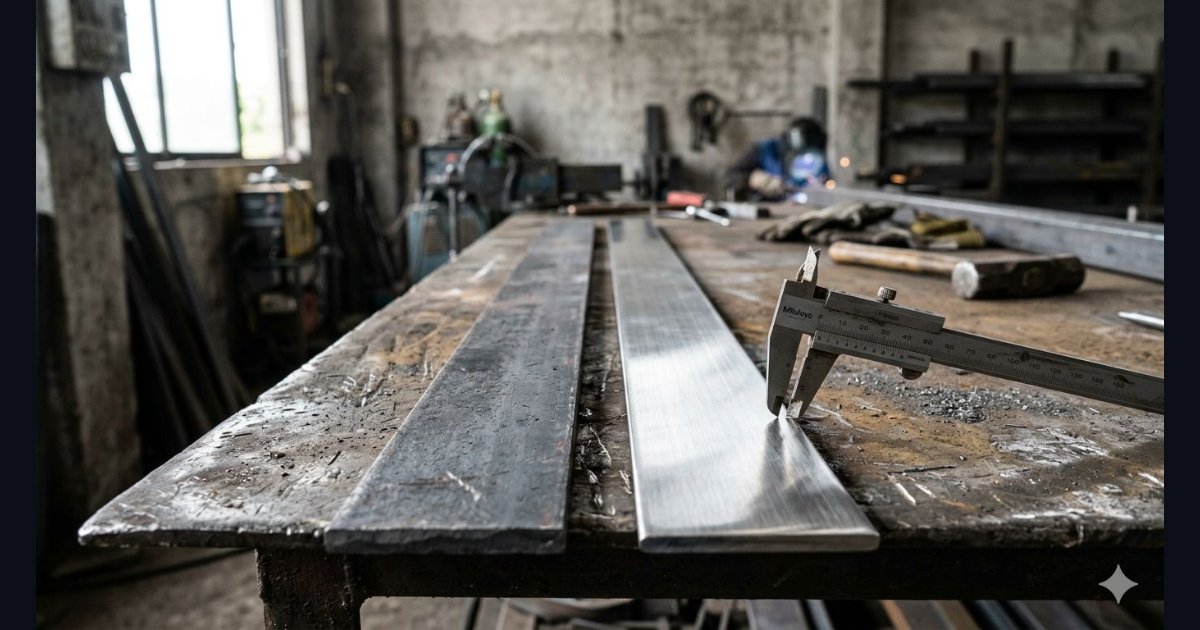
Mild steel and stainless steel of identical dimensions weigh almost the same — MS at 7.85 g/cm³ versus SS 304 at 7.93 g/cm³ is a difference of barely 1%. For a 25mm NB medium class pipe, this translates to 2.42 kg/m for MS and 2.44 kg/m for SS 304 — a gap of 20 grams per metre. The real comparison between mild steel vs stainless steel is not weight, it is cost per kg (4–6× higher for SS) and corrosion resistance, and understanding this distinction prevents expensive material specification errors.
Key Facts
- MS density: 7.85 g/cm³ — IS 2062 structural grade
- SS 304 density: 7.93 g/cm³ — IS 6911 / ASTM A240
- SS 316 density: 7.98 g/cm³ — higher due to molybdenum content
- Weight difference: <1% for same dimensions — treated as equal in practice
- Cost difference: SS 304 costs 4–6× more than MS per kg
Density — The Root of the Weight Difference
Density is the only variable that determines weight difference between MS and SS when dimensions are identical. Steel's density is set by its alloying elements — carbon, nickel, chromium and molybdenum all change the atomic packing of the crystal structure slightly.
| Grade | Standard | Density (g/cm³) | Density (kg/m³) | vs MS (%) |
|---|---|---|---|---|
| Mild Steel (IS 2062 E250) | IS 2062 | 7.85 | 7,850 | Baseline |
| SS 202 | IS 6911 / ASTM A240 | 7.92 | 7,920 | +0.89% |
| SS 304 | IS 6911 / ASTM A240 | 7.93 | 7,930 | +1.02% |
| SS 316 | IS 6911 / ASTM A240 | 7.98 | 7,980 | +1.66% |
SS 202 is the low-nickel, high-manganese grade that dominates the Indian decorative and kitchenware market — supplied primarily by Jindal Stainless. Its density is nearly identical to SS 304. SS 316, with its 2–3% molybdenum addition for superior chloride resistance, is the densest of the four grades at 7.98 g/cm³, but even this is only 1.66% heavier than MS.
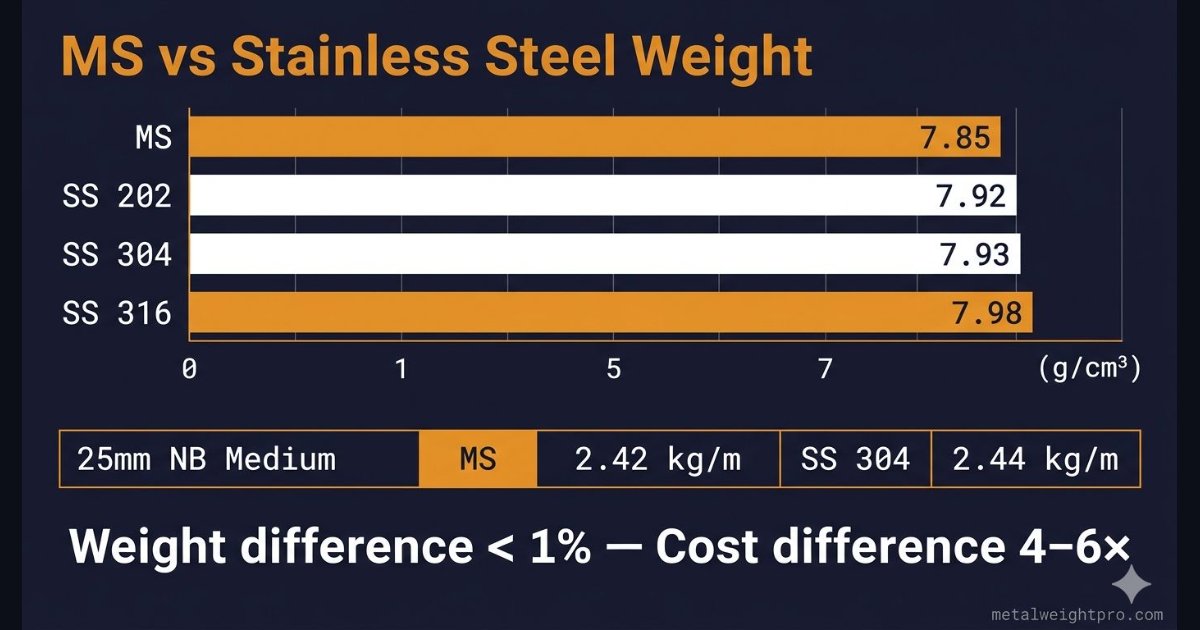
Weight Per Metre Comparison — MS vs SS 304 Pipe
To make the 1% density difference concrete, here is a direct weight-per-metre comparison for common pipe sizes. The pipe weight formula is identical for MS and SS: Weight (kg/m) = 0.02466 × t × (OD − t) for MS. For SS 304, multiply the MS result by the density ratio: 7.93 ÷ 7.85 = 1.0102.
| NB (mm) | OD (mm) | Wall (mm) | MS (kg/m) | SS 304 (kg/m) | Difference (g/m) |
|---|---|---|---|---|---|
| 15 | 21.3 | 2.65 | 1.07 | 1.08 | 10 |
| 25 | 33.7 | 3.25 | 2.00 | 2.02 | 20 |
| 40 | 48.3 | 3.25 | 3.61 | 3.65 | 40 |
| 50 | 60.3 | 3.65 | 4.88 | 4.93 | 50 |
| 80 | 88.9 | 4.05 | 8.36 | 8.44 | 80 |
| 100 | 114.3 | 4.50 | 11.97 | 12.09 | 120 |
Worked Example: 25mm NB Medium Class Pipe — MS vs SS 304
*MS aur SS mein weight ka fark kya hota hai practically?* — this is a fair question, and the numbers tell the real story. Here is the full calculation for 25mm NB medium class pipe in both materials.
Given:
- Nominal bore: 25mm
- Class: Medium
- OD (IS 1239): 33.7mm
- Wall thickness (t): 3.25mm
MS weight (density 7.85 g/cm³):
Weight = 0.02466 × 3.25 × (33.7 − 3.25) = 0.02466 × 3.25 × 30.45 = 2.440 kg/m
SS 304 weight (density 7.93 g/cm³):
Weight = 2.440 × (7.93 ÷ 7.85) = 2.440 × 1.0102 = 2.465 kg/m
Difference: 0.025 kg/m — 25 grams per metre, or 150 grams over a 6-metre pipe length.
Over 500 metres of pipe — a medium-sized project — the total weight difference between MS and SS is only 12.5 kg. The cost difference on that same 500 metres at 2025 market prices (MS ~₹70/kg, SS 304 ~₹350/kg) is approximately ₹1,40,000. The decision is never about weight — it is always about cost and corrosion resistance.
Use the free Metal Weight Calculator → to verify these numbers — the calculator uses 7.85 for MS and 7.93 for SS 304 as default density values.
Where the Real Difference Shows — Cost, Not Weight
JSW Steel's IS 2062 E250 mild steel plate typically trades at ₹65–75 per kg ex-mill. Jindal Stainless's SS 304 plate of the same thickness trades at ₹310–380 per kg. The cost ratio is consistently 4–6× regardless of thickness or market conditions — it reflects the raw material cost of nickel, chromium and the more complex manufacturing process for stainless steel.
For a fabricated structure requiring 100 kg of material, the MS cost is roughly ₹7,000 and the SS 304 cost is roughly ₹35,000 — the extra ₹28,000 buys corrosion resistance and a surface finish that requires no painting or galvanising. Whether that trade-off makes sense depends entirely on the service environment.
When to Choose MS and When to Choose SS
The grade selection decision is not complicated once you answer three questions: Where will the part be used? Will it contact food, chemicals or water? Does the budget allow SS?
Choose MS (IS 2062 E250) when: the application is structural — beams, columns, purlins, frames, brackets. Paint or powder coat provides adequate protection. MS is also correct for any internal, dry or protected environment where corrosion is not a concern.
Choose SS 202 when: the application requires a bright decorative finish (railings, furniture, signage) and exposure is limited to rain and normal atmosphere. SS 202 from Jindal Stainless offers adequate atmospheric corrosion resistance at roughly 30–40% less cost than SS 304.
Choose SS 304 when: the application involves food contact, pharmaceutical contact, water handling or humid environments where painting is impractical. Kitchens, food processing plants, water tanks and chemical storage vessels are typical SS 304 applications. IS 6911 specifies SS 304 as Grade 04Cr18Ni10.
Choose SS 316 when: chloride exposure is present — marine environments, coastal installations, swimming pools, chemical plants handling acids or saline solutions. The 2–3% molybdenum in SS 316 provides resistance to pitting corrosion that SS 304 cannot offer. Also specified under IS 6911 as Grade 04Cr17Ni12Mo2.
For further reading on how density affects weight calculations across different steel grades, see the article on steel density and why 7.85 g/cm³ is used →.
Frequently Asked Questions
Is stainless steel heavier than mild steel of the same size?
Stainless steel is marginally heavier than mild steel of the same dimensions — but the difference is less than 1% for all common grades. Mild steel has a density of 7.85 g/cm³, while SS 304 is 7.93 g/cm³ and SS 316 is 7.98 g/cm³. For a 25mm NB medium class pipe, MS weighs 2.44 kg/m and SS 304 weighs 2.47 kg/m — a difference of 30 grams per metre. For practical engineering purposes — structural calculations, freight, and material estimates — MS and SS weight are treated as equal.
What is the density of SS 304 compared to mild steel?
SS 304 has a density of 7.93 g/cm³ (7,930 kg/m³), compared to mild steel at 7.85 g/cm³ (7,850 kg/m³). The 1% difference is due to the chromium (18%) and nickel (8–10%) additions that make SS 304 an austenitic stainless steel. SS 316 is slightly denser at 7.98 g/cm³ due to its additional molybdenum content. SS 202 — the low-nickel grade widely used in India for decorative applications — has a density of approximately 7.92 g/cm³, almost identical to SS 304.
MS aur SS mein weight ka fark kya hota hai practically?
Practically, MS aur SS ka weight almost same hota hai — fark sirf 1% se kam hai. Agar aap 25mm NB medium class pipe calculate karo, toh MS ka weight 2.44 kg/m aata hai aur SS 304 ka 2.47 kg/m. Matlab 100 metre pipe mein sirf 3 kg ka fark. Weight ke liye dono materials ko same treat karo. Real fark cost mein hota hai — JSW ka MS plate ₹65–75/kg mein milta hai, jabki Jindal Stainless ka SS 304 plate ₹310–380/kg mein. Yeh 4 se 6 guna zyada hai. Isliye SS ka decision always corrosion resistance ke liye hota hai, weight ke liye nahi.
When should I choose SS 316 over SS 304 for a fabrication job?
Choose SS 316 over SS 304 when the application involves chloride exposure — marine environments, coastal structures, swimming pools, chemical processing with acids or saline solutions, and pharmaceutical clean rooms. SS 316 contains 2–3% molybdenum which significantly improves resistance to pitting corrosion from chlorides. For standard food processing, architectural railings, kitchenware and water tanks where chloride concentrations are low, SS 304 from Jindal Stainless provides adequate corrosion resistance at approximately 10–15% lower cost than SS 316.
Calculate exact weights for MS, SS 304 and SS 316 sections in seconds.
Try the Free Metal Weight Calculator →