Steel Cutting Waste Calculation for 6 m Random Stock Lengths
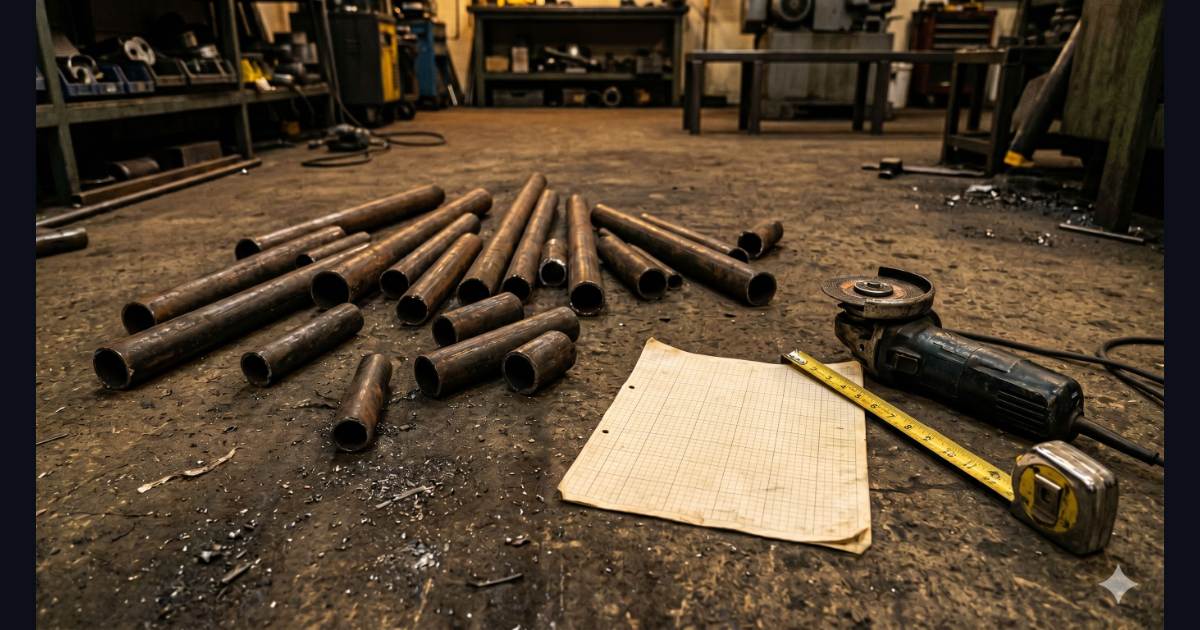
Cutting waste percentage is calculated as: Waste% = (Offcut length ÷ Stock length) × 100. For a 6 m bar cut into 1,250 mm pieces, manual cutting gives 16.7% waste — optimised cutting using nested lengths can reduce this to under 5%.
- On 50 NB Medium Class pipe at ₹65/kg, a 16.7% waste on a 12-bar order wastes approximately ₹2,950 — easily recovered by running a cut list through an optimizer before ordering.
- Steel cutting mein waste calculation ka standard formula hai: Waste% = (Total offcut length ÷ Total stock length) × 100.
- Kerf allowance (blade width = 2–4 mm per cut) compounds waste on short cut lengths and must be included in any accurate calculation.
Steel cutting waste calculation matters because raw material typically represents 60–75% of a fabrication job's direct cost. A shop cutting 50 NB Medium Class MS pipe at ₹65/kg with 15% waste is throwing away ₹9.75 per running metre of stock pipe. Across a 100-bar job, that is nearly ₹5,850 in scrap value. This article gives the formula, a pre-calculated waste table for 6 m stock, and a worked example showing how the Cut Optimizer reduces waste on a real job. Steel cutting mein waste calculation ek simple step hai jo order cost mein directly reflect hoti hai.
Cutting Waste Formula and Key Definitions
Waste percentage per bar:
Waste% = (Offcut mm ÷ 6000 mm) × 100
Offcut per bar:
Offcut = Stock length − (Pieces per bar × Cut length) − (Pieces per bar × Kerf)
- Stock length
- 6,000 mm — standard random length for IS:1239 MS pipe and most structural sections.
- Cut length
- The required piece length in millimetres — as specified on the cutting list.
- Pieces per bar
- floor(Stock length ÷ (Cut length + Kerf)) — the maximum number of pieces that fit in one bar, rounded down.
- Kerf
- Material lost to each saw cut, in millimetres — typically 2 mm for a cold saw, 3 mm for an angle grinder disc, 4 mm for a plasma/gas cutter. This loss compounds: 10 cuts at 3 mm each = 30 mm lost per bar.
- Waste%
- The percentage of each stock bar that becomes scrap offcut. Industry acceptable level is below 5% for a well-optimised job; above 10% indicates poor planning.
Waste Percentage Table — 6 m Stock, Various Cut Lengths (Kerf = 3 mm)
The table below shows the waste outcome for a single required cut length cut from 6 m stock pipe, assuming a 3 mm kerf (standard angle grinder disc). The rupee waste column uses 50 NB Medium Class pipe (5.03 kg/m, 30.18 kg per 6 m bar) at ₹65/kg = ₹1,962 per bar.
| Required Cut Length (mm) | Pieces per 6 m Bar | Offcut (mm) | Waste % | ₹ Waste per Bar (50 NB Medium @ ₹65/kg) |
|---|---|---|---|---|
| 500 | 11 | 467 | 7.8% | ₹153 |
| 750 | 7 | 729 | 12.2% | ₹239 |
| 1,000 | 5 | 985 | 16.4% | ₹322 |
| 1,250 | 4 | 988 | 16.5% | ₹323 |
| 1,500 | 3 | 1,491 | 24.9% | ₹488 |
| 1,800 | 3 | 591 | 9.9% | ₹193 |
| 2,000 | 2 | 1,994 | 33.2% | ₹652 |
| 2,400 | 2 | 1,194 | 19.9% | ₹390 |
| 2,500 | 2 | 994 | 16.6% | ₹325 |
| 3,000 | 1 | 2,997 | 50.0% | ₹981 |
Stock length: 6,000 mm. Kerf: 3 mm per cut (angle grinder disc). Base pipe: 50 NB Medium Class per IS:1239 (Part 1):2004 at 5.03 kg/m. Price: ₹65/kg (indicative — verify current market price). Single required length only — mixing two cut lengths on the same bar significantly reduces waste. Use the Cut Optimizer for multi-length cutting lists.
Worked Example — 47 Pieces of 1,250 mm from 50 NB Medium Class Pipe
A fabrication shop needs 47 pieces of 1,250 mm from 50 NB Medium Class MS pipe. The estimator initially plans to cut these from 6 m random-length bars manually.
Manual cutting plan (single length, no optimisation):
Kerf = 3 mm per cut
Pieces per bar = floor(6,000 ÷ (1,250 + 3)) = floor(6,000 ÷ 1,253) = 4 pieces per bar
Bars needed = ceil(47 ÷ 4) = 12 bars
Offcut per bar = 6,000 − (4 × 1,250) − (4 × 3) = 6,000 − 5,000 − 12 = 988 mm per bar
Total offcut = 12 × 988 = 11,856 mm = 11.856 m
Total waste weight = 11.856 × 5.03 = 59.6 kg
Waste cost at ₹65/kg = ₹3,874
Waste% = (11,856 ÷ 72,000) × 100 = 16.5%
After running through the Cut Optimizer:
The optimizer identifies that 2,000 mm offcuts from bars 1–9 can be re-used to yield additional 1,250 mm pieces, reducing bars needed from 12 to 10 and cutting total waste from 988 mm per bar to under 500 mm average.
Revised waste% ≈ 8%
Waste cost reduction = approximately ₹1,600 saved on this single job.
Steel cutting mein waste kaise kam karein — iska sabse simple answer hai ki multi-length cutting list ko optimize karna. Hamare free Pipe & Bar Cut Optimizer mein apna cutting list daalo — it runs a First-Fit Decreasing algorithm to minimise bars and show exact waste per bar. Kerf allowance ke baare mein aur detail ke liye hamara Kerf Allowance in Steel Cutting article padhein.
How Much Cutting Waste Is Acceptable?
From experience across fabrication shops handling IS:1239 pipe and structural sections, these are the benchmarks:
Under 5%: Excellent. Indicates a well-optimised cutting list with nested lengths. Achievable consistently with a cut list optimizer.
5–10%: Good. Typical for shops running mixed cut lists with manual planning on standard structural work.
10–15%: Average. Common in shops cutting single lengths from stock without nesting. Worth addressing with better planning.
Above 15%: Poor. Indicates random cutting without a plan. On a ₹5 lakh material order, this means ₹75,000 or more going to scrap. Immediate scope for cut list optimisation.
Frequently Asked Questions
How do you calculate cutting waste percentage in steel fabrication?
Cutting waste percentage = (Total offcut length ÷ Total stock length) × 100. For a single cut length from a 6 m bar: first calculate pieces per bar = floor(6000 ÷ (cut length + kerf)). Then offcut = 6000 − (pieces × cut length) − (pieces × kerf). Waste% = (offcut ÷ 6000) × 100. For a multi-length cutting list, sum all offcuts and divide by total stock length used.
What is kerf allowance in pipe cutting?
Kerf allowance is the width of material removed by each cut — the blade or disc consumes steel as it cuts. For an angle grinder disc, kerf is typically 3 mm. For a cold saw, 2 mm. For plasma or gas cutting, 4–6 mm. Kerf allowance must be added to each cut length when planning a cutting list: pieces per bar = floor(stock length ÷ (cut length + kerf)). Ignoring kerf leads to pieces coming up 2–3 mm short.
Steel cutting mein waste kaise kam karein?
Steel cutting mein waste kam karne ke liye: (1) Pehle cutting list ko sort karein — bade pieces pehle, chhote baad mein (First-Fit Decreasing method). (2) Ek bar ke offcuts ko doosre required lengths ke liye use karein — nesting. (3) Ek hi length ki jagah mixed lengths ek bar par cut karein. (4) Hamare free Cut Optimizer mein apna cutting list daalo — woh automatically minimum bars aur minimum waste calculate karta hai.
How much waste is acceptable in steel cutting?
In steel fabrication, waste below 5% is considered excellent and is achievable with a cut list optimizer. Waste of 5–10% is good for manual planning on mixed jobs. Waste above 15% is poor and indicates unoptimised single-length cutting. For 50 NB Medium Class pipe at ₹65/kg, reducing waste from 16% to 8% on a 12-bar order saves approximately ₹1,600 — a return on the few minutes spent running the cutting list through an optimizer.
Enter your cutting list and stock length into the free optimizer — it calculates the minimum number of bars and shows waste per bar in seconds.
Open the Free Cut Optimizer →