MS Plate Weight Calculator: Formula and Ready-Reckoner Table
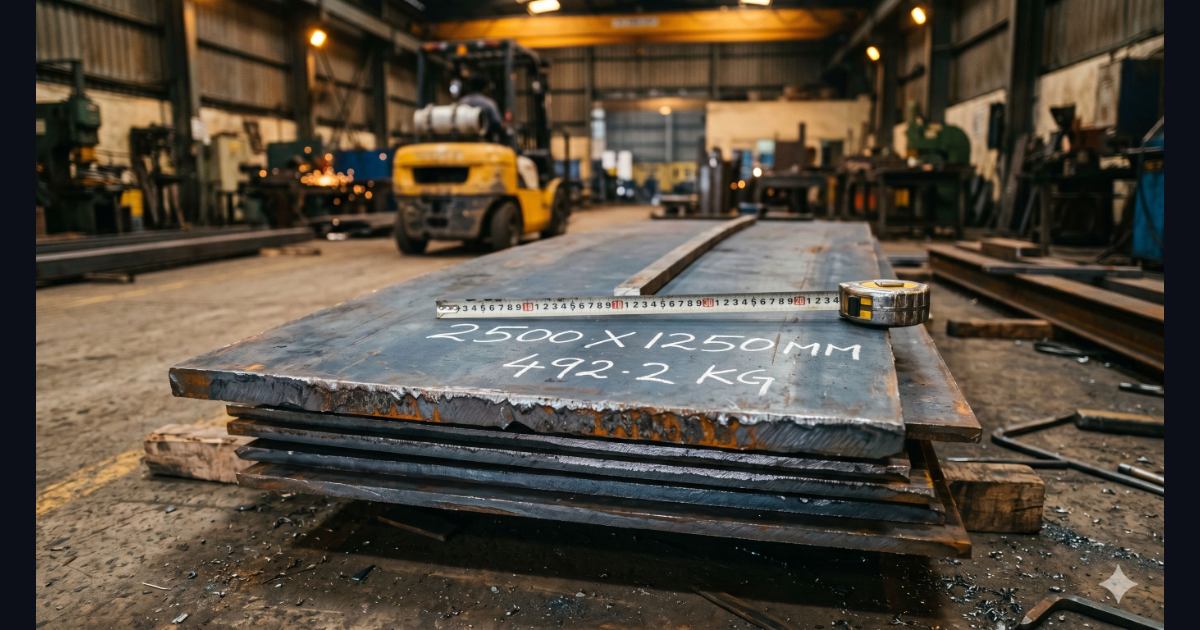
The MS plate weight calculator formula is straightforward: Weight (kg) = Length (m) × Width (m) × Thickness (mm) × 7.85. That one formula covers every mild steel plate from a 3mm gusset plate to a 25mm base plate, and it is what I use every time I need to estimate plate weight on the shop floor or build a procurement BOM.
Key Facts
- Formula: Weight (kg) = L (m) × W (m) × t (mm) × 7.85
- Shortcut: Weight per m² = Thickness (mm) × 7.85
- Standard: IS 2062: 2011 — Hot Rolled Structural Steel (E250 / E350)
- Density used: 7.85 g/cm³ for mild steel
- Unit output: Kilograms (kg)
The MS Plate Weight Formula — Where the 7.85 Comes From
Mild steel has a density of 7,850 kg/m³. To get the weight of a plate, you multiply volume by density. Volume = Length × Width × Thickness. The trick is that thickness is almost always given in millimetres while length and width are in metres, so the units don't match directly.
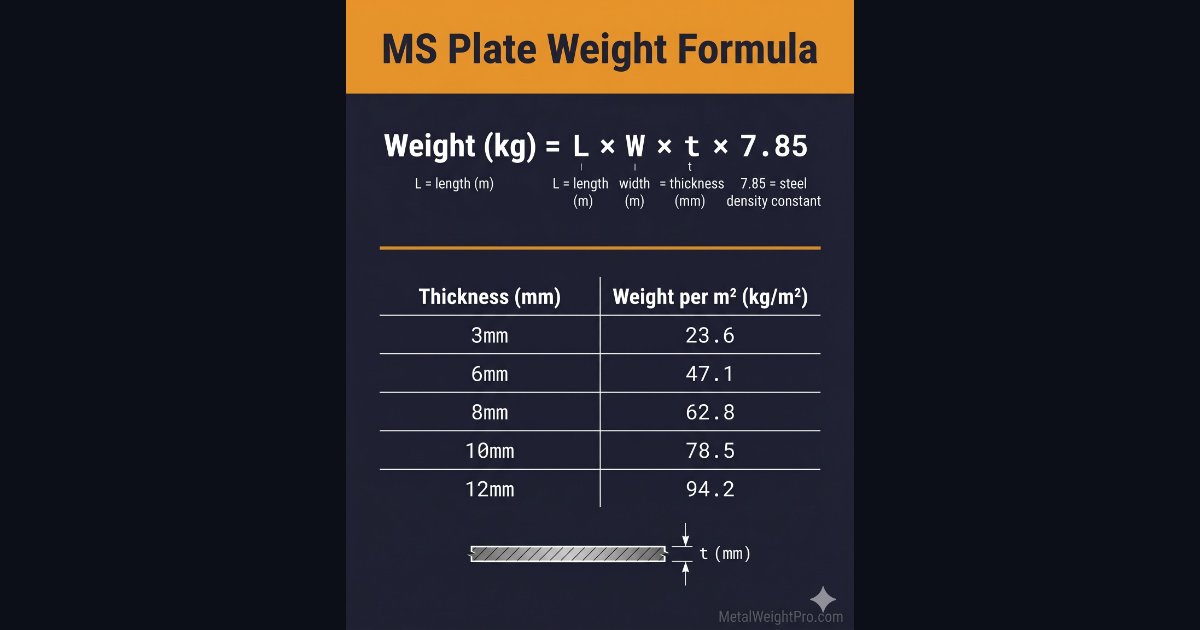
The cleanest way to handle this is to keep thickness in mm and absorb the unit conversion into the density constant: 7,850 kg/m³ ÷ 1,000 = 7.85. This gives you a constant that works when thickness is in mm and the other two dimensions are in metres:
Weight (kg) = L (m) × W (m) × t (mm) × 7.85
If you only need the weight per square metre — useful for quick load estimates on a flat bed or for comparing plate grades — the formula reduces further:
Weight per m² (kg/m²) = Thickness (mm) × 7.85
A 6mm plate weighs 47.1 kg/m². A 10mm plate weighs 78.5 kg/m². You can do this mental arithmetic in seconds once you know the constant. On our site, you can also skip the manual steps entirely and use the free Metal Weight Calculator → — select Mild Steel, Flat Plate, enter your dimensions and get the result instantly.
Worked Example: 2500 × 1250 × 6mm MS Plate
The 2500 × 1250mm sheet is the most common stock size you'll find at any Indian steel stockist — it's the metric equivalent of the old 8×4 ft sheet. On a recent structural job, I needed to confirm the total weight of 20 of these plates before booking a vehicle. Here's how the calculation works:
Given:
- Length: 2500mm → 2.5 m
- Width: 1250mm → 1.25 m
- Thickness: 6mm
- Quantity: 1 sheet (for the per-sheet calculation)
Step 1 — Calculate area:
2.5 m × 1.25 m = 3.125 m²
Step 2 — Apply the formula:
Weight = 3.125 × 6 × 7.85 = 147.2 kg per sheet
Step 3 — Scale for quantity:
20 sheets × 147.2 kg = 2,944 kg = 2.94 tonnes
Cross-check using kg/m²: 6mm × 7.85 = 47.1 kg/m². Area 3.125 m² × 47.1 = 147.2 kg ✓ — both routes give the same answer.
Verify this result yourself: use the Metal Weight Calculator → — select Mild Steel, Flat Plate, enter 2500mm length × 1250mm width × 6mm thickness, quantity 1.
MS Plate Weight Chart — 3mm to 25mm Per IS 2062
The table below gives the weight per square metre for each common plate thickness, plus the total weight of a standard 2500 × 1250mm sheet. All values use density 7.85 g/cm³ as specified in IS 2062: 2011 for mild steel grades E250 and E350. Tata Steel, JSW Steel, and SAIL all supply IS 2062-certified plates across this thickness range.
| Thickness (mm) | Weight per m² (kg/m²) | Standard 2500×1250 sheet (kg) | Standard 3000×1500 sheet (kg) |
|---|---|---|---|
| 3 | 23.6 | 73.6 | 106.2 |
| 4 | 31.4 | 98.1 | 141.3 |
| 5 | 39.3 | 122.7 | 176.6 |
| 6 | 47.1 | 147.2 | 212.0 |
| 8 | 62.8 | 196.3 | 282.6 |
| 10 | 78.5 | 245.3 | 353.3 |
| 12 | 94.2 | 294.4 | 423.9 |
| 16 | 125.6 | 392.5 | 565.2 |
| 20 | 157.0 | 490.6 | 706.5 |
| 25 | 196.3 | 613.3 | 883.1 |
All weights calculated using density 7.85 g/cm³ per IS 2062: 2011. Values rounded to one decimal place. Standard sheet weights based on 3.125 m² (2500×1250) and 4.5 m² (3000×1500).
IS 2062 and Plate Weight — What the Standard Tells You
IS 2062: 2011 — "Hot Rolled Medium and High Tensile Structural Steel" — is the primary standard governing MS plates used in structural and fabrication work in India. It defines two grades relevant to most shop-floor work: E250 (formerly Grade A / Fe 410) and E350 (formerly Grade B / Fe 490).
Both grades share the same density of 7.85 g/cm³ for weight calculation purposes. The grade designation refers to mechanical properties — E350 has a higher yield strength (350 MPa minimum vs 250 MPa for E250) and is used where additional structural load is expected. But when you're calculating how much a plate weighs, grade is irrelevant. A 10mm E350 plate and a 10mm E250 plate of the same dimensions weigh exactly the same.
IS 2062 also specifies a permissible mass tolerance of ±2.5% on individual plates. This means a 147.2 kg plate can legally be delivered weighing anywhere between 143.5 kg and 150.9 kg and still be within standard. For procurement and freight purposes, always build in a small buffer — using 148 kg instead of 147.2 kg for a 6mm 2500×1250 sheet is good practice.
Tata Steel's Shaktee HR plates and JSW Steel's HR structural plates are both IS 2062 certified and among the most widely distributed plate products in India. Their published weight data aligns with the formula values in this article to within the 2.5% tolerance band. SAIL (Steel Authority of India) plates, commonly available through MSTC and registered distributors, follow the same IS 2062 specification.
For fabrication involving hollow sections alongside plates, see our MS pipe weight per metre guide → which covers the parallel formula for round hollow sections under IS 1239.
Plate ka Wajan — Common Stock Sizes in Indian Fabrication Shops
Indian stockists typically carry MS plates in two standard sheet sizes: 2500 × 1250mm and 3000 × 1500mm. You'll also find 2000 × 1000mm sheets in thinner gauges (3mm and 4mm) and coil-slit strip in widths from 50mm to 1500mm. The table above covers both standard sheet sizes.
A useful on-site Hinglish check is: "is chadar ka wajan kitna hoga?" (how much does this sheet weigh?). With the kg/m² column, you can answer that in under 10 seconds: measure the sheet, multiply the two dimensions to get area, multiply by the kg/m² value for that thickness, and you're done. No calculator needed for standard sizes once you've memorised a few reference values — 6mm at 47.1 kg/m² and 10mm at 78.5 kg/m² cover the majority of structural plate work.
For plates above 25mm — used in heavy fabrication like press platens, crane beams, or machine beds — the formula is unchanged. A 40mm plate weighs 40 × 7.85 = 314 kg/m². A standard 2500 × 1250mm sheet at 40mm would weigh 981.3 kg — nearly a tonne per sheet. At these sizes, confirming crane capacity and truck axle limits before moving material becomes critical.
Frequently Asked Questions
What is the formula to calculate MS plate weight?
The formula is: Weight (kg) = Length (m) × Width (m) × Thickness (mm) × 7.85. The constant 7.85 comes from mild steel density (7,850 kg/m³) divided by 1,000 to reconcile the thickness unit (mm) with the area units (m²). For example, a 2500mm × 1250mm × 6mm plate weighs 2.5 × 1.25 × 6 × 7.85 = 147.2 kg. If you only need weight per square metre, simplify to: kg/m² = Thickness (mm) × 7.85.
MS plate ka wajan per square meter kaise nikale?
MS plate ka wajan per square meter nikalna bahut simple hai: bas thickness (mm) ko 7.85 se multiply karo. Agar plate 6mm thick hai, toh 6 × 7.85 = 47.1 kg per square meter hoga. Agar 10mm thick hai, toh 10 × 7.85 = 78.5 kg/m² hoga. Is shortcut se aap jaldi estimate kar sakte ho bina poora formula lagaye — especially jab site pe quickly check karna ho ki truck ka load kitna hoga ya ek chadar uthane ke liye crane ki zaroorat hai ya nahi.
What is the weight of a 6mm MS plate per square metre?
A 6mm thick mild steel plate weighs 47.1 kg per square metre. This is calculated as 6 × 7.85 = 47.10 kg/m². For a standard 2500 × 1250mm sheet (area = 3.125 m²), the total weight is 3.125 × 47.1 = 147.2 kg. For a 3000 × 1500mm sheet (area = 4.5 m²), the total is 4.5 × 47.1 = 212.0 kg. This value applies to any IS 2062 E250 or E350 grade MS plate of 6mm thickness — grade does not affect weight, only mechanical strength.
Does MS plate grade (E250 vs E350) affect the weight?
No. IS 2062 E250 and E350 are both mild steel grades with the same density of 7.85 g/cm³. The grade designation refers to yield strength — E250 has a minimum yield strength of 250 MPa and E350 has 350 MPa — but neither the density nor the weight per unit volume changes between grades. You can use the same formula and the same ready-reckoner table above for both grades. A 10mm E350 Tata Steel plate and a 10mm E250 JSW plate of identical dimensions weigh exactly the same.
Save time on your next plate order — calculate exact weights in seconds.
Try the Free Metal Weight Calculator →